 Back
BackIndeterminate Forms and L'Hôpital's Rule: Calculus Study Guide
Study Guide - Smart Notes
 Tailored notes based on your materials, expanded with key definitions, examples, and context.
Indeterminate Forms and L'Hôpital's Rule
Introduction to Indeterminate Forms
In calculus, certain limits produce expressions that are called indeterminate forms. These forms do not guarantee the existence or value of a limit, and require special techniques to evaluate. The most common indeterminate forms are 0/0 and ∞/∞.
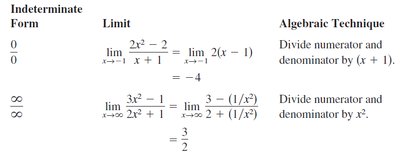
Indeterminate Form 0/0: Occurs when both the numerator and denominator approach zero.
Indeterminate Form ∞/∞: Occurs when both the numerator and denominator approach infinity.
Other indeterminate forms include 0·∞, ∞−∞, 1^∞, 0^0, and ∞^0.
Algebraic Techniques for Indeterminate Forms
Some indeterminate forms can be resolved using algebraic manipulation, such as factoring, dividing by highest powers, or rationalizing.
Example: To evaluate , factor and divide by to resolve the 0/0 form.
Example: To evaluate , divide numerator and denominator by to resolve the ∞/∞ form.
Limits Involving Transcendental Functions
Algebraic techniques can sometimes be extended to transcendental functions, but not all limits can be resolved this way. For example, the limit produces the indeterminate form 0/0.
When algebraic manipulation fails, other methods such as L'Hôpital's Rule are required.
Estimating Limits with Tables and Graphs
Numerical and graphical methods can help estimate the value of a limit when algebraic techniques are insufficient.

The Extended Mean Value Theorem
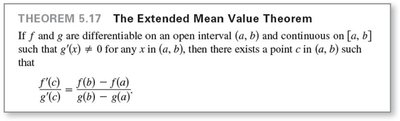
The Extended Mean Value Theorem is a generalization of the Mean Value Theorem and is used in the proof of L'Hôpital's Rule.
Theorem: If f and g are differentiable on an open interval (a, b) and continuous on [a, b], and for any x in (a, b), then there exists a point c in (a, b) such that:
L'Hôpital's Rule
L'Hôpital's Rule provides a systematic way to evaluate limits that produce indeterminate forms 0/0 or ∞/∞. It states that under certain conditions, the limit of a quotient is equal to the limit of the quotient of their derivatives.
Theorem: If produces 0/0 or ∞/∞, then:
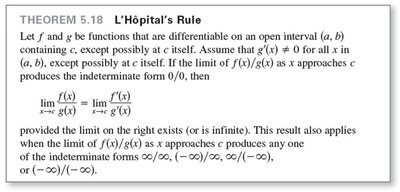
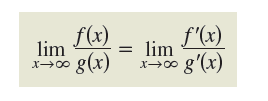
L'Hôpital's Rule can also be applied to one-sided limits and limits at infinity.
Applying L'Hôpital's Rule: Examples
To apply L'Hôpital's Rule, verify that the limit produces an indeterminate form and then differentiate the numerator and denominator.
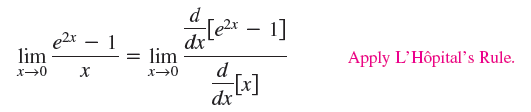
Example 1: produces 0/0. Apply L'Hôpital's Rule:
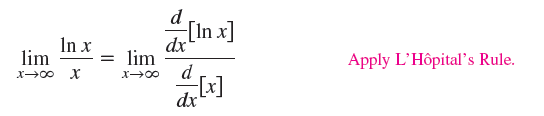
Example 2: produces ∞/∞. Apply L'Hôpital's Rule:
Other Indeterminate Forms and Conversions
Forms such as 0·∞, ∞−∞, 1^∞, 0^0, and ∞^0 are also indeterminate. These can often be converted to 0/0 or ∞/∞ forms to apply L'Hôpital's Rule.
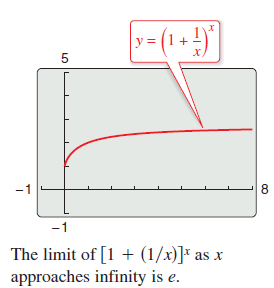
Example: produces the indeterminate form 1^∞. Take the natural logarithm to convert to a form suitable for L'Hôpital's Rule.
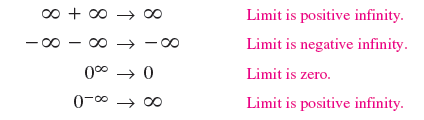
Determinate Forms
Some forms are not indeterminate and have predictable limit values. For example:

Limits Involving Variable Bases and Exponents
Indeterminate forms such as 1^∞, 0^0, and ∞^0 arise from limits of functions with variable bases and exponents. These are often resolved by taking logarithms and applying L'Hôpital's Rule.
Example:
One-Sided Limits and L'Hôpital's Rule
L'Hôpital's Rule can be applied to one-sided limits, provided the indeterminate form is present and the derivatives exist.
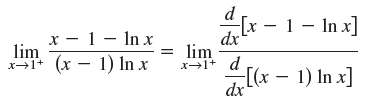
Example: produces 0/0. Apply L'Hôpital's Rule:
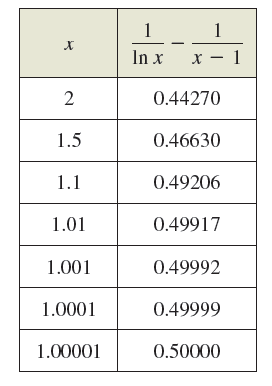
Summary of Indeterminate and Determinate Forms
Recognizing indeterminate forms is essential for applying L'Hôpital's Rule. Determinate forms have predictable outcomes and do not require special techniques.
Restrictions and Proper Use of L'Hôpital's Rule
L'Hôpital's Rule can only be applied to quotients that produce the indeterminate forms 0/0 or ∞/∞. If the numerator and denominator do not both approach zero or infinity, the rule does not apply.
Always check the hypotheses before applying L'Hôpital's Rule.
Additional info: L'Hôpital's Rule is a powerful tool for evaluating limits, but it must be used correctly and only when the proper conditions are met. For other forms, algebraic manipulation or logarithmic transformation may be necessary before applying the rule.
