 Back
BackInfinite Limits and Limits at Infinity
Study Guide - Smart Notes
 Tailored notes based on your materials, expanded with key definitions, examples, and context.
Infinite Limits and Limits at Infinity
Introduction
This section explores the concepts of infinite limits and limits at infinity, which are foundational in understanding the behavior of functions as inputs or outputs grow without bound. These topics are essential for calculus students, especially when analyzing asymptotic behavior and discontinuities.
Infinite Limits
Definition and Graphical Interpretation
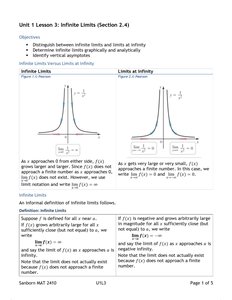
An infinite limit describes the behavior of a function as it increases or decreases without bound as the input approaches a specific value. This often occurs near vertical asymptotes.
Formal Definition: If the values of f(x) increase or decrease without bound as x approaches a, we write:
or
Graphical Example: The function as increases without bound, indicating a vertical asymptote at .
Limits at Infinity
Definition and Graphical Interpretation
A limit at infinity describes the behavior of a function as the input grows very large (positively or negatively). This is used to analyze horizontal asymptotes.
Formal Definition: If approaches a finite value as approaches or , we write:
or
Graphical Example: The function approaches 0 as or .
One-Sided Infinite Limits
Definition
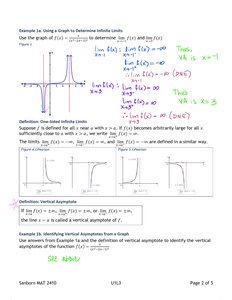
A one-sided infinite limit considers the behavior of a function as the input approaches a value from only one side (left or right).
Left-hand limit: or
Right-hand limit: or
Vertical Asymptotes
Definition and Identification
A vertical asymptote occurs at if at least one of the one-sided limits of as approaches is infinite:
or
Vertical asymptotes are found where the denominator of a rational function is zero but the numerator is not zero at that point.
Finding Infinite Limits Analytically
Algebraic Techniques
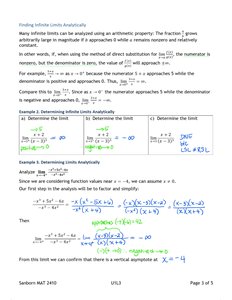
Infinite limits can be analyzed using algebraic manipulation, especially for rational functions. The key is to examine the behavior of the numerator and denominator as approaches the value of interest.
If the denominator approaches zero while the numerator approaches a nonzero value, the limit is infinite.
Compare the degrees of the numerator and denominator to determine the behavior as approaches infinity.
Example | Determine the Limit |
|---|---|
Using Limits to Identify Features of Rational Functions
Domain, Asymptotes, and Graphing
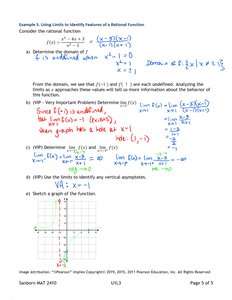
Limits are used to determine the domain, vertical asymptotes, and horizontal asymptotes of rational functions. By analyzing where the denominator is zero, we can identify points of discontinuity and asymptotic behavior.
Domain: All real numbers except where the denominator is zero.
Vertical Asymptotes: Occur at values excluded from the domain where the numerator is nonzero.
Horizontal Asymptotes: Determined by the degrees of the numerator and denominator as or .
Summary Table: Infinite Limits and Asymptotes
Type | Definition | Example |
|---|---|---|
Infinite Limit | or | |
Limit at Infinity | ||
Vertical Asymptote | Occurs at if | for |
Horizontal Asymptote | Occurs if | for |
Key Takeaways
Infinite limits describe unbounded behavior near specific points (often vertical asymptotes).
Limits at infinity describe the end behavior of functions (often horizontal asymptotes).
One-sided limits help identify the direction of divergence near discontinuities.
Algebraic techniques and graphical analysis are both essential for evaluating limits and identifying asymptotes.
