 Back
Back2.4 Infinite Limits and Vertical Asymptotes
Study Guide - Smart Notes
 Tailored notes based on your materials, expanded with key definitions, examples, and context.
Section 2.4: Infinite Limits
Introduction to Infinite Limits
Infinite limits occur when the values of a function increase or decrease without bound as the independent variable approaches a specific point. This concept is fundamental in calculus, especially when analyzing the behavior of rational functions near points where the denominator approaches zero.
Infinite Limit: The function approaches ±∞ as x approaches a certain value a.
Limit at Infinity: The function approaches a finite value as x increases or decreases without bound (i.e., as x approaches ±∞).
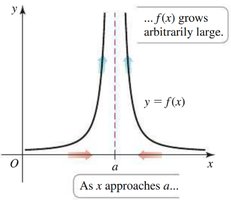
Rational Functions and Asymptotes
Rational functions often exhibit infinite limits and asymptotic behavior.
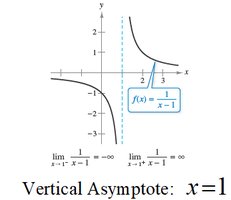
Vertical Asymptote: A vertical line x = a that the graph of a function approaches but never touches, typically where the denominator of a rational function is zero.
Horizontal Asymptote: A horizontal line y = L that the function approaches as x goes to ±∞.
Behavior Near Vertical Asymptotes
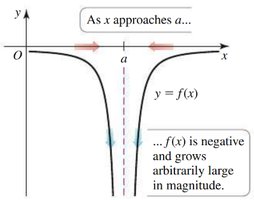
As x approaches the value where the denominator is zero, the function can grow arbitrarily large (positive or negative).
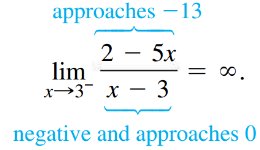
Positive Infinite Limit:
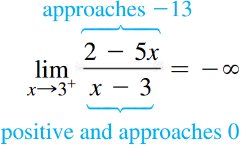
Negative Infinite Limit:
Examples of Infinite Limits
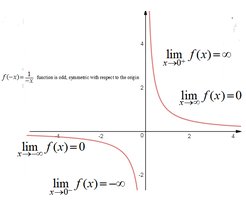
Reciprocal Function:
As x approaches 0 from the right,
As x approaches 0 from the left,
As x approaches ±∞, and
One-Sided Infinite Limits
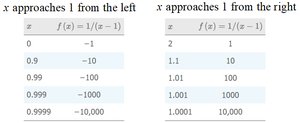
Infinite limits can be one-sided, depending on whether x approaches the asymptote from the left or right.
Right-Sided Limit:
Left-Sided Limit:
Arrow Notation for Limits
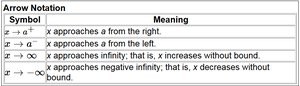
Arrow notation is used to describe the direction in which x approaches a value or infinity.
Symbol | Meaning |
|---|---|
x \to a^+ | x approaches a from the right |
x \to a^− | x approaches a from the left |
x \to \infty | x approaches infinity; x increases without bound |
x \to -\infty | x approaches negative infinity; x decreases without bound |
Vertical Asymptote Definition and Examples
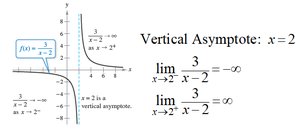
A vertical asymptote occurs at x = a if the function grows without bound as x approaches a.
For , the vertical asymptote is at x = 2.
Analyzing Limits with Rational Functions
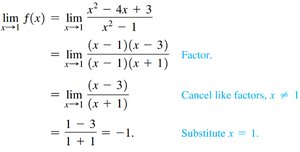
Consider . To determine limits and vertical asymptotes:
Factor numerator and denominator:
Cancel common factors (for x ≠ 1):

Evaluating Infinite Limits Analytically
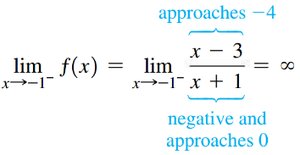
As x approaches -1:
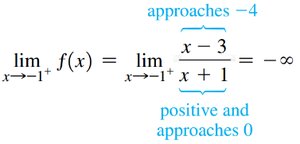
As x approaches -1 from the right:
Graphical Analysis of Infinite Limits
Graphs are useful for visualizing the behavior of functions near vertical asymptotes and for determining the sign of infinite limits.
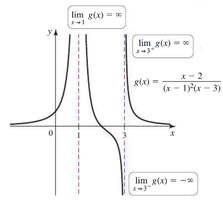
For , vertical asymptotes occur at x = 1 and x = 3.
Summary Table: Infinite Limits and Asymptotes
Infinite limits indicate unbounded growth near a point.
Vertical asymptotes are locations where the function is undefined and grows without bound.
Horizontal asymptotes describe the end behavior as x approaches ±∞.
One-sided limits help distinguish behavior from the left and right of an asymptote.
Additional info:
Infinite limits are a key concept in calculus, especially for understanding discontinuities and the behavior of rational functions.
Analytical techniques such as factoring and canceling common terms are essential for evaluating limits and identifying asymptotes.
