 Back
BackIntroduction to Limits: Concepts, Definitions, and Applications
Study Guide - Smart Notes
 Tailored notes based on your materials, expanded with key definitions, examples, and context.
Unit 1: Introduction to Limits
Overview of Limits
Limits are a foundational concept in calculus, essential for understanding instantaneous velocity, the slope of a tangent line, and the behavior of functions near specific points. This section introduces the formal and intuitive definitions of limits, their graphical interpretation, and cases where limits do not exist.
Instantaneous velocity and slope of a tangent line are key applications of limits.
Limits help analyze jumps, oscillations, and unbounded behavior in functions.
Limits and Instantaneous Velocity
Average vs. Instantaneous Velocity
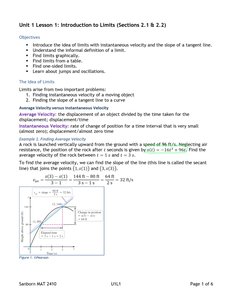
The average velocity of an object over a time interval is the change in position divided by the change in time. The instantaneous velocity is the velocity at a single moment, found by taking the limit as the time interval approaches zero.
Average velocity formula:
Instantaneous velocity:
Example: For an object thrown upward with ft/s, gives position at time .
Slope of the Tangent Line
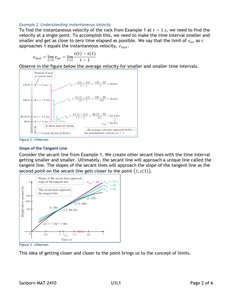
The slope of the tangent line to a curve at a point is the limit of the slopes of secant lines as the interval shrinks to zero. This is a geometric interpretation of the derivative.
The tangent slope at is .
Definitions of Limits
Preliminary Definition
Suppose is defined for all near except possibly at $a$. The limit means $f(x)$ gets arbitrarily close to as $x$ gets arbitrarily close to $a$ (from either side).
We write if approaches as approaches .
The value of does not affect the limit.
Finding Limits Graphically and Numerically
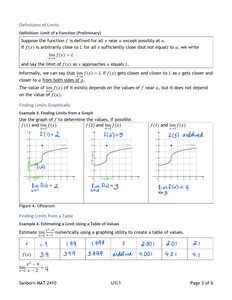
Limits can be estimated from graphs by observing the -value as approaches from both sides.
Numerical tables can be used to approximate limits by evaluating for values of close to .
One-Sided Limits
Left-Sided and Right-Sided Limits
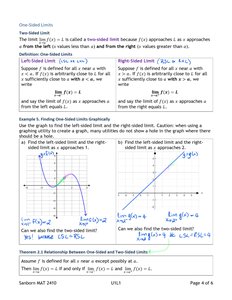
One-sided limits consider the behavior of as approaches from only one direction.
Left-sided limit: (as approaches from the left)
Right-sided limit: (as approaches from the right)
A two-sided limit exists only if both one-sided limits exist and are equal.
Theorem: Relationship Between One-Sided and Two-Sided Limits
The two-sided limit exists if and only if both one-sided limits exist and are equal:
if and only if and
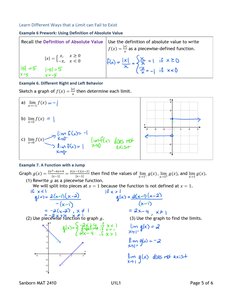
Limits Involving Absolute Value
Piecewise Definition of Absolute Value
The absolute value function can be defined piecewise, which is useful for evaluating limits involving .
Different Right and Left Behavior
Some functions have different limits from the left and right at a point, indicating a jump or discontinuity.
Cases Where Limits Fail to Exist
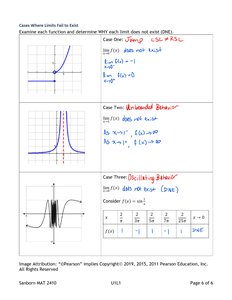
Types of Non-Existence
Jump discontinuity: Left and right limits are not equal.
Unbounded behavior: Function approaches infinity or negative infinity.
Oscillating behavior: Function does not settle to a single value as approaches .
Summary Table: Types of Limit Behavior
Case | Description | Limit Exists? |
|---|---|---|
Jump | Left and right limits not equal | No |
Unbounded | Function approaches infinity | No |
Oscillating | Function fluctuates without settling | No |
Key Takeaways
Limits describe the behavior of functions as inputs approach a specific value.
They are essential for defining derivatives and understanding continuity.
Limits can be estimated graphically, numerically, or analytically.
One-sided limits help analyze discontinuities and piecewise functions.
Limits may fail to exist due to jumps, unboundedness, or oscillation.
