 Back
BackLimits: A Numerical and Graphical Approach
Study Guide - Smart Notes
 Tailored notes based on your materials, expanded with key definitions, examples, and context.
Limits: A Numerical and Graphical Approach
Definition and Notation of Limits
The concept of a limit is fundamental in calculus and describes the behavior of a function as its input approaches a particular value. Limits are used to define continuity, derivatives, and integrals.
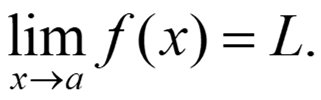
Limit of a function: The limit of a function f(x) as x approaches a is written as . This means that as the values of x get closer to a, the corresponding values of f(x) approach L.
Uniqueness and finiteness: The value of L must be a unique, finite number for the limit to exist.
Graphical and numerical approaches: Limits can be estimated using tables of values or by analyzing the graph of the function near x = a.
One-Sided Limits
One-sided limits consider the behavior of a function as the input approaches a value from only one direction—either from the left or the right.
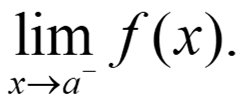
Left-hand limit: The left-hand limit is written as . This represents the value that f(x) approaches as x approaches a from values less than a.
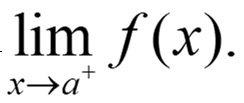
Right-hand limit: The right-hand limit is written as . This represents the value that f(x) approaches as x approaches a from values greater than a.
Existence of Limits
For a limit to exist at a point a, both the left-hand and right-hand limits must exist and be equal. If they are not equal, the limit does not exist at that point.
Equality of one-sided limits: If , then does not exist.
Function value vs. limit: The limit may exist even if the function value does not exist, or the limit may exist and be different from .
Using Graphs and Tables to Determine Limits
Graphs and tables are practical tools for estimating limits. By observing the behavior of f(x) as x approaches a, one can determine the value the function approaches, even if the function is not defined at a.
Graphical approach: Look for the value that the graph of f(x) approaches as x nears a.
Numerical approach: Create a table of values for f(x) as x gets closer to a from both sides.
Example: If is undefined at , but as approaches 2 from both sides, approaches 5, then .
