 Back
Back2.5 Limits at Infinity and End Behavior
Study Guide - Smart Notes
 Tailored notes based on your materials, expanded with key definitions, examples, and context.
Limits at Infinity
Definition and End Behavior
Limits at infinity describe the value a function approaches as the independent variable (usually x) increases or decreases without bound. These limits are fundamental in understanding the end behavior of functions, especially in calculus.
Limit at Infinity: If f(x) approaches a finite value L as x approaches infinity (or negative infinity), we write or .
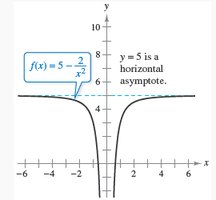
Horizontal Asymptote: The line y = L is called a horizontal asymptote of f(x) if or .
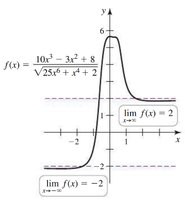
A function can cross a horizontal asymptote, but it can never cross a vertical asymptote.
Examples of Horizontal Asymptotes
For , as , . Thus, y = 5 is a horizontal asymptote.
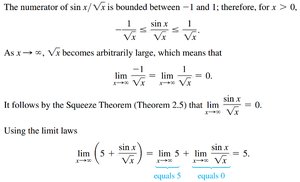
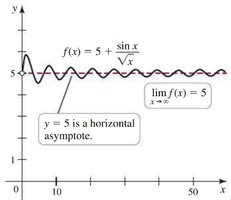
For , as , by the Squeeze Theorem, so .
Infinite Limits at Infinity
Definition
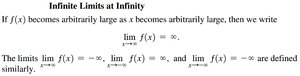
An infinite limit at infinity occurs when f(x) becomes arbitrarily large (positive or negative) as x increases or decreases without bound.
means f(x) increases without bound as x increases.
means f(x) decreases without bound as x decreases.
Limits at Infinity for Powers and Polynomials
Power Functions
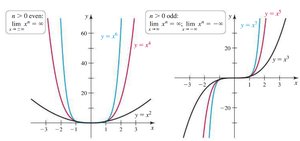
The behavior of power functions as x approaches infinity depends on whether the exponent is even or odd.
For with n even: , .
For with n odd: , .
Reciprocal Power Functions
For , .
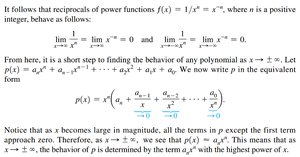
Theorem: Limits at Infinity of Powers and Polynomials
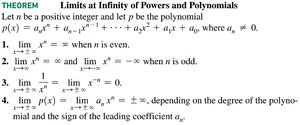
Let where .
when n is even.
, when n is odd.
.
(determined by the leading term).
Examples: Limits of Polynomials
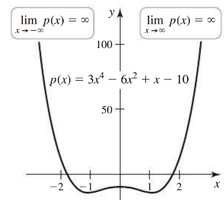
For , (even degree, positive leading coefficient).
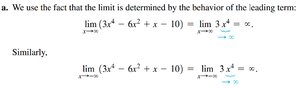
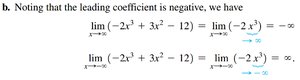
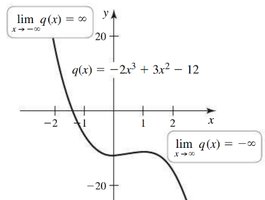
For , , (odd degree, negative leading coefficient).
Limits at Infinity for Rational Functions
General Strategy
To determine the limit at infinity for rational functions, divide both the numerator and denominator by the highest power of x in the denominator.
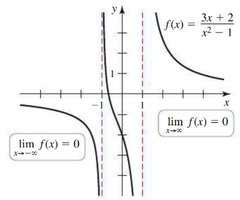
For , dividing by yields .
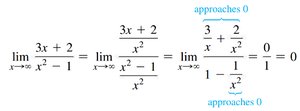
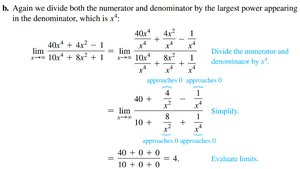
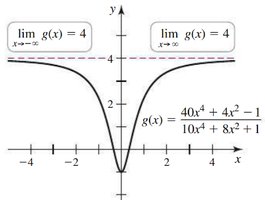
For , dividing by yields .
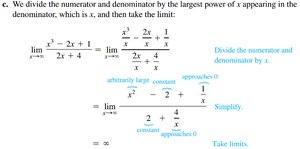
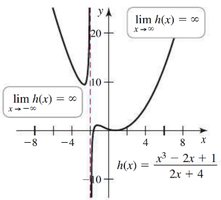
For , dividing by yields (numerator degree higher).
Slant Asymptotes
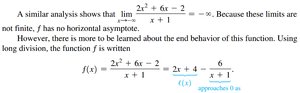
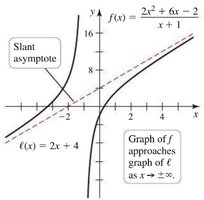
A slant (oblique) asymptote occurs when the degree of the numerator is exactly one more than the degree of the denominator. The function approaches a line (not horizontal) as x goes to infinity.
For , long division gives , so the slant asymptote is .
Limits at Infinity for Radical and Mixed Functions
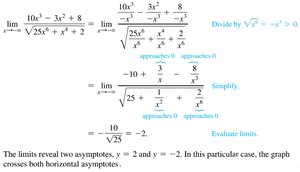
Example: Rational Function with Radical Denominator
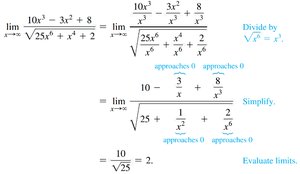
For , divide by in the numerator and in the denominator (since ): .
For , .
Limits at Infinity for Exponential and Logarithmic Functions
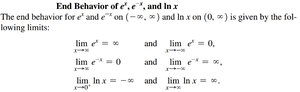
End Behavior of , , and
,
,
,
Examples
For , as , ; as , . The horizontal asymptote is .

For , as , ; as , .

Limits at Infinity for Trigonometric Functions
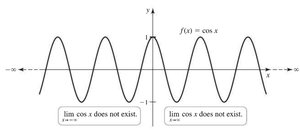
Oscillatory Functions
For , the limit as or does not exist because the function oscillates between -1 and 1 indefinitely.
Summary Table: End Behavior of Common Functions
Function Type | Limit as | Limit as | Asymptote |
|---|---|---|---|
Polynomial (even degree, positive lead) | None | ||
Polynomial (odd degree, negative lead) | None | ||
Rational (denominator degree > numerator) | 0 | 0 | Horizontal |
Rational (equal degree) | Ratio of leading coefficients | Ratio of leading coefficients | Horizontal |
Rational (numerator degree > denominator) | or | or | Slant |
Exponential | 0 | Horizontal | |
Logarithmic | (as ) | None | |
Trigonometric | Does not exist | Does not exist | None |
Additional info: The above notes expand on the brief points in the original material, providing definitions, examples, and a summary table for clarity and completeness.
