 Back
BackLimits at Infinity and Horizontal Asymptotes
Study Guide - Smart Notes
 Tailored notes based on your materials, expanded with key definitions, examples, and context.
Limits at Infinity and Horizontal Asymptotes
Introduction to Limits at Infinity
Limits at infinity describe the behavior of a function as the independent variable (usually x) increases or decreases without bound. These limits are essential for understanding the end behavior of functions and identifying horizontal asymptotes.
Limit at Infinity: The value that f(x) approaches as x goes to positive or negative infinity.
Horizontal Asymptote: A horizontal line y = c that the graph of f(x) approaches as x goes to infinity or negative infinity.
Example: For f(x) = \frac{1}{x^2}, as x \to \pm\infty, f(x) \to 0.
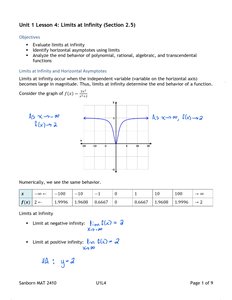
Numerical Approach to Limits at Infinity
Numerically, we can observe the behavior of a function as x increases or decreases by evaluating the function at large values of x.
As x becomes very large, f(x) approaches a constant value.
Table of values can help visualize this behavior.
Example: For f(x) = \frac{1}{x^2}, as x increases, f(x) gets closer to 0.
x | f(x) |
|---|---|
10 | 0.01 |
100 | 0.0001 |
1000 | 0.000001 |
10000 | 0.00000001 |
Definition: Limits at Infinity and Horizontal Asymptotes
Formal Definition
If f(x) becomes arbitrarily close to a finite number L for all sufficiently large and positive x, we write:
The line y = L is a horizontal asymptote of f(x).
Similarly, .
Using the Squeeze Theorem
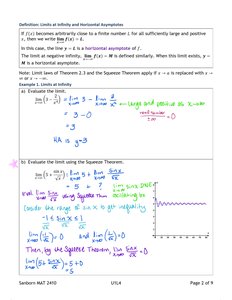
The Squeeze Theorem can be used to evaluate limits at infinity, especially when the function is bounded between two simpler functions whose limits are known.
Squeeze Theorem: If g(x) \leq f(x) \leq h(x) for all x in some interval, and , then .
Example: For f(x) = \frac{5 \sin x}{x}, since and both bounds go to 0 as x \to \infty, .
Infinite Limits at Infinity
Definition and Behavior
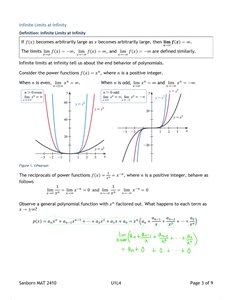
If f(x) becomes arbitrarily large as x increases without bound, then . Infinite limits at infinity are often observed in polynomial and rational functions.
Example: For f(x) = x^n (where n is a positive integer):
If n is even, f(x) goes to infinity as x \to \pm\infty.
If n is odd, f(x) goes to infinity as x \to \infty and negative infinity as x \to -\infty.
Reciprocals of Power Functions
The reciprocals of power functions, f(x) = \frac{1}{x^n}, approach zero as x increases or decreases without bound.
Example: For f(x) = \frac{1}{x^2}, .
End Behavior of Rational and Algebraic Functions
Determining Limits at Infinity for Rational Functions
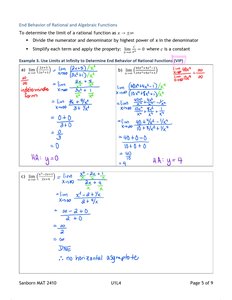
To determine the limit at infinity for a rational function f(x) = \frac{P(x)}{Q(x)}:
Divide the numerator and denominator by the highest power of x in the denominator.
Simplify each term and apply the property where n is a constant.
Example: For f(x) = \frac{2x^2 + 3}{x^2 - 1}, as x \to \infty, .
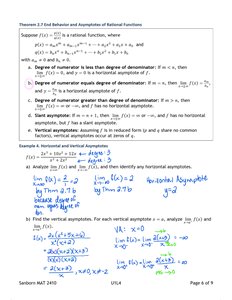
Theorem: End Behavior and Asymptotes of Rational Functions
The end behavior of rational functions depends on the degrees of the numerator and denominator:
If degree of numerator < degree of denominator: (horizontal asymptote at y = 0).
If degree of numerator = degree of denominator: (horizontal asymptote at y = \frac{a_n}{b_n}).
If degree of numerator > degree of denominator: is infinite (no horizontal asymptote).
Degree Relationship | Limit at Infinity | Horizontal Asymptote |
|---|---|---|
Numerator < Denominator | 0 | y = 0 |
Numerator = Denominator | Leading coefficient ratio | y = a_n / b_n |
Numerator > Denominator | Infinity | None |
Example: Identifying Asymptotes
For f(x) = \frac{2x^2 + 3}{x^2 - 1}, the horizontal asymptote is y = 2. For f(x) = \frac{x^3}{x^2 + 1}, there is no horizontal asymptote.
Summary Table: Horizontal Asymptotes of Rational Functions
Function | Limit at Infinity | Horizontal Asymptote |
|---|---|---|
f(x) = \frac{1}{x^2} | 0 | y = 0 |
f(x) = \frac{2x^2 + 3}{x^2 - 1} | 2 | y = 2 |
f(x) = \frac{x^3}{x^2 + 1} | Infinity | None |
