 Back
BackLimits, Continuity, and Graph Analysis in Calculus I
Study Guide - Smart Notes
 Tailored notes based on your materials, expanded with key definitions, examples, and context.
Q1. Analyze the graph of the function f to answer the following questions:
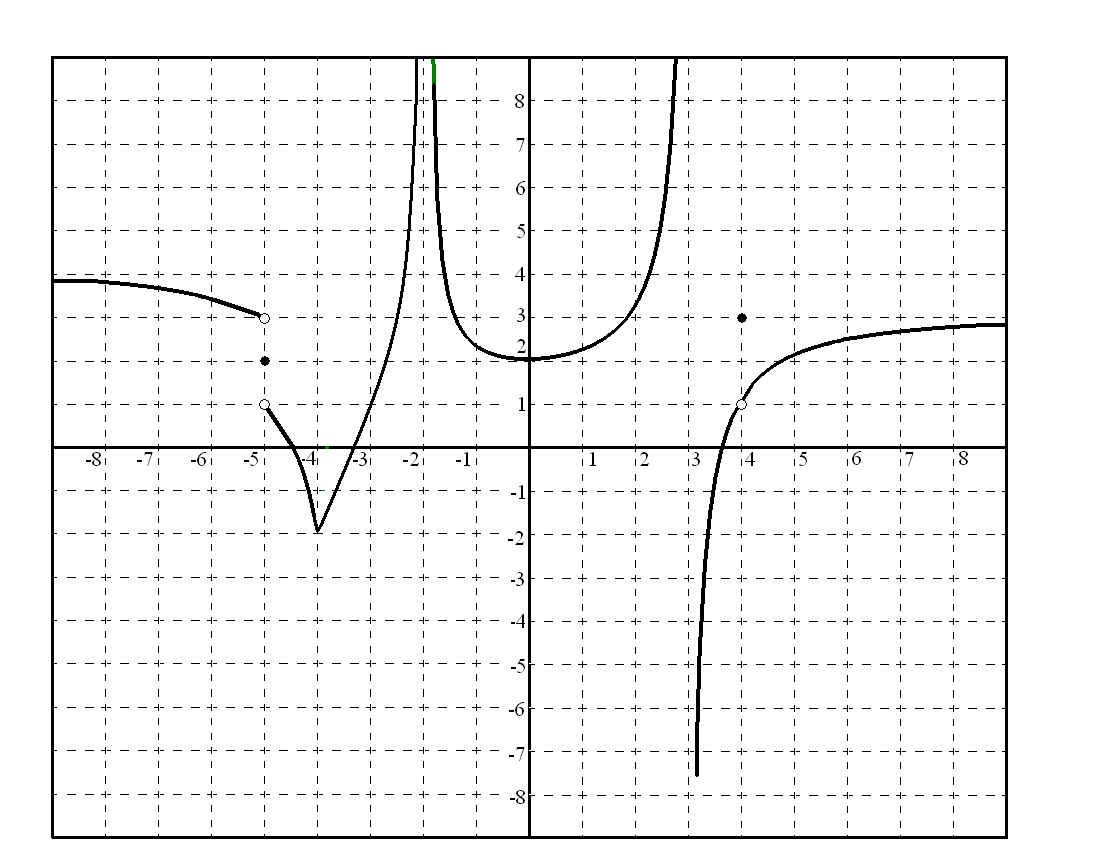
Background
Topic: Limits, Continuity, and Differentiability
This question tests your understanding of how to interpret a graph to determine limits, points of continuity/discontinuity, and differentiability. You will use visual cues from the graph to answer questions about the behavior of the function at specific points.
Key Terms and Concepts:
Limit: The value that a function approaches as the input approaches a certain point.
Continuity: A function is continuous at a point if the limit exists and equals the function's value at that point.
Discontinuity: A point where the function is not continuous (can be jump, removable, or infinite).
Differentiability: A function is differentiable at a point if it is smooth (no sharp corners or cusps) and continuous there.
Vertical Asymptote: A line where the function grows without bound as it approaches a certain x-value.
Step-by-Step Guidance
For each limit question (e.g., ), examine the graph near the specified x-value. Look at the left and right sides to see if the function approaches a specific value or diverges.
If the function jumps, has a hole, or diverges at the point, consider whether the limit exists or if you should use DNE (Does Not Exist).
For continuity questions, check if the function is unbroken at the specified x-value. The function must be defined, the limit must exist, and both must be equal.
For differentiability, look for sharp corners, cusps, or discontinuities. If the function is not smooth or not continuous at the point, it is not differentiable there.
For vertical asymptotes, identify where the function grows very large (positive or negative) as x approaches a certain value.
Try solving on your own before revealing the answer!
Final Answer:
For each part, fill in the limits using the graph, mark continuity/discontinuity, and identify differentiability and asymptotes as appropriate. Use DNE where the limit does not exist.
For example, is determined by the value the function approaches from both sides at . If the left and right limits are not equal, the limit does not exist.
Continuity and differentiability depend on the function's behavior at each point. Use the graph to justify your answers.
