 Back
BackLogarithmic and Exponential Functions with Other Bases
Study Guide - Smart Notes
 Tailored notes based on your materials, expanded with key definitions, examples, and context.
Logarithmic and Exponential Functions with Other Bases
General Exponential Functions
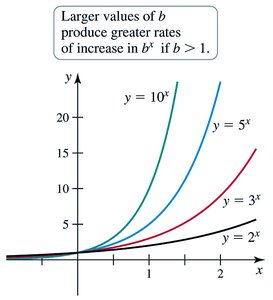
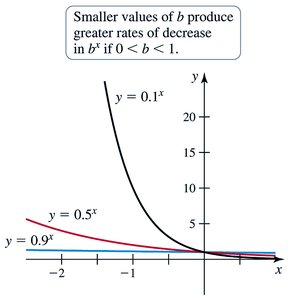
Exponential functions of the form f(x) = bx are fundamental in calculus, especially when the base b is not equal to the natural base e. The properties of these functions depend on the value of b:
Domain:
Range:
For all :
If : is an increasing function
If : is a decreasing function
Exponential functions can be rewritten using the natural exponential function:
This representation is useful for differentiation and integration.
General Logarithmic Functions
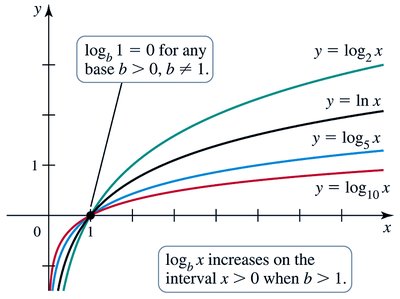
The logarithmic function with base b, denoted logbx, is the inverse of the exponential function bx. For any base , , the function is one-to-one and has the following properties:
Domain:
Range:
logb1 = 0 for any base ,
If : is an increasing function
Inverse Relations for Exponential and Logarithmic Functions
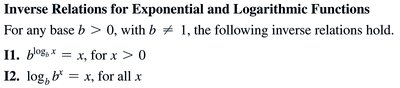
Exponential and logarithmic functions are inverses of each other. The following relations hold for any base , :
, for
, for all
Derivatives of Exponential Functions
The derivative of an exponential function with base is given by:
For a function ,
Example: Find the derivative of :
Integrals of Exponential Functions
The indefinite integral of an exponential function with base is:
Example:
The General Power Rule
The general power rule applies to functions of the form :
, for real and
If is a positive differentiable function,
Example:
Derivatives of General Logarithmic Functions
The derivative of the logarithmic function with base is:
, for
For ,
Summary of New Rules
Integral Rules | Derivative Rules |
|---|---|
Additional info:
Some images, such as image_6, depict trigonometric unit circle values and are not directly relevant to the topic of logarithmic and exponential functions, so they are not included.
