 Back
BackLecture 9 - Intro: Logarithms and Laws of Exponents: Foundations for Calculus
Study Guide - Smart Notes
 Tailored notes based on your materials, expanded with key definitions, examples, and context.
Logarithms and Exponents
Introduction to Logarithms
Logarithms are mathematical functions that help us solve equations involving exponents. They are essential in calculus for simplifying expressions and solving exponential equations.
Definition: The logarithm base b of a, written as , is the exponent k such that .
Common Logarithm: usually refers to the logarithm base 10.
Example: because .
Powers of 10 and Scientific Notation
Understanding powers of 10 is crucial for working with logarithms and for expressing large or small numbers in scientific notation.
Example:
Multiplication:
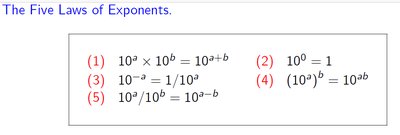
The Five Laws of Exponents
The laws of exponents provide rules for manipulating exponential expressions, which are foundational for calculus topics such as derivatives and integrals involving exponential functions.
Law 1 (Product Rule):
Law 2 (Zero Exponent):
Law 3 (Negative Exponent):
Law 4 (Power Rule):
Law 5 (Quotient Rule):
Examples of Exponent Calculations
Applying the laws of exponents to compute various expressions:
Example 1:
Example 2:
Example 3:
Example 4:
Example 5:
Example 6:
Example 7:
Example 8:
Example 9:
Exponent Calculations with Decimals
Exponents can also be applied to decimal bases, which is useful for scientific calculations.
Example 1:
Example 2:
Example 3: is approximately
Observation: Exponents with decimal values can be interpreted as roots or fractional powers.
Applications of Powers of 10
Estimating Large Distances in Science
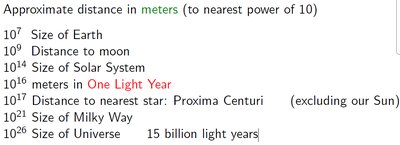
Powers of 10 are used to estimate and express large distances in astronomy and physics, making calculations manageable and comparisons easier.
Size of Earth: meters
Distance to Moon: meters
Size of Solar System: meters
One Light Year: meters
Distance to Nearest Star (Proxima Centauri): meters
Size of Milky Way: meters
Size of Universe: meters (about 15 billion light years)
Summary Table: Laws of Exponents
The following table summarizes the five fundamental laws of exponents:
Law | Formula | Description |
|---|---|---|
1 | Product Rule | |
2 | Zero Exponent | |
3 | Negative Exponent | |
4 | Power Rule | |
5 | Quotient Rule |
Importance in Calculus
Logarithms and exponents are foundational for understanding derivatives and integrals of exponential and logarithmic functions.
They are used in solving equations, modeling growth and decay, and analyzing scientific data.
Additional info: The examples and applications provided are expanded for clarity and completeness, ensuring the notes are self-contained and suitable for calculus students.
