 Back
BackMAT 2410 Unit 1 Calculus Exam Study Guide & Review Problems
Study Guide - Smart Notes
 Tailored notes based on your materials, expanded with key definitions, examples, and context.
Q1. Evaluate the limits analytically, or if a limit does not exist, explain.
Background
Topic: Limits and Continuity
This question tests your understanding of how to evaluate limits using algebraic techniques and recognize when a limit does not exist.
Key Terms and Formulas:
Limit:
Direct Substitution: Plugging the value of into the function
Indeterminate Forms: , , etc.
Factoring, Rationalizing, and Simplifying: Techniques to resolve indeterminate forms
Step-by-Step Guidance
Identify the type of limit (e.g., direct substitution, indeterminate form, one-sided limit).
Attempt direct substitution for each limit. If you get an indeterminate form, note it.
If indeterminate, use algebraic techniques such as factoring or rationalizing to simplify the expression.
Re-evaluate the limit after simplification. If the limit still does not exist, consider whether it diverges or approaches infinity.
Try solving on your own before revealing the answer!
Q2. Determine the following. If a limit does not exist, explain why.
Background
Topic: One-Sided Limits and Discontinuity
This question tests your ability to evaluate one-sided limits and recognize discontinuities in piecewise functions.
Key Terms and Formulas:
One-sided limit: and
Piecewise function: Function defined by different expressions for different intervals
Discontinuity: Point where the function is not continuous
Step-by-Step Guidance
Identify the point of interest and the relevant piece of the function for each side.
Evaluate the left-hand and right-hand limits separately using the appropriate expressions.
Compare the two one-sided limits. If they are equal, the limit exists; if not, explain why.
Try solving on your own before revealing the answer!
Q3. Using the graph of f(x) shown to the right, complete each statement.
Background
Topic: Graphical Analysis of Limits
This question tests your ability to interpret limits and function values from a graph.
Key Terms and Formulas:
Limit from a graph: is the value the function approaches as gets close to .
Function value: is the actual value at .
Discontinuity: Jump, hole, or asymptote in the graph
Step-by-Step Guidance
Locate the point on the graph.
Observe the behavior of as approaches from both sides.
Determine if the left and right limits are equal and if the function value matches the limit.
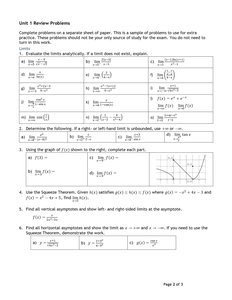
Try solving on your own before revealing the answer!
Q4. Use the Squeeze Theorem. Given satisfies and , find .
Background
Topic: Squeeze Theorem
This question tests your understanding of how to use the Squeeze Theorem to evaluate limits.
Key Terms and Formulas:
Squeeze Theorem: If and , then .
Step-by-Step Guidance
Identify the functions , , and and the interval where the inequalities hold.
Evaluate the limits of and as approaches .
Confirm that both limits are equal to .
Conclude that must also be by the Squeeze Theorem.
Try solving on your own before revealing the answer!
Q5. Find vertical and horizontal asymptotes and left- and right-sided limits at the asymptotes.
Background
Topic: Asymptotes and Limits
This question tests your ability to find vertical and horizontal asymptotes and evaluate limits at those points.
Key Terms and Formulas:
Vertical asymptote: where or diverges
Horizontal asymptote: where
Step-by-Step Guidance
Identify points where the denominator of is zero (potential vertical asymptotes).
Evaluate left- and right-sided limits at these points to confirm vertical asymptotes.
Analyze the behavior of as and to find horizontal asymptotes.
Try solving on your own before revealing the answer!
Q6. Find limits using asymptotes and show the limit as and . If you need to use the Squeeze Theorem, explain why.
Background
Topic: Limits at Infinity and Squeeze Theorem
This question tests your ability to evaluate limits as approaches infinity and recognize when the Squeeze Theorem is applicable.
Key Terms and Formulas:
Limit at infinity:
Squeeze Theorem: Used when is bounded between two functions with known limits
Step-by-Step Guidance
Analyze the degree of the numerator and denominator to determine the behavior as .
If is bounded, identify bounding functions and check their limits.
Explain why the Squeeze Theorem applies if used.
Try solving on your own before revealing the answer!
Q7. Find the x values at which f is discontinuous and classify each as removable or non-removable.
Background
Topic: Discontinuity and Classification
This question tests your ability to identify points of discontinuity and classify them as removable or non-removable.
Key Terms and Formulas:
Removable discontinuity: Can be "fixed" by redefining at a point
Non-removable discontinuity: Cannot be fixed, often due to jump or infinite discontinuity
Step-by-Step Guidance
Find points where the function is not defined or the limit does not match the function value.
Check if the limit exists at those points. If so, the discontinuity is removable; if not, it is non-removable.
Try solving on your own before revealing the answer!
Q8. Apply the Intermediate Value Theorem to determine if the function f(x) is continuous on the interval and if it takes on a given value.
Background
Topic: Intermediate Value Theorem
This question tests your understanding of the Intermediate Value Theorem and continuity on an interval.
Key Terms and Formulas:
Intermediate Value Theorem: If is continuous on and is between and , then for some in .
Continuity: is continuous if for all in the interval
Step-by-Step Guidance
Check if is continuous on the given interval.
Evaluate and and determine if the target value lies between them.
Apply the theorem to conclude if takes on the value .
Try solving on your own before revealing the answer!
Q9. List all the conditions that must be true for a function to be continuous at a point.
Background
Topic: Continuity at a Point
This question tests your understanding of the formal definition of continuity at a point.
Key Terms and Formulas:
Continuity at requires:
is defined
exists
Step-by-Step Guidance
State each condition clearly and explain why it is necessary for continuity.
Provide examples or counterexamples for each condition.
Try solving on your own before revealing the answer!
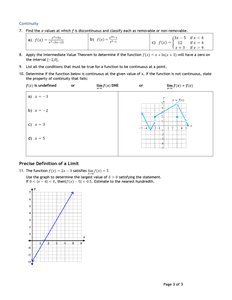
Q10. Use the graph to determine the largest value of δ so that whenever for .
Background
Topic: Precise Definition of a Limit (Epsilon-Delta)
This question tests your understanding of the epsilon-delta definition of a limit using a graph.
Key Terms and Formulas:
Epsilon (): Desired closeness to the limit value
Delta (): Corresponding closeness to the input value
For , whenever
Step-by-Step Guidance
Set up the inequality and relate it to .
Use the graph to visually estimate the largest possible that satisfies the condition.
Check your estimate by plugging values into the inequality.
Try solving on your own before revealing the answer!
