 Back
BackMATH 10524 Exam I Review – Limits and Derivatives Study Guide
Study Guide - Smart Notes
 Tailored notes based on your materials, expanded with key definitions, examples, and context.
Q2. The graph of is shown above. Find the following limits:
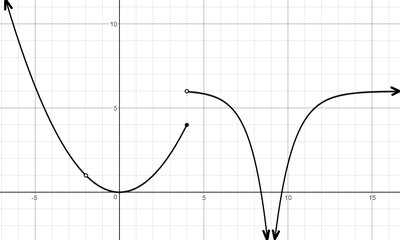
Background
Topic: Limits from Graphs
This question tests your ability to evaluate limits by interpreting the behavior of a function as approaches a particular value, using a graph. You will need to consider left-hand and right-hand limits, as well as limits at infinity and at points of discontinuity.
Key Terms and Concepts:
Limit: The value that approaches as approaches a certain value.
Left-hand limit (): The value approaches as approaches from the left.
Right-hand limit (): The value approaches as approaches from the right.
Limit at infinity: The value approaches as becomes very large (positive or negative).
Discontinuity: A point where the function is not continuous (could be jump, removable, or infinite).
Step-by-Step Guidance
For each limit, carefully observe the graph as approaches the specified value. For limits at infinity, look at the end behavior of the graph as $x$ goes to or .
For one-sided limits (like or ), trace the graph from the left or right side of the point and see what -value the function approaches.
For two-sided limits (like ), check if the left-hand and right-hand limits are equal. If they are, that is the limit; if not, the limit does not exist at that point.
At points of discontinuity (such as jumps or asymptotes), determine if the function approaches a finite value, infinity, or if the limit does not exist.
For each limit, write down what you observe from the graph, but do not state the final value yet. For example, note if the function approaches a certain -value, or if it diverges to infinity, or if there is a jump.
Try solving on your own before revealing the answer!
