 Back
BackMultivariable Calculus: Surfaces, Partial Derivatives, and Vector Calculus
Study Guide - Smart Notes
 Tailored notes based on your materials, expanded with key definitions, examples, and context.
Surfaces
Sections of Surfaces
In multivariable calculus, a surface can be described by a function of two variables, such as z = f(x, y). Each point (x, y) in the domain corresponds to a height value z, forming a surface above the xy-plane. To analyze the shape of a surface, we often examine sections—curves obtained by fixing one variable and varying the other.
Section with y constant: Set y = c, then z = f(x, c) describes a curve in the xz-plane.
Section with x constant: Set x = c, then z = f(c, y) describes a curve in the yz-plane.
Contour (level curve): Set z = c, then f(x, y) = c describes a curve in the xy-plane where the surface has constant height.
Example: For z = x2 - y2, sections with y = 0, 1, 2 yield parabolas opening upwards, while sections with x = 0, 1, 2 yield parabolas opening downwards. The surface is a saddle (hyperbolic paraboloid).
Contour Plots
A contour plot (or level curve plot) is a projection of a surface onto the xy-plane, showing curves where the function takes constant values. These are widely used in topography and physics to represent surfaces such as hills or potential fields.
Where contour lines are close together, the surface is steep.
Where contour lines are far apart, the surface is relatively flat.
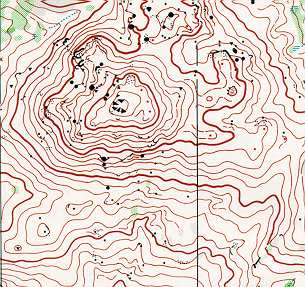
Example: The image above shows a contour plot, which could represent the surface z = x2 - y2 or a topographic map. Peaks, valleys, and saddle points can be identified by the arrangement of the contour lines.
Planes
The general equation of a plane in three dimensions is:
where (a, b, c) is a normal vector to the plane. Planes are the simplest surfaces and are characterized by linear equations in x, y, and z.
Sections and contours of planes are straight, parallel lines.
All points on a plane share the same normal vector.
Functions of Three Variables
Functions of three variables, such as T(x, y, z), can represent quantities like temperature in a room. Level surfaces (e.g., x2 + y2 + z2 = c) are called level surfaces or isosurfaces, generalizing the idea of contours to three dimensions.
Partial Derivatives and the Directional Derivative
Partial Derivatives
For a function f(x, y), the partial derivative with respect to x is found by treating y as a constant:
: Rate of change of f in the x-direction.
: Rate of change of f in the y-direction.
Example: If f(x, y) = x2y + x, then and .
Higher Order Partial Derivatives
Higher order partial derivatives are obtained by repeated differentiation. For example:
means differentiate first with respect to y, then x.
Clairaut’s Theorem: If f is sufficiently smooth, mixed partial derivatives are equal: .
Taylor’s Theorem (Multivariable)
Taylor’s theorem allows us to approximate a function near a point using its derivatives. For f(x, y):
Directional Derivative
The directional derivative of f in the direction of a unit vector is:
This gives the rate of change of f in any specified direction.
The Gradient
Definition and Properties
The gradient of f(x, y) is the vector:
Key properties:
Points in the direction of greatest increase of f.
Magnitude gives the rate of fastest increase.
Perpendicular to level curves (contours) of f.
Divergence, Curl, and Laplacian
Divergence
The divergence of a vector field is:
Measures the net rate of 'outflow' from a point.
Curl
The curl of a vector field is:
(vector cross product with the del operator)
Measures the tendency to rotate about a point.
Laplacian
The Laplacian of a scalar function f is:
Appears in equations modeling diffusion, heat, and wave propagation.
Applications and Further Topics
Double and triple integrals: Used to compute areas, volumes, mass, and other quantities over regions and volumes.
Coordinate systems: Cylindrical and spherical coordinates are useful for problems with symmetry.
Parameterization: Curves and surfaces can be described using parameters for integration and analysis.
Vector fields: Functions assigning a vector to each point in space, important in physics and engineering.
Additional info: The image included is a contour plot, which visually represents level curves of a function of two variables. Such plots are essential in understanding the geometry of surfaces and are directly relevant to the study of multivariable calculus.
