 Back
BackParametric and Polar Curves: Foundations and Applications
Study Guide - Smart Notes
 Tailored notes based on your materials, expanded with key definitions, examples, and context.
Parametric and Polar Curves
Introduction to Parametric Curves
Parametric equations provide a powerful way to describe curves in the plane by expressing the coordinates as functions of a parameter, typically denoted as t. This approach is especially useful for representing curves that cannot be described as functions in the form y = f(x).
Parametric equations define a curve by specifying both x and y as functions of a third variable (the parameter): for .
Curves such as circles, ellipses, and more complex paths are naturally described using parametric equations.
Basic Ideas and Example: Circular Motion
Consider a motor boat traveling counterclockwise around a circular course with a radius of 4 miles, completing one lap every hours at a constant speed. The position of the boat at any time can be described parametrically:
x-coordinate:
y-coordinate:


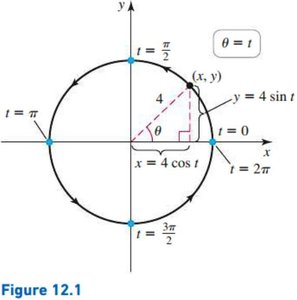
These equations trace out a circle of radius 4 centered at the origin as varies from $0.
Parametric vs. Standard Descriptions
There are two main ways to describe curves:
Standard (explicit) form:
Parametric form:
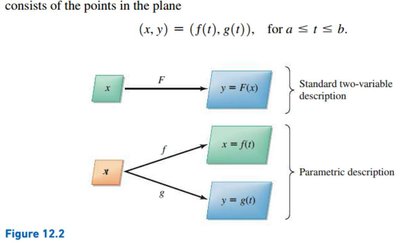
Parametric equations allow for more flexibility, especially for curves that loop or have multiple y-values for a single x-value.
Eliminating the Parameter
To convert parametric equations to a standard form, solve one equation for and substitute into the other. For example, given:
Solving for from gives . Substitute into :


This is the equation of a parabola in standard form.
Orientation of Parametric Curves
The positive orientation of a parametric curve is the direction in which the curve is traced as the parameter increases. This is typically indicated by arrows on the curve.

Example: Parametric Equations for a Circle
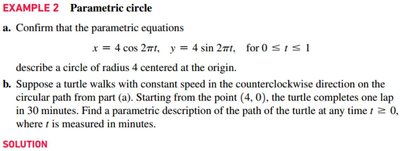
Consider the parametric equations:
for
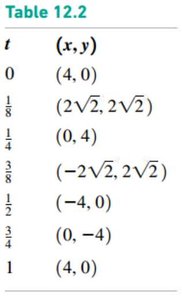
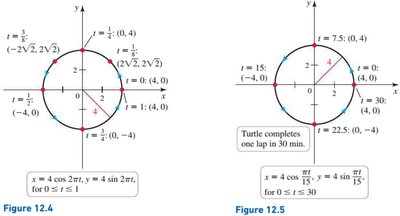
These describe a circle of radius 4 centered at the origin. The table below shows key points as varies:
t | (x, y) |
|---|---|
0 | (4, 0) |
1/8 | |
1/4 | (0, 4) |
3/8 | |
1/2 | (-4, 0) |
3/4 | (0, -4) |
1 | (4, 0) |

Application: Turtle on a Circular Path
If a turtle walks with constant speed in the counterclockwise direction on the same circle, starting at (4, 0) and completing one lap in 30 minutes, the parametric equations become:
for


General Parametric Equations for Circles
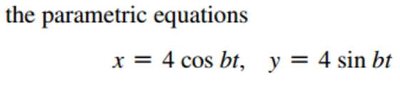
The general form for a circle of radius centered at is:
If , the curve is traced in the counterclockwise direction as increases.
Parametric Equations of a Line
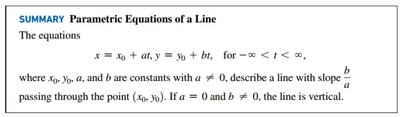
The parametric equations for a line passing through with direction vector are:
for
The slope of the line is (if ). If and , the line is vertical.
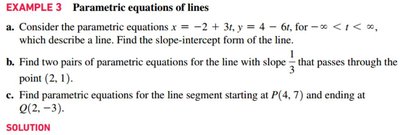
Example: Parametric Equations of Lines
Consider the parametric equations for :
To find the slope-intercept form, solve for in terms of and substitute into :

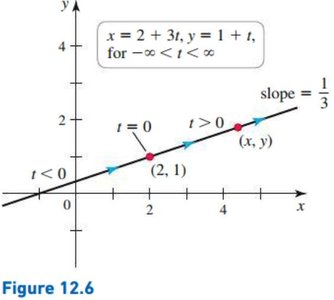
For a line with slope passing through , choose :


For a line segment from to , the slope is . To traverse from to , let , :

Summary Table: Key Parametric Forms
Curve Type | Parametric Equations | Notes |
|---|---|---|
Circle (centered at origin) | ||
Circle (centered at ) | Counterclockwise if | |
Line | Slope | |
Parabola | Eliminate for standard form |
