 Back
BackParametric Curves: Concepts, Examples, and Applications
Study Guide - Smart Notes
 Tailored notes based on your materials, expanded with key definitions, examples, and context.
Parametric Curves
Introduction to Parametric Curves
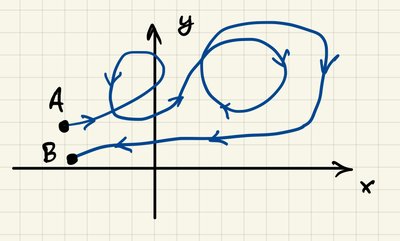
Parametric curves are a fundamental concept in calculus, allowing us to describe curves in the plane that cannot be represented as the graph of a function y = f(x) or x = g(y). Instead, both x and y are expressed as functions of a third variable, typically t, which often represents time or another parameter. This approach is especially useful for describing trajectories and motion in two dimensions.
Parametric equations define a curve by specifying both x and y as functions of t: , where and is an interval.
The parameter t provides a direction along the curve, indicating how the curve is traced as t increases.
Parametric curves can represent complex shapes and motions that are not possible with standard function graphs.
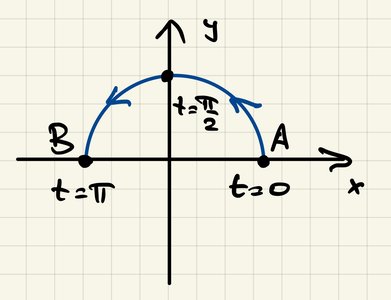
Example 1: Parametric Representation of a Circle Segment
Consider the parametric equations for . This describes a segment of a circle of radius 1 centered at the origin.
By eliminating t, we find , confirming the curve lies on the unit circle.
The direction of increasing t traces the curve from point A () to point B ().
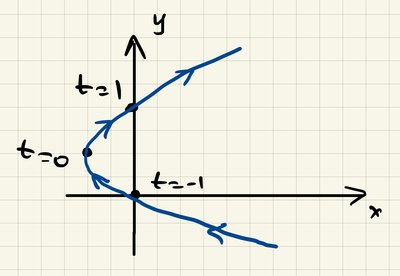
Example 2: Parametric Representation of a Parabola
Given for , we can eliminate t to find the Cartesian equation.
Solving for t:
Substitute into x:
This is a parabola, and the direction of increasing t is indicated by arrows on the curve.
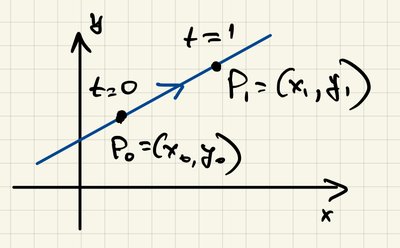
Example 3: Parameterization of a Straight Line
To parameterize a straight line passing through points and , with at and at :
The parameterization is for .
Both x and y are linear functions of t.
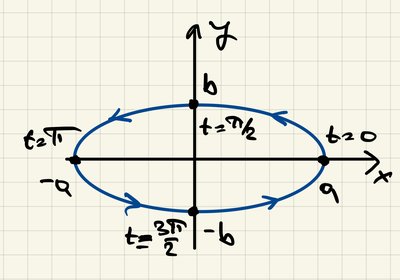
Example 4: Parametric Representation of an Ellipse
Consider for , . Eliminating t gives the equation of an ellipse.
,
The curve is an ellipse centered at the origin, with axes of length 2a and 2b.
Definition: Plane Curves and Parameterization
A plane curve is a set of points such that and for in some interval , where and are continuous functions. The choice of , , and is called a parameterization of the curve.
A single curve can have many different parameterizations.
Parameterizations can affect the speed and direction with which the curve is traced.
Example 5: Multiple Parameterizations of a Circle
The unit circle can be parameterized in different ways:
Standard: ,
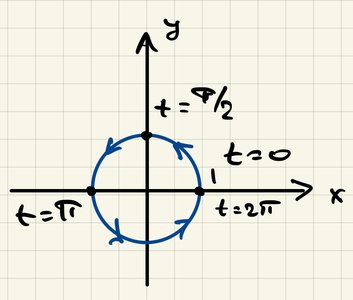
Alternative: ,
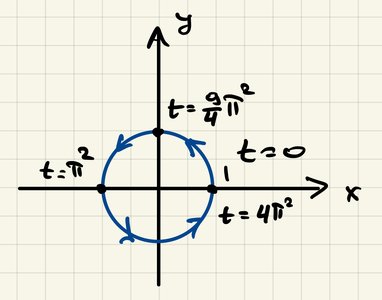
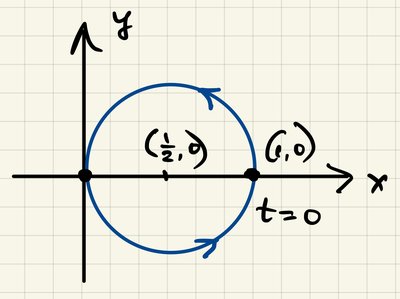
Example 6: Parametric Circle with Shifted Center
Consider for . Eliminating t gives:
Rewriting:
This is a circle of radius centered at .
The curve is traced counterclockwise, starting from as .
The point does not belong to the curve.
Summary Table: Common Parametric Curves
Curve Type | Parametric Equations | Interval for t | Cartesian Equation |
|---|---|---|---|
Circle (radius r) | , | ||
Ellipse | , | ||
Parabola | , | ||
Straight Line | , | Linear equation | |
Shifted Circle | , |
Additional info: The notes above expand on the original lecture content by providing full definitions, step-by-step elimination of parameters, and a summary table for common parametric curves. All included images directly illustrate the parametric equations and their geometric interpretations.
