 Back
BackPascal's Triangle and Lattice Paths: Foundations for Discrete Models and Combinatorics
Study Guide - Smart Notes
 Tailored notes based on your materials, expanded with key definitions, examples, and context.
Pascal's Triangle and Binomial Coefficients
Understanding Pascal's Triangle
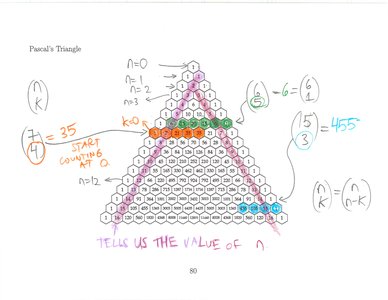
Pascal's Triangle is a triangular array of numbers that represents the coefficients in the binomial expansion and is fundamental in combinatorics. Each number in the triangle is the sum of the two numbers directly above it. The triangle is widely used to calculate combinations, which are essential in probability, algebra, and discrete mathematics.
Rows and Columns: The top row is labeled as n = 0, and each subsequent row increases n by 1. The position in the row is labeled by k, starting from 0.
Binomial Coefficient: Each entry in the triangle is a binomial coefficient, denoted as , which counts the number of ways to choose k objects from n objects without regard to order.
Formula: The binomial coefficient is calculated as: $
Symmetry: The triangle is symmetric, meaning .
Example: (the number of ways to choose 4 objects from 7).
Application: Binomial coefficients are used in probability, algebraic expansions, and counting problems.
Lattice Paths and the Integer Lattice
Definition of Integer Lattice
The integer lattice is the set of all points in the Cartesian plane where both coordinates are integers. It forms a grid of points at every intersection of horizontal and vertical lines on graph paper.
Lattice Paths
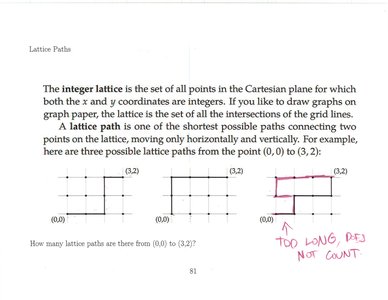
A lattice path is one of the shortest possible paths connecting two points on the integer lattice, moving only horizontally and vertically. These paths are important in combinatorics and discrete mathematics for counting problems and probability.
Shortest Path: The shortest path from (0,0) to (m,n) consists of exactly m horizontal and n vertical steps, in any order.
Counting Lattice Paths: The number of shortest lattice paths from (0,0) to (m,n) is given by the binomial coefficient: $
Invalid Paths: Paths that are not the shortest (e.g., those that backtrack or take extra steps) are not counted.
Example: The number of shortest lattice paths from (0,0) to (3,2) is .
Connection Between Pascal's Triangle and Lattice Paths
Combinatorial Interpretation
Pascal's Triangle provides a visual and computational tool for determining the number of shortest lattice paths between two points on the integer lattice. Each entry in the triangle corresponds to the number of ways to arrange k vertical and n-k horizontal steps in a path.
Application: This connection is foundational in discrete-time models, sequences, and difference equations, as well as in probability and statistics.
