 Back
Back2.7 Precise Definition of Limits in Calculus
Study Guide - Smart Notes
 Tailored notes based on your materials, expanded with key definitions, examples, and context.
Section 2.7: Precise Definition of Limits
Limit of a Function
The concept of a limit is fundamental in calculus, providing a rigorous foundation for understanding how functions behave as their inputs approach specific values. The limit of a function as x approaches a is denoted as:
This means that for any number , there exists a corresponding number such that:
whenever
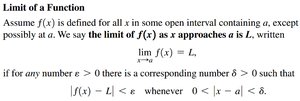
Key Point: The definition ensures that the function values can be made arbitrarily close to the limit L by choosing x sufficiently close to a, but not equal to a.
Application: This definition is used to rigorously prove statements about limits and to analyze the behavior of functions near specific points.
Steps for Proving a Limit
To prove that using the precise definition, follow these steps:
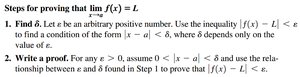
Find : Let be an arbitrary positive number. Use the inequality to find a condition of the form , where depends only on the value of .
Write a Proof: For any , assume and use the relationship between and found in Step 1 to prove that .
Key Point: The proof must show that for every , a suitable can be found, ensuring the function values are within of the limit.
Example: Finding for a Linear Function
Suppose we want to find the largest value of such that for a given function and limit. Consider the function as approaches 1, with and .
Set up the inequalities for near the limit:
→
→
Therefore,
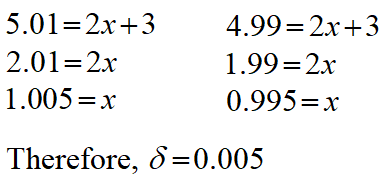
Key Point: By solving for values that keep within of , we determine how close must be to (here, ) to satisfy the definition.
Example Application: This process is used for more complex functions, adjusting the algebra to solve for in terms of .
Summary Table: Epsilon-Delta Definition Steps
The following table summarizes the steps for proving a limit using the epsilon-delta definition:
Step | Description |
|---|---|
1. Find | Express in terms of |
2. Write Proof | Show that for any , whenever |
Additional info: The notes provided are directly relevant to Chapter 2: Limits, specifically focusing on the precise (epsilon-delta) definition of limits and its application in proofs and examples.
