 Back
BackReview of Functions and Their Properties
Study Guide - Smart Notes
 Tailored notes based on your materials, expanded with key definitions, examples, and context.
Section 1.1: Review of Functions
Functions: Definitions and Basic Properties
A function is a rule that assigns to each element in a set called the domain a unique value in another set called the range. Functions are fundamental objects in calculus, used to model relationships between varying quantities.
Domain: The set of all possible input values (usually denoted as x) for which the function is defined.
Range: The set of all possible output values (usually denoted as f(x)) that the function can produce as x varies over the domain.
Example: Determining if a relation is a function involves checking that each input in the domain is assigned to exactly one output in the range.
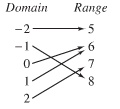
Determining Domain and Range
To find the domain and range of a function, analyze the set of all possible inputs and the resulting outputs. For algebraic functions, this often involves considering restrictions such as division by zero or taking square roots of negative numbers.
Example 1: For , the domain is all real numbers, and the range is .
Example 2: For , the domain is all real numbers (since the denominator is never zero), and the range is all real numbers except possibly the value that makes the numerator zero if it cannot be achieved by any .
Graphical Representation of Functions
Functions can be represented graphically by plotting points on the Cartesian plane. A relation is a function if no vertical line intersects the graph at more than one point (the vertical line test).
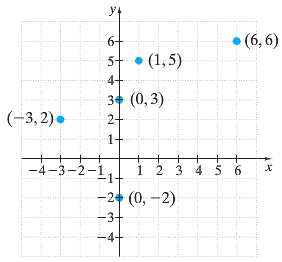
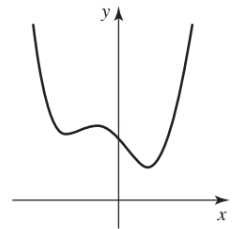
Composite Functions
Definition and Evaluation
A composite function is formed when the output of one function becomes the input of another. Given functions and , the composite function is defined by:
To evaluate a composite function, first apply to , then apply to the result.
Example: If and , then .
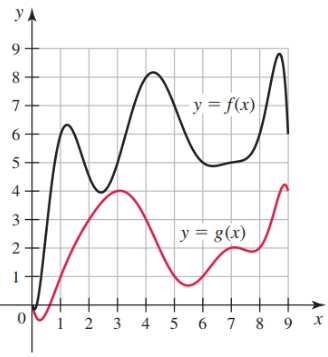
Identifying Inner and Outer Functions
When working with composite functions, it is important to identify the inner function (applied first) and the outer function (applied second). The domain of the composite function consists of all in the domain of such that is in the domain of .
Example: For , the inner function is , and the outer function is .
Secant Lines and the Difference Quotient
Secant Lines
A secant line is a straight line that passes through two points on the graph of a function. The slope of the secant line between points and is given by the difference quotient:
This formula measures the average rate of change of the function over the interval .
Example: For , the difference quotient is .
Symmetry in Graphs and Functions
Types of Symmetry
Graphs can exhibit different types of symmetry:
Y-axis symmetry: If is on the graph, so is . The function is even.
X-axis symmetry: If is on the graph, so is .
Origin symmetry: If is on the graph, so is . The function is odd.
Even and Odd Functions
Even function: for all in the domain. The graph is symmetric about the y-axis.
Odd function: for all in the domain. The graph is symmetric about the origin.
Example:
is an even function.
is an odd function.
Summary Table: Types of Symmetry
Type of Symmetry | Algebraic Test | Graphical Description |
|---|---|---|
Y-axis (Even) | Symmetric about y-axis | |
X-axis | Replace with | Symmetric about x-axis |
Origin (Odd) | Symmetric about origin |
Additional info: These foundational concepts are essential for understanding more advanced calculus topics such as limits, derivatives, and integrals.
