 Back
BackLecture 17
Study Guide - Smart Notes
 Tailored notes based on your materials, expanded with key definitions, examples, and context.
Summary of Derivatives
Introduction to Derivatives
The derivative of a function describes how one quantity changes in response to changes in another. If y is a function of x, written as y = f(x), the derivative quantifies the rate at which y changes as x varies.
Definition: The derivative of f(x) with respect to x is denoted f'(x) or \( \frac{df}{dx} \).
Interpretation: The derivative at a point gives the slope of the tangent line to the graph at that point.
Example: For y = 7x, if x increases by 0.1, then y increases by 7 \times 0.1 = 0.7.
Calculating Derivatives and Tangent Slopes
To find how quickly a function changes at a specific value, compute its derivative and evaluate at that point.
Example: For y = x^2, the derivative is \( \frac{d}{dx}(x^2) = 2x \).
Slope at Specific Points:
At x = -3: Slope = 2 \times (-3) = -6
At x = 0: Slope = 2 \times 0 = 0
At x = 2: Slope = 2 \times 2 = 4
Graphical Interpretation of Derivatives
Comparing Derivative Values to a Constant
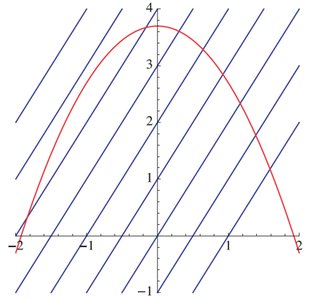
Given a function y = f(x) and a set of lines with a fixed slope, we can visually determine where the function's derivative exceeds, equals, or is less than that slope.
Key Point: Where the tangent to f(x) is steeper than the reference lines, f'(x) is greater than the slope of those lines.
Example: For lines parallel to y = 2x, f'(x) > 2 where the curve is steeper than these lines.
Identifying Where the Derivative is Zero or Negative
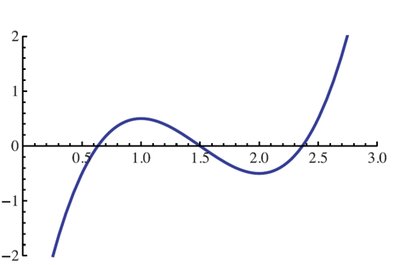
The sign of the derivative indicates whether the function is increasing, decreasing, or has a horizontal tangent (local maximum or minimum).
f'(x) = 0: The function has a horizontal tangent (possible local max/min).
f'(x) < 0: The function is decreasing at those points.
Importance of Units in Derivatives
Interpreting the Derivative with Units
When interpreting derivatives, it is crucial to consider the units of both the function and the variable. The derivative's units are the units of the output divided by the units of the input.
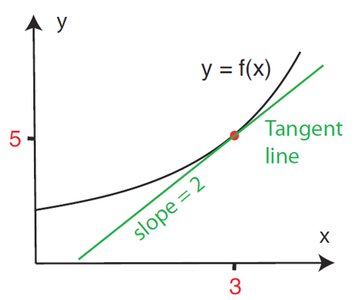
Example: If f(3) = 5 and f'(3) = 2, then at x = 3, the function passes through the point (3, 5) and the tangent line has a slope of 2.
Interpretation: For each unit increase in x, y increases by 2 units near x = 3.
Applications of Derivatives in Context
Interpreting Derivatives in Real-World Scenarios
Derivatives can be used to analyze rates of change in various contexts, such as disease spread, temperature variation, and business applications.
Example 1 (Epidemiology): If f(x) is the percentage of children who get measles when x% are inoculated, then f'(40) represents the rate at which the percentage of measles cases changes as the inoculation rate increases from 40%.
Example 2 (Temperature): If T(x) is the temperature at height x, then T'(2000) is the rate of temperature change per meter at 2000 meters above sea level.
Example 3 (Business): If f(x) is monthly sales (in thousands of dollars) as a function of advertising spending x (in thousands), then f'(20) = 3 means that at $20,000 spent, each additional $1,000 spent increases sales by $3,000.
Choosing Plausible Values and Interpretations
Sign of the Derivative: The sign (positive or negative) of the derivative should match the context (e.g., temperature usually decreases with altitude, so T'(x) is negative).
Units: Always check that the units of the derivative make sense for the scenario.
Summary Table: Interpreting Derivatives in Context
Context | Function | Derivative | Interpretation |
|---|---|---|---|
Disease Spread | f(x): % with measles vs. % inoculated | f'(x): % change in measles per % inoculated | Negative value: more inoculation reduces measles cases |
Temperature | T(x): Temp at height x | T'(x): Change in temp per meter | Negative value: temp decreases with height |
Business | f(x): Sales vs. advertising | f'(x): Change in sales per $1,000 advertising | Positive value: more advertising increases sales |
Additional info: The above notes expand on the brief examples and questions in the original material, providing academic context, definitions, and structured explanations suitable for calculus students.
