 Back
BackTechniques for Computing Limits in Calculus
Study Guide - Smart Notes
 Tailored notes based on your materials, expanded with key definitions, examples, and context.
Limits and Techniques for Computing Limits
Introduction to Limits of Functions
Limits are a foundational concept in calculus, describing the behavior of a function as its input approaches a particular value. Understanding limits is essential for defining derivatives and integrals.
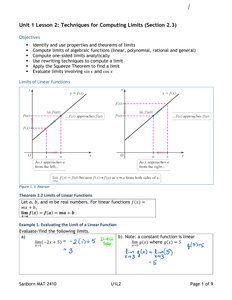
Limit of a function: The value that f(x) approaches as x approaches a specific value a.
Linear functions: The limit of a linear function as x approaches a is simply the function evaluated at a.
Constant functions: The limit of a constant function is the constant itself.
Graphical interpretation: The limit can be visualized as the y-value the graph approaches as x approaches a.
Notation:
Limit Laws
Theorem: Limit Laws
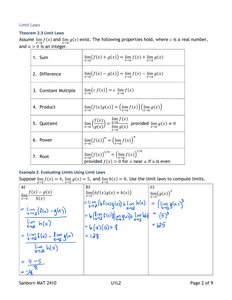
Limit laws provide rules for computing limits of combinations of functions, assuming the individual limits exist. These laws simplify the process of evaluating limits algebraically.
# | Law | Formula |
|---|---|---|
1 | Sum | |
2 | Difference | |
3 | Constant Multiple | |
4 | Product | |
5 | Quotient | , provided |
6 | Power | |
7 | Root |
Example:
Limits of Algebraic Functions
Limits of Polynomial and Rational Functions
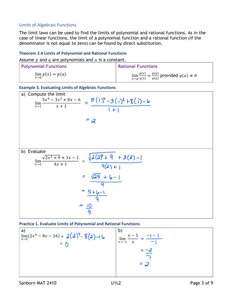
The limit laws can be used to evaluate limits of polynomial and rational functions directly, provided the denominator does not approach zero. If the denominator is zero, further algebraic manipulation is required.
Function Type | Limit Formula |
|---|---|
Polynomial | |
Rational | , provided |
Example:
One-Sided Limits
Left-Sided and Right-Sided Limits
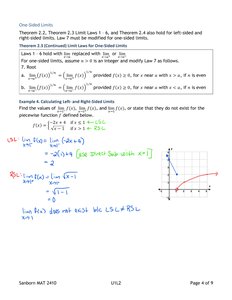
One-sided limits consider the behavior of a function as x approaches a value from only one side (left or right). The notation denotes the left-sided limit, and denotes the right-sided limit.
One-sided limits are useful for piecewise functions and for determining if a two-sided limit exists.
If the left and right limits are equal, the two-sided limit exists and equals this common value.
Example: For defined differently on either side of , compute and separately.
Other Techniques for Computing Limits
Factoring and Cancelling
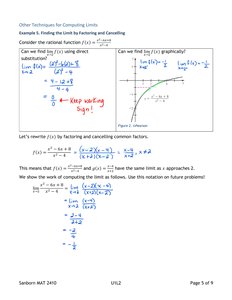
When direct substitution in a rational function yields an indeterminate form (such as ), factoring and cancelling common factors can simplify the expression and allow the limit to be evaluated.
Factor numerator and denominator, cancel common terms, then substitute the value of x.
Example: Factor numerator: Cancel :
Using Conjugates
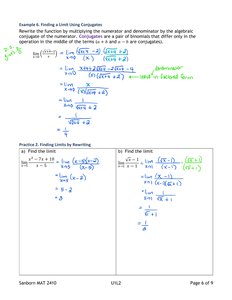
For limits involving square roots, multiplying numerator and denominator by the conjugate can eliminate the root and simplify the expression.
The conjugate of is .
Multiply and simplify, then substitute the value of x.
Example: Multiply by to rationalize the numerator.
The Squeeze Theorem
Theorem: Squeeze Theorem
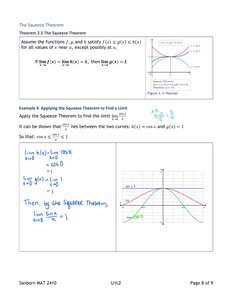
The Squeeze Theorem is used to find the limit of a function that is bounded above and below by two functions with the same limit at a point. If near , and , then .
Example: because and both bounds approach 0 as .
Trigonometric Limits
Important Trigonometric Limits
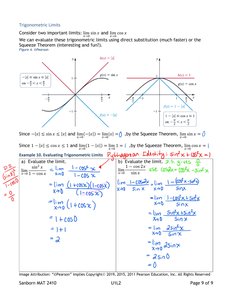
Some trigonometric limits are fundamental in calculus, especially:
These can be evaluated using the Squeeze Theorem or direct substitution when appropriate.
Additional info: The notes also include worked examples and graphical illustrations to reinforce the algebraic techniques for finding limits, as well as the application of the Squeeze Theorem to trigonometric functions.
