 Back
BackTrigonometric Functions and Their Applications in Calculus
Study Guide - Smart Notes
 Tailored notes based on your materials, expanded with key definitions, examples, and context.
Trigonometric Functions
Angles and Their Measurement
Angles are fundamental in trigonometry and calculus, and can be measured in either degrees (°) or radians (rad). A full revolution is 360°, which is equivalent to radians. The conversion between degrees and radians is essential for calculus applications.
Degrees to Radians: Multiply by
Radians to Degrees: Multiply by
Example:
Convert 60° to radians: radians
Convert radians to degrees:
Arc Length
The arc length of a circle sector with central angle (in radians) and radius is given by:
Example: On a circle of radius 10 cm, the arc length subtended by an angle of radians is cm.
Coterminal Angles
Coterminal angles are angles that share the same initial and terminal sides, differing by multiples of radians (or 360°).
To find a positive coterminal angle: Add until the angle is positive and less than .
To find a negative coterminal angle: Subtract as needed.
Example: The least positive coterminal angle for is .
Definitions of Trigonometric Functions
Right Triangle Definitions
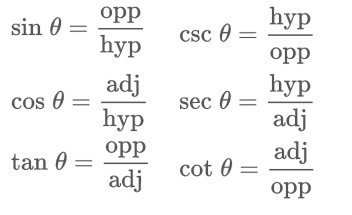
For an acute angle in a right triangle, the six trigonometric functions are defined as ratios of the sides:
Sine:
Cosine:
Tangent:
Cosecant:
Secant:
Cotangent:
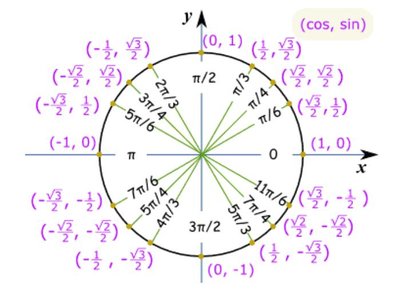
Trigonometric Functions on the Unit Circle
The unit circle (a circle of radius 1 centered at the origin) is a powerful tool for understanding trigonometric functions for all angles. The coordinates of a point on the unit circle corresponding to an angle are .
ASTC Chart (Signs of Trigonometric Functions)
The ASTC chart helps determine which trigonometric functions are positive in each quadrant:
Quadrant I: All functions are positive
Quadrant II: Sine and cosecant are positive
Quadrant III: Tangent and cotangent are positive
Quadrant IV: Cosine and secant are positive
Trigonometric Identities and Formulas
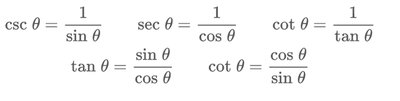
Reciprocal and Quotient Identities
These identities relate the six trigonometric functions to each other:
Pythagorean Identities
The Pythagorean identities are derived from the Pythagorean Theorem and are fundamental in calculus:
Double-Angle and Half-Angle Formulas
These formulas are useful for simplifying expressions and solving equations:
Double-Angle:
Half-Angle:
Solving Trigonometric Equations
To solve trigonometric equations, use identities and algebraic manipulation to isolate the variable. Consider all solutions in the specified interval, and remember to check for extraneous solutions.
Example: Solve for .
Take square roots:
Find all in the interval where this is true (e.g., )
Common Triangles and the Unit Circle
Special right triangles (30-60-90 and 45-45-90) and the unit circle are essential tools for evaluating trigonometric functions at common angles. The unit circle provides exact values for sine and cosine at multiples of , , and .
Summary Table: Common Angles and Their Trigonometric Values
Angle (degrees) | Angle (radians) | sin | cos | tan |
|---|---|---|---|---|
0° | 0 | 0 | 1 | 0 |
30° | ||||
45° | 1 | |||
60° | ||||
90° | 1 | 0 | undefined |
Additional info: This table is inferred from standard trigonometric values for common angles.
