 Back
BackLecture 16
Study Guide - Smart Notes
 Tailored notes based on your materials, expanded with key definitions, examples, and context.
Understanding What the Derivative Tells Us
Interpreting the Derivative
The derivative of a function at a point provides the instantaneous rate of change of the function with respect to its variable. In practical terms, it tells us how fast a quantity is changing at a specific moment.
Definition: If is a function, then its derivative at , denoted , is the slope of the tangent line to the graph of at .
Physical Meaning: In real-world contexts, the derivative often represents speed, growth rate, or other rates of change.
Units: The units of the derivative are the units of the output variable divided by the units of the input variable.
Applications and Examples of Derivatives
Example: Speed from a Distance-Time Graph
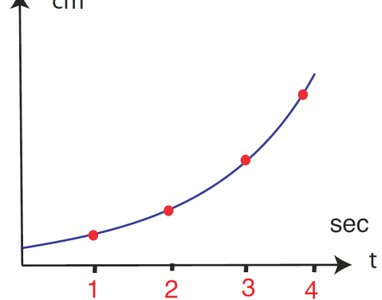
Given a graph showing the distance from the origin (in cm) of a rat after seconds, we can compare instantaneous and average speeds at different times.
Instantaneous Speed: The derivative at a specific time gives the rat's speed at that moment.
Average Speed: The average speed between and is .
Comparisons: By examining the steepness of the graph at different points, we can determine which speed is greatest.
Interpreting Derivatives in Context
Understanding the meaning of and in various real-world situations is crucial for applying calculus concepts:
Temperature Example: If is the temperature in degrees Fahrenheit at hours after midnight:
means the temperature at 7 AM is 48°F.
means the temperature is increasing at a rate of 3°F per hour at 7 AM.
means the temperature at 9 AM is -5°F.
Distance Example: If is the distance from the origin of a rat on the x-axis after seconds:
means the rat is 3 cm from the origin at seconds.
means the rat is moving toward the origin at 5 cm/sec at seconds.
Population Example: If is the population of a city in year :
means the population in 1550 was 900.
means the population was increasing at 100 people per year in 1650.
Reasoning with Derivative Information
Given values of a function and its derivative, we can deduce information about the behavior of the function:
Example: If and :
At 1550, the population was 3000.
At 1650, the population was increasing at 100 people per year, but the actual population at 1650 is not directly given.
It is incorrect to assume the population in 1650 is 3100 unless the rate was constant over 100 years.
Example: If and :
The average rate of change is per unit time.
However, the instantaneous rate at could be different, even negative.
Rate of Change Without Time
Interpreting Derivatives with Respect to Other Variables
Derivatives can represent rates of change with respect to variables other than time, such as temperature or cost.
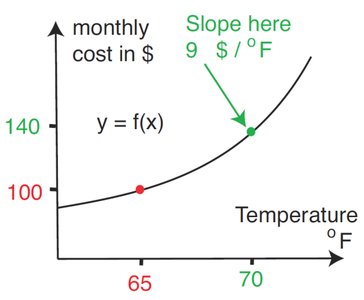
Example: If is the monthly cost of heating a house to degrees Fahrenheit:
means the cost is $140 when the temperature is 70°F.
means that for each additional degree, the cost increases by at 70°F.
Importance of Units in Derivatives
Understanding Units in Context
Units are essential for interpreting the meaning of derivatives. The units of the derivative are always the units of the output variable divided by the units of the input variable.
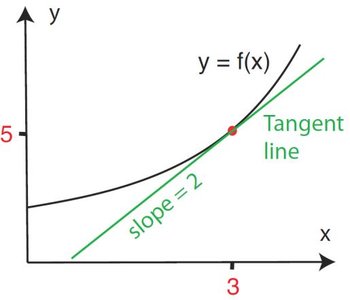
Example: If and for a function :
means the value of is 5 when .
means the rate of change of with respect to is 2 at .
The tangent line at has a slope of 2.
Further Examples of Derivative Interpretation
Temperature and Heart Rate Examples
Oven Temperature: If is the temperature of an oven in degrees Celsius after minutes:
means the oven is at 20°C after 3 minutes.
means the temperature is rising at 15°C per minute at 3 minutes.
Adrenaline and Heart Rate: If is the number of heartbeats per minute with mg of adrenaline in the blood:
means that at 5 mg of adrenaline, each additional mg increases the heart rate by 2 bpm.
