 Back
BackVectors and Conic Sections: Study Notes for Calculus Students
Study Guide - Smart Notes
 Tailored notes based on your materials, expanded with key definitions, examples, and context.
Vectors in the Plane
Definition and Representation
Vectors are fundamental mathematical objects characterized by both magnitude and direction. They are commonly represented as directed line segments in the plane, with a tail and a head indicating their orientation.
Magnitude: The length of the vector.
Direction: The angle between the vector and the positive x-axis.
Notation: A vector u is often written as <u1, u2> in component form.
Equal and Parallel Vectors
Equal Vectors: Two vectors are equal if they have the same magnitude and direction.
Parallel Vectors: Vectors u and v are parallel if one is a scalar multiple of the other: for some constant .
Scalar Multiplication
Scalar multiplication involves multiplying a vector by a real number (scalar), affecting its magnitude and possibly its direction.
If , the direction remains the same.
If , the direction is reversed.
The magnitude becomes times the original.

Vector Operations
Addition and Subtraction
Vector addition and subtraction are performed component-wise:
Addition:
Subtraction:
Position Vector
A position vector is a vector whose tail is at the origin and whose head is at the point . It is written as .
Component Form and Magnitude
Component Form:
Magnitude:

Unit Vector
A unit vector has a magnitude of 1 and points in the direction of a given vector.
To find a unit vector in the direction of , divide by its magnitude:
Example: Finding Vectors in Component Form
Given points and :
Magnitude:
Unit vector:

Vectors in Three Dimensions
3-D Coordinate System
In three dimensions, points are represented as ordered triples . The z-axis is perpendicular to both the x- and y-axes.
Distance Formula:
Midpoint Formula:
Vector in 3-D
A vector in space is written as .
Magnitude:
Standard Unit Vectors in 3-D
(x-direction)
(y-direction)
(z-direction)

Dot Product
Definition and Properties
The dot product (scalar product) of two vectors and is defined as:
where is the angle between and .
In component form:
The dot product is a scalar.
Properties
Vectors are orthogonal if
Example: Calculating Dot Product and Angle
Given and :
Magnitude: ,
Angle:
Conic Sections and Polar Coordinates
The Hyperbola
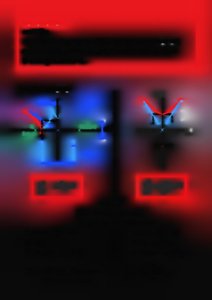
A hyperbola is the set of all points such that the absolute value of the difference of the distances from two fixed points (the foci) is constant.
Standard Equation:
Vertices:
Foci: where
Eccentricity:
Asymptotes:
Conic Sections in Polar Coordinates
Conic sections can be unified and represented in polar coordinates, especially when one focus is at the pole (origin).
General Polar Equation:
Eccentricity (): Determines the type of conic:
: Ellipse
: Parabola
: Hyperbola
Example: Polar Equation of an Ellipse
Given , identify the eccentricity and plot points.
Eccentricity: (ellipse)
Plot points for various values to sketch the graph.
Applications of Vectors
Physical Quantities
Vectors are used in physics to represent quantities such as velocity and force. For example, the velocity of an airplane relative to the ground can be modeled as the sum of its velocity relative to the air and the wind velocity.
Resultant velocity:
Speed: Magnitude of the resultant vector
Direction: Calculated using the arctangent of the vector components

Geometric Objects in Space
The Sphere and the Ball
Sphere: The set of all points at a fixed distance from a center .
Equation:
Ball: The set of all points on and inside the sphere.
Equation:

Example: Sphere Passing Through Two Points
Given points and , find the equation of the sphere with center at the midpoint of and passing through both points.
Midpoint:
Radius:
Equation:
Summary Table: Vector Operations in Component Form
Operation | Formula |
|---|---|
Addition | |
Subtraction | |
Scalar Multiplication | |
Magnitude | |
Dot Product |
