 Back
BackVectors: Definitions, Operations, and Applications in Calculus
Study Guide - Smart Notes
 Tailored notes based on your materials, expanded with key definitions, examples, and context.
Vectors: Fundamental Concepts
Definition and Properties
A vector is a mathematical object characterized by both magnitude (length) and direction. Vectors are commonly used in calculus and physics to represent quantities such as displacement, velocity, and force.
Magnitude: The length of the vector, denoted as .
Direction: The orientation from the initial point to the final point.
Notation: A vector from point A to point B is written as .
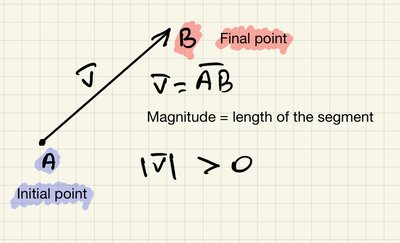
Key Point: The magnitude of a vector is always positive: .
Operations with Vectors
Addition of Vectors
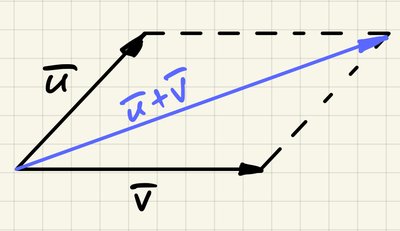
Vectors can be added using the parallelogram rule. The sum of two vectors and is a new vector , which represents the diagonal of the parallelogram formed by $\vec{u}$ and $\vec{v}$.
Commutative property:
Associative property:
Multiplication by a Scalar
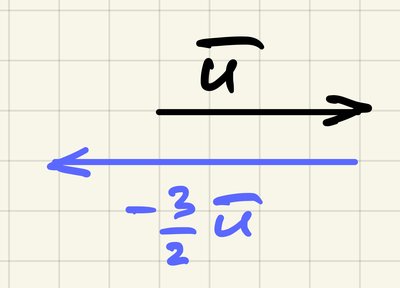
Multiplying a vector by a scalar changes its magnitude but not its direction (unless $k$ is negative, which reverses the direction).
If , points in the same direction as , with length .
If , points in the opposite direction, with length .
Properties of Vector Operations
There is a zero vector such that .
For each vector , there exists such that .
Distributive property: .
Associative property for scalars: .
Vectors in Two Dimensions (2D)
Component Form and Unit Vectors
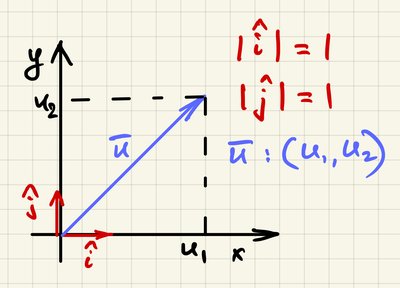
In 2D, vectors are represented using unit vectors and , which point in the direction of the x and y axes, respectively.
and
Any vector can be written as
Vector addition:
Scalar multiplication:
Example: Let , .
Magnitude:
Unit vector:
Vectors in Three Dimensions (3D)
Component Form and Unit Vectors
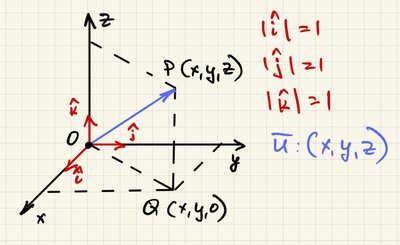
In 3D, vectors use unit vectors , , and for the x, y, and z axes.
, ,
Any vector can be written as
Vector from to :
Distance between points:
The Dot Product (Scalar Product)
Definition and Properties
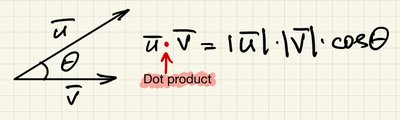
The dot product of two vectors and is a scalar quantity defined as:
where is the angle between the vectors.
If and are perpendicular (), then .
In 2D: , ,
In 3D: , ,
Properties: ,
Example: For and , find such that is perpendicular to :
Set
Projections of Vectors
Definition and Calculation
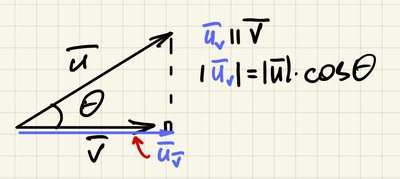
The projection of vector onto vector is a vector parallel to $\vec{v}$ with length .
Unit vector in direction of :
Projection formula:
Decomposition: , where is perpendicular to
Example: Express as a sum of vectors , where and :
Check:
Vectors in n Dimensions
Generalization
Vectors can be extended to n dimensions, where a vector is an ordered set of n real numbers.
Basis vectors: , , ...,
Dot product:
Magnitude:
Angle between vectors:
