 Back
BackWork Done Lifting a Bucket and Rope (Work as an Integral)
Study Guide - Smart Notes
 Tailored notes based on your materials, expanded with key definitions, examples, and context.
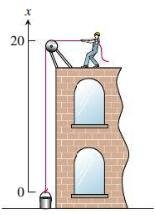
Q11. A 5-lb bucket is lifted from the ground into the air by pulling in 20 ft of rope at a constant speed. The rope weighs 0.08 lb/ft. How much work was spent lifting the bucket and rope?
Background
Topic: Applications of Integration – Work
This problem is about calculating the work required to lift a bucket and a rope, where the rope's weight is distributed along its length. This is a classic calculus application involving variable force and integration.
Key Terms and Formulas
Work (W): The work done by a variable force over a distance is given by the integral where is the force at position .
Weight of Rope: Since the rope is being lifted, the amount of rope still hanging decreases as the bucket rises, so the force due to the rope is a function of height.
Constant Weight: The bucket's weight is constant (5 lb), but the rope's weight changes as it is lifted.
Step-by-Step Guidance
Let be the height (in feet) the bucket has been lifted, with at the ground and at the top.
The work to lift the bucket alone is $5 ft): .
For the rope, at height , there are feet of rope still hanging. The weight of this rope is lb.
The work to lift each small piece of rope a distance is . To find the total work, integrate from to :
Add the work done lifting the bucket and the rope to get the total work. Set up the sum, but do not compute the final value yet.
Try solving on your own before revealing the answer!
Final Answer: 112 lb-ft
The work to lift the bucket is lb-ft. The work to lift the rope is lb-ft. Total work is lb-ft.
This combines the constant work for the bucket and the variable work for the rope.
