Back
Back
Problem 11.7.20
Hyperbolas and Eccentricity
In Exercises 17-24, find the eccentricity of the hyperbola. Then find and graph the hyperbola's foci and directrices.
y² − x² = 4
Problem 11.7.12
Ellipses and Eccentricity
Exercises 9–12 give the foci or vertices and the eccentricities of ellipses centered at the origin of the xy-plane. In each case, find the ellipse’s standard-form equation in Cartesian coordinates.
Vertices: (±10,0)
Eccentricity: 0.24
Problem 11.3.56
Cartesian to Polar Equations
Replace the Cartesian equations in Exercises 53–66 with equivalent polar equations.
x - y = 3
Problem 11.6.2
Identifying Graphs
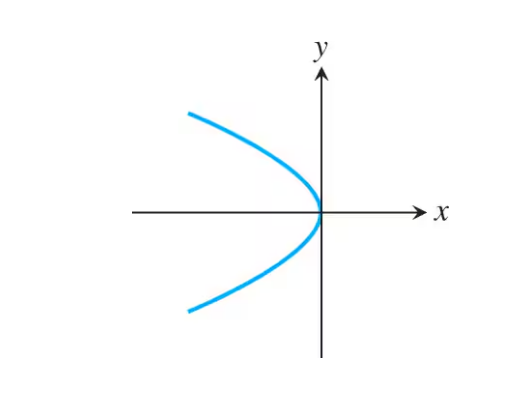
Match the parabolas in Exercises 1−4 with the following equations: x² = 2y, x² = −6y, y² = 8x, y² = −4x
Then find each parabola's focus and directrix.
Problem 11.2.25
Lengths of Curves
Find the lengths of the curves in Exercises 25–30.
x = cos t, y = t + sin t, 0 ≤ t ≤ π
Problem 11.2.39
Centroids
Find the coordinates of the centroid of the curve x = cos t, y = t + sin t, 0 ≤ t ≤ π.
Problem 11.7.28
Hyperbolas and Eccentricity
Exercises 25–28 give the eccentricities and the vertices or foci of hyperbolas centered at the origin of the xy-plane. In each case, find the hyperbola’s standard-form equation in Cartesian coordinates.
Eccentricity: 1.25
Foci: (0, ±5)
Problem 11.5.18
Finding Polar Areas
Find the areas of the regions in Exercises 9–18.
Inside the circle r = 4 sin θ and below the horizontal line r = 3 csc θ
Problem 11.2.14
Tangent Lines to Parametrized Curves
In Exercises 1−14, find an equation for the line tangent to the curve at the point defined by the given value of t. Also, find the value of d²y/dx² at this point.
x = t + eᵗ, y = 1 − eᵗ, t = 0
Problem 11.1.36
Finding Parametric Equations
In Exercises 31–36, find a parametrization for the curve.
the ray (half line) with initial point (-1,2) that passes through the point (0,0)
Problem 11.3.66
Cartesian to Polar Equations
Replace the Cartesian equations in Exercises 53–66 with equivalent polar equations.
(x + 2)² + (y − 5)² = 16"
Problem 11.7.68
Examples of Polar Equations
[Technology Exercise] Graph the lines and conic sections in Exercises 65–74.
r = −2 cos θ
Problem 11.5.10
Finding Polar Areas
Find the areas of the regions in Exercises 9–18.
Shared by the circles r = 1 and r = 2 sin θ
Problem 11.1.14
Finding Cartesian from Parametric Equations
Exercises 1–18 give parametric equations and parameter intervals for the motion of a particle in the xy-plane. Identify the particle’s path by finding a Cartesian equation for it. Graph the Cartesian equation. (The graphs will vary with the equation used.) Indicate the portion of the graph traced by the particle and the direction of motion.
x=√(t+1), y=√t, t ≥ 0
Problem 11.3.19
Graphing Sets of Polar Coordinate Points
Graph the sets of points whose polar coordinates satisfy the equations and inequalities in Exercises 11–26.
θ = π/2, r ≥ 0
Problem 11.7.48
Lines
Sketch the lines in Exercises 45–48 and find Cartesian equations for them.
r cos (θ + π/3) = 2
Problem 11.4.6
Symmetries and Polar Graphs
Identify the symmetries of the curves in Exercises 1–12. Then sketch the curves in the xy-plane.
r = 1 + 2 sin θ
Problem 11.2.6
Tangent Lines to Parametrized Curves
In Exercises 1−14, find an equation for the line tangent to the curve at the point defined by the given value of t. Also, find the value of d²y/dx² at this point.
x = sec² t − 1, y = tan t, t = −π/4
Problem 11.6.77
Theory and Examples
Tangents Find equations for the tangents to the circle (x − 2)² + (y − 1)² = 5 at the points where the circle crosses the coordinate axes.
Problem 11.7.32
Eccentricities and Directrices
Exercises 29–36 give the eccentricities of conic sections with one focus at the origin along with the directrix corresponding to that focus. Find a polar equation for each conic section.
e = 2, x = 4
Problem 11.1.32
Finding Parametric Equations
In Exercises 31–36, find a parametrization for the curve.
the line segment with endpoints (-1,3) and (3,-2)
Problem 11.2.33
Surface Area
Find the areas of the surfaces generated by revolving the curves in Exercises 31-34 about the indicated axes.
x = t + √2, y = (t²/2) + √2t, −√2 ≤ t ≤ √2; y−axis
Problem 11.1.10
Finding Cartesian from Parametric Equations
Exercises 1–18 give parametric equations and parameter intervals for the motion of a particle in the xy-plane. Identify the particle’s path by finding a Cartesian equation for it. Graph the Cartesian equation. (The graphs will vary with the equation used.) Indicate the portion of the graph traced by the particle and the direction of motion.
x = 1 + sin t, y = cos t − 2, 0 ≤ t ≤ π
Problem 11.5.27
Finding Lengths of Polar Curves
Find the lengths of the curves in Exercises 21–28.
The curve r = cos³(θ/3), 0 ≤ θ ≤ π/4
Problem 11.1.24
Finding Cartesian from Parametric Equations
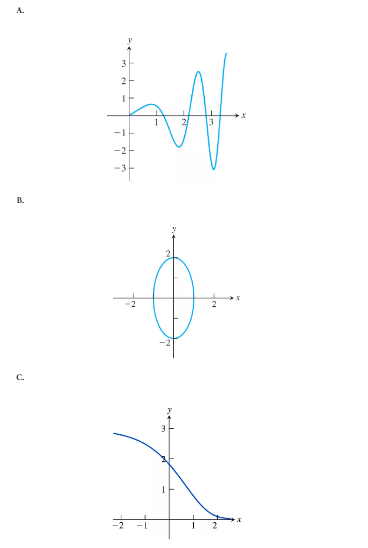
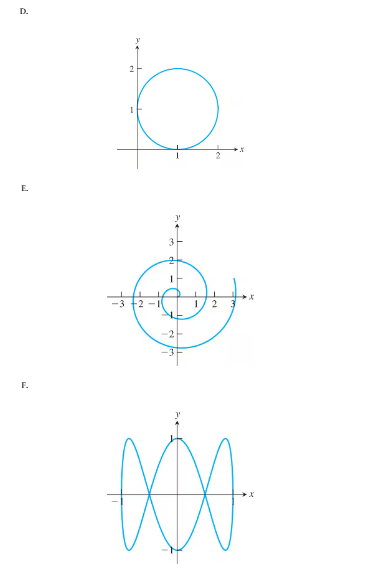
In Exercises 19–24, match the parametric equations with the parametric curves labeled A through F.
x = cos t, y = sin 3t
Problem 11.7.55
Circles
Sketch the circles in Exercises 53–56. Give polar coordinates for their centers and identify their radii.
r = −2 cos θ
Problem 11.1.18
Finding Cartesian from Parametric Equations
Exercises 1–18 give parametric equations and parameter intervals for the motion of a particle in the xy-plane. Identify the particle’s path by finding a Cartesian equation for it. Graph the Cartesian equation. (The graphs will vary with the equation used.) Indicate the portion of the graph traced by the particle and the direction of motion.
x = 2 sinh t, y = 2 cosh t, −∞<t<∞
Problem 11.6.62
Shifting Conic Sections
Find the center, foci, vertices, asymptotes, and radius, as appropriate, of the conic sections in Exercises 57-68.
9x² + 6y² + 36y = 0
Problem 11.3.36
Polar to Cartesian Equations
Replace the polar equations in Exercises 27–52 with equivalent Cartesian equations. Then describe or identify the graph.
r² = 4r sin θ
Problem 11.2.18
Implicitly Defined Parametrizations
Assuming that the equations in Exercises 15−20 define x and y implicitly as differentiable functions x=f(t), y=g(t), find the slope of the curve x=f(t), y=g(t) at the given value of t.
x sin t + 2x = t, t sin t − 2t = y, t = π