
Textbook Question
Limits of Rational Functions
In Exercises 13–22, find the limit of each rational function (a) as x → ∞ and (b) as x → −∞. Write ∞ or −∞ where appropriate.
f(x) = (x + 1)/(x² + 3)
365
views

 Verified step by step guidance

 05:50
05:50
 05:34
05:34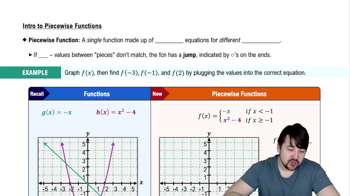 05:36
05:36Limits of Rational Functions
In Exercises 13–22, find the limit of each rational function (a) as x → ∞ and (b) as x → −∞. Write ∞ or −∞ where appropriate.
f(x) = (x + 1)/(x² + 3)
Finding Limits of Differences When x → ±∞
Find the limits in Exercises 84–90. (Hint: Try multiplying and dividing by the conjugate.)
lim x → ∞ (√(9x² − x) − 3x)
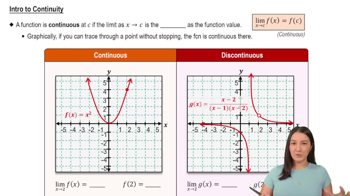
Limits and Continuity
Graph the function
1 , x ≤ ―1
―x , ―1 < x < 0
ƒ(x) = { 1 , x = 0 ,
―x , 0 < x < 1
1 , x ≥ 1
Then discuss, in detail, limits, one-sided limits, continuity, and one-sided continuity of ƒ at x = ―1 , 0 , and 1. Are any of the discontinuities removable? Explain.
Limits and Continuity
On what intervals are the following functions continuous?
a. ƒ(x) = tan x
Average Rates of Change
In Exercises 1–6, find the average rate of change of the function over the given interval or intervals.
g(x)=x²−2x
a. [1, 3]
Suppose that limx→−2 p(x) = 4, limx→−2 r(x) = 0, and limx→−2 s(x) = −3. Find
a. limx→−2 (p(x) + r(x) + s(x))