

Ch. 2 - Limits and Continuity
Hass - Thomas' Calculus 15th Edition
Hass15th EditionThomas' CalculusISBN: 9780137616077Not the one you use?Change textbook
Chapter 2, Problem 2.2.77

Theory and Examples


If limx→4 (f(x) − 5) / (x − 2) = 1, find limx→4 f(x).

Verified step by step guidance
1
First, understand the given limit expression: lim(x→4) (f(x) − 5) / (x − 2) = 1. This indicates that as x approaches 4, the expression (f(x) − 5) / (x − 2) approaches 1.
Recognize that this is a limit problem involving a rational expression. The numerator is (f(x) − 5) and the denominator is (x − 2). The limit is given as x approaches 4.
To find lim(x→4) f(x), consider the behavior of the function f(x) as x approaches 4. The expression (f(x) − 5) / (x − 2) approaching 1 suggests that f(x) can be expressed in a form that allows simplification.
Assume f(x) can be expressed as f(x) = a(x − 2) + 5, where a is a constant. This form allows the expression (f(x) − 5) / (x − 2) to simplify to a, which should equal 1 based on the given limit.
Substitute x = 4 into the expression f(x) = a(x − 2) + 5 to find lim(x→4) f(x). Since a = 1, the expression becomes f(4) = 1(4 − 2) + 5, which simplifies to the value of the limit.

Verified video answer for a similar problem:

This video solution was recommended by our tutors as helpful for the problem above.
Video duration:
2m
Was this helpful?

Key Concepts

Here are the essential concepts you must grasp in order to answer the question correctly.

Limits

A limit is a fundamental concept in calculus that describes the behavior of a function as its input approaches a certain value. In this case, we are interested in the limit of the function f(x) as x approaches 4. Understanding limits is crucial for evaluating functions at points where they may not be explicitly defined.
Recommended video:
05:50
One-Sided Limits

L'Hôpital's Rule

L'Hôpital's Rule is a method used to evaluate limits of indeterminate forms, such as 0/0 or ∞/∞. It states that if the limit of f(x)/g(x) results in an indeterminate form, the limit can be found by taking the derivative of the numerator and the derivative of the denominator. This rule can simplify the process of finding limits in complex scenarios.
Recommended video:

Continuity of Functions

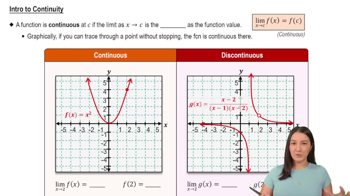
A function is continuous at a point if the limit of the function as it approaches that point equals the function's value at that point. In this problem, understanding the continuity of f(x) at x = 4 is essential, as it allows us to directly relate the limit of (f(x) - 5)/(x - 2) to the limit of f(x) itself.
Recommended video:
05:34
Intro to Continuity
Related Practice
Textbook Question

Using the Sandwich Theorem


a. It can be shown that the inequalities 1 − x²/ 6 < (x sin x) / (2−2cos x) < 1 hold for all values of x close to zero (except for x = 0). What, if anything, does this tell you about limx→0 (x sin x) / (2 − 2cos x)?


Give reasons for your answer.


[Technology Exercise] b. Graph y = 1 − (x²/6), y=(x sinx)/(2 − 2cos x), and y = 1 together for −2 ≤ x ≤2. Comment on the behavior of the graphs as x→0.

359
views
Textbook Question

Use the Intermediate Value Theorem in Exercises 69–74 to prove that each equation has a solution. Then use a graphing calculator or computer grapher to solve the equations.

x³ − 15x + 1 = 0 (three roots)

338
views
Textbook Question

Domains and Asymptotes


Determine the domain of each function in Exercises 69–72. Then use various limits to find the asymptotes.


y = 2x / (x² − 1)

334
views
Textbook Question

Find the limits in Exercises 31–40. Are the functions continuous at the point being approached?

lim ϴ → 0 cos (πϴ/sin ϴ)

226
views
Textbook Question

Finding Limits of Differences When x → ±∞


Find the limits in Exercises 84–90. (Hint: Try multiplying and dividing by the conjugate.)


lim x → ∞ (√(x² + 25) − √(x² − 1))

196
views
Textbook Question

Limits as x → ∞ or x → −∞


The process by which we determine limits of rational functions applies equally well to ratios containing noninteger or negative powers of x. Divide numerator and denominator by the highest power of x in the denominator and proceed from there. Find the limits in Exercises 23–36. Write ∞ or −∞ where appropriate.


lim x→∞ (2√x + x⁻¹) / (3x − 7)

296
views