
Textbook Question
In Exercises 41–58, find dy/dt.
y = (t tan(t))¹⁰
263
views

 Verified step by step guidance
 05:53
05:53
 05:13
05:13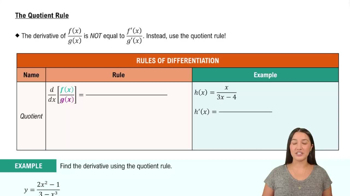 06:43
06:43In Exercises 41–58, find dy/dt.
y = (t tan(t))¹⁰
Differentiating Implicitly
Use implicit differentiation to find dy/dx in Exercises 1–14.
x⁴ + sin y = x³y²
Find the derivatives of the functions in Exercises 17–28.
y = ((x + 1)(x + 2)) / ((x − 1)(x − 2))
For what value or values of the constant m, if any, is
ƒ(x) = { sin 2x, x ≤ 0
{ mx, x > 0
a. continuous at x = 0?
b. differentiable at x = 0?
Give reasons for your answers.
Free-Fall Applications
Free fall on Mars and Jupiter The equations for free fall at the surfaces of Mars and Jupiter (s in meters, t in seconds) are s = 1.86t² on Mars and s = 11.44t² on Jupiter. How long does it take a rock falling from rest to reach a velocity of 27.8 m/sec (about 100 km/h) on each planet?
Suppose that functions ƒ(x) and g(x) and their first derivatives have the following values at x = 0 and x = 1.
x ƒ(x) g(x) ƒ'(x) g'(x)
0 1 1 -3 1/2
1 3 5 1/2 -4
Find the first derivatives of the following combinations at the given value of x.
a. 6ƒ(x) - g(x), x = 1