Ch. 3 - Derivatives
Hass - Thomas' Calculus 15th Edition
Hass15th EditionThomas' CalculusISBN: 9780137616077Not the one you use?Change textbook
Chapter 3, Problem 22b

Economics


Marginal revenue
Suppose that the revenue from selling x washing machines is


r(x) = 20000(1 − 1/x) dollars.


b. Use the function r'(x) to estimate the increase in revenue that will result from increasing production from 100 machines a week to 101 machines a week.

Verified step by step guidance
1
First, understand that the function r(x) = 20000(1 - 1/x) represents the revenue from selling x washing machines. We need to find the derivative r'(x) to determine the marginal revenue, which is the rate of change of revenue with respect to the number of machines sold.
To find r'(x), apply the derivative rules. The function r(x) = 20000(1 - 1/x) can be rewritten as r(x) = 20000 - 20000/x. Differentiate this function with respect to x.
The derivative of a constant is zero, so the derivative of 20000 is 0. For the term -20000/x, use the power rule. Rewrite -20000/x as -20000x^(-1) and differentiate to get 20000x^(-2) or 20000/x^2.
Thus, the derivative r'(x) = 20000/x^2. This represents the marginal revenue function, which gives the approximate change in revenue for a small change in the number of machines sold.
To estimate the increase in revenue from increasing production from 100 machines to 101 machines, evaluate r'(100). Substitute x = 100 into the marginal revenue function: r'(100) = 20000/(100^2). This value will give the estimated increase in revenue for producing one additional machine.

Verified video answer for a similar problem:

This video solution was recommended by our tutors as helpful for the problem above.
Video duration:
4m
Was this helpful?

Key Concepts

Here are the essential concepts you must grasp in order to answer the question correctly.

Derivative

The derivative of a function measures how the function's output changes as its input changes. In this context, r'(x) represents the rate of change of revenue with respect to the number of washing machines sold. Calculating r'(x) allows us to estimate the marginal revenue, which is the additional revenue generated by selling one more unit.
Recommended video:
05:44
Derivatives

Marginal Revenue

Marginal revenue is the additional income from selling one more unit of a good or service. It is calculated as the derivative of the revenue function with respect to quantity. In this problem, r'(x) gives the marginal revenue, helping estimate the revenue increase when production rises from 100 to 101 machines.
Recommended video:
04:18
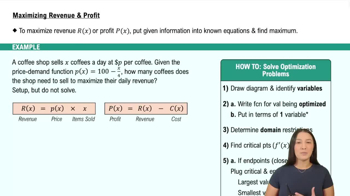
Maximizing Profit & Revenue

Function Evaluation

Function evaluation involves substituting specific values into a function to determine its output. Here, evaluating r'(x) at x = 100 provides the marginal revenue for the 100th machine, which helps estimate the revenue change when production increases to 101 machines. This step is crucial for applying the derivative to real-world scenarios.
Recommended video:
4:26
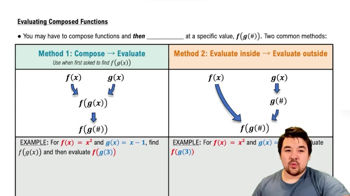
Evaluating Composed Functions
Related Practice
Textbook Question

Economics


Marginal revenue

Suppose that the revenue from selling x washing machines is


r(x) = 20000(1 − 1/x) dollars.


c. Find the limit of r'(x) as x → ∞. How would you interpret this number?

192
views

Textbook Question

Economics


Marginal cost Suppose that the dollar cost of producing x washing machines is c(x) = 2000 + 100x − 0.1x².


a. Find the average cost per machine of producing the first 100 washing machines.

198
views
Textbook Question

Economics


Marginal cost Suppose that the dollar cost of producing x washing machines is c(x) = 2000 + 100x − 0.1x².


c. Show that the marginal cost when 100 washing machines are produced is approximately the cost of producing one more washing machine after the first 100 have been made, by calculating the latter cost directly.

207
views
Textbook Question

Using the Alternative Formula for Derivatives


Use the formula

f'(x) = lim (z → x) (f(z) − f(x)) / (z − x)

to find the derivative of the functions in Exercises 23–26.


f(x) = x² − 3x + 4

272
views
Textbook Question

In Exercises 19–22, find the values of the derivatives.


dr/dθ |θ₌₀ if r = 2/√(4 – θ)

151
views
Textbook Question

Additional Applications


Bacterium population

When a bactericide was added to a nutrient broth in which bacteria were growing, the bacterium population continued to grow for a while, but then stopped growing and began to decline. The size of the population at time t (hours) was b = 10⁶ + 10⁴t − 10³t². Find the growth rates at


a. t = 0 hours.

b. t = 5 hours.

c. t = 10 hours.

217
views