Find an equation of the straight line having slope 1/4 that is tangent to the curve y = √x.
Ch. 3 - Derivatives
Chapter 3, Problem 3.6.78
Find dy/dt when x = 1 if y = x² + 7x − 5 and dx/dt = ¹/₃.
Verified step by step guidance1
First, identify the given function y = x² + 7x − 5. This is the function for which we need to find the derivative with respect to time, t.
To find dy/dt, use the chain rule. The chain rule states that dy/dt = (dy/dx) * (dx/dt). We need to find dy/dx first.
Differentiate y = x² + 7x − 5 with respect to x to find dy/dx. The derivative of x² is 2x, and the derivative of 7x is 7. Therefore, dy/dx = 2x + 7.
Substitute x = 1 into the expression for dy/dx to find the specific value of the derivative at x = 1. This gives dy/dx = 2(1) + 7.
Now, substitute dy/dx and dx/dt = ¹/₃ into the chain rule formula: dy/dt = (dy/dx) * (dx/dt). Calculate dy/dt using the values obtained in the previous steps.

Verified video answer for a similar problem:
This video solution was recommended by our tutors as helpful for the problem above.
Video duration:
2mWas this helpful?
Key Concepts
Here are the essential concepts you must grasp in order to answer the question correctly.
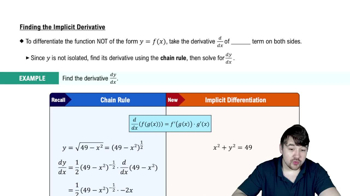
Implicit Differentiation
Implicit differentiation is a technique used to find the derivative of a function when it is not explicitly solved for one variable in terms of another. In this context, it helps us differentiate y with respect to t by considering the relationship between x and y, and using the chain rule to account for dx/dt.
Recommended video:
Finding The Implicit Derivative
Chain Rule
The chain rule is a fundamental concept in calculus used to differentiate composite functions. It states that the derivative of a composite function is the derivative of the outer function evaluated at the inner function times the derivative of the inner function. Here, it allows us to find dy/dt by multiplying dy/dx by dx/dt.
Recommended video:
Intro to the Chain Rule
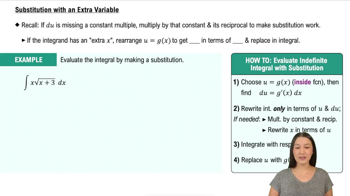
Substitution
Substitution involves replacing variables with known values to simplify expressions or solve equations. In this problem, after finding the expression for dy/dt, we substitute x = 1 and dx/dt = 1/3 to calculate the specific value of dy/dt at that point, providing a concrete solution to the problem.
Recommended video:
Substitution With an Extra Variable
Related Practice
Textbook Question
225
views
Textbook Question
Theory and Examples
Intersecting normal line The line that is normal to the curve x² + 2xy – 3y² = 0 at (1,1) intersects the curve at what other point?
340
views
Textbook Question
In Exercises 41–58, find dy/dt.
y = √(3t + (√2 + √(1 − t)))
288
views
Textbook Question
Are there any points on the curve y = x - 1/(2x) where the slope is 2? If so, find them.
212
views
Textbook Question
A growing sand pile Sand falls from a conveyor belt at the rate of 10 m³/min onto the top of a conical pile. The height of the pile is always three-eighths of the base diameter. How fast are the (a) height and (b) radius changing when the pile is 4 m high? Answer in centimeters per minute.
303
views
Textbook Question
If r + s² + v³ = 12, dr/dt = 4, and ds/dt = –3, find dv/dt when r = 3 and s = 1.
187
views