Find ds/dt when θ = 3π/2 if s = cosθ and dθ/dt = 5.
Ch. 3 - Derivatives
Chapter 3, Problem 3.27
Find the derivatives of the functions in Exercises 1–42.
𝔂 = x² sin² (2x²)
Verified step by step guidance1
Step 1: Identify the function y = x² sin²(2x²). Notice that this is a product of two functions: u(x) = x² and v(x) = sin²(2x²).
Step 2: Apply the product rule for derivatives, which states that if y = u(x) * v(x), then y' = u'(x) * v(x) + u(x) * v'(x).
Step 3: Differentiate u(x) = x². The derivative u'(x) is 2x.
Step 4: Differentiate v(x) = sin²(2x²). Use the chain rule: v'(x) = 2 * sin(2x²) * cos(2x²) * (d/dx)(2x²).
Step 5: Calculate (d/dx)(2x²), which is 4x. Substitute back into the expression for v'(x) to get v'(x) = 2 * sin(2x²) * cos(2x²) * 4x.

Verified video answer for a similar problem:
This video solution was recommended by our tutors as helpful for the problem above.
Video duration:
5mWas this helpful?
Key Concepts
Here are the essential concepts you must grasp in order to answer the question correctly.
Derivative
The derivative of a function measures how the function's output value changes as its input value changes. It is a fundamental concept in calculus that represents the slope of the tangent line to the curve of the function at any given point. The derivative can be computed using various rules, such as the power rule, product rule, and chain rule.
Recommended video:
Derivatives
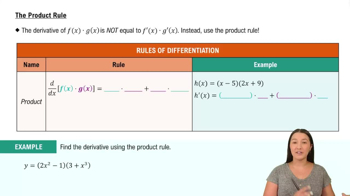
Product Rule
The product rule is a formula used to find the derivative of the product of two functions. It states that if you have two functions, u(x) and v(x), the derivative of their product is given by u'v + uv'. This rule is essential when differentiating functions that are products of simpler functions, as seen in the given function y = x² sin²(2x²).
Recommended video:
The Product Rule
Chain Rule
The chain rule is a technique for differentiating composite functions. If a function y is defined as a composition of two functions, say y = f(g(x)), the chain rule states that the derivative is given by dy/dx = f'(g(x)) * g'(x). This rule is particularly useful when dealing with functions that include nested expressions, such as sin²(2x²) in the given problem.
Recommended video:
Intro to the Chain Rule
Related Practice
Textbook Question
248
views
Textbook Question
Differential Estimates of Change
In Exercises 35–40, write a differential formula that estimates the given change in volume or surface area.
The change in the lateral surface area S = πr√(r² + h²) of a right circular cone when the radius changes from r₀ to r₀ + dr and the height does not change
163
views
Textbook Question
Using the Alternative Formula for Derivatives
Use the formula
f'(x) = lim (z → x) (f(z) − f(x)) / (z − x)
to find the derivative of the functions in Exercises 23–26.
g(x) = 1 + √x
239
views
Textbook Question
The general polynomial of degree n has the form
P(x) = aₙxⁿ + aₙ₋₁xⁿ⁻¹ + ... + a₂x² + a₁x + a₀,
where aₙ ≠ 0. Find P'(x).
203
views
Textbook Question
Derivatives in Differential Form
In Exercises 17–28, find dy.
2y³/² + xy − x = 0
178
views
Textbook Question
Find the derivatives of all orders of the functions in Exercises 29–32.
y = x⁵ / 120
183
views