Ch. 3 - Derivatives
Hass - Thomas' Calculus 15th Edition
Hass15th EditionThomas' CalculusISBN: 9780137616077Not the one you use?Change textbook
Chapter 3, Problem 3.5.34b

Find y⁽⁴⁾ = d⁴y/dx⁴ if:


b. y = 9 cos x

Verified step by step guidance
1
Start by identifying the function y = 9 cos(x). We need to find the fourth derivative of this function with respect to x.
Recall that the derivative of cos(x) is -sin(x). Therefore, the first derivative y' = dy/dx is y' = -9 sin(x).
Next, find the second derivative y'' = d²y/dx². The derivative of -sin(x) is -cos(x), so y'' = -9 cos(x).
Now, find the third derivative y''' = d³y/dx³. The derivative of -cos(x) is sin(x), so y''' = 9 sin(x).
Finally, find the fourth derivative y⁽⁴⁾ = d⁴y/dx⁴. The derivative of sin(x) is cos(x), so y⁽⁴⁾ = 9 cos(x).

Verified video answer for a similar problem:

This video solution was recommended by our tutors as helpful for the problem above.
Video duration:
2m
Was this helpful?

Key Concepts

Here are the essential concepts you must grasp in order to answer the question correctly.

Higher-Order Derivatives

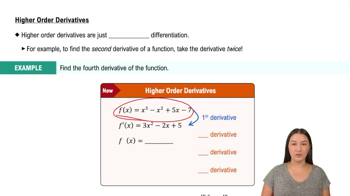
Higher-order derivatives refer to the derivatives of a function taken multiple times. The first derivative represents the rate of change of the function, the second derivative indicates the curvature or concavity, and so on. In this case, we are interested in the fourth derivative, which provides insights into the function's behavior beyond its initial slope and curvature.
Recommended video:
02:42
Higher Order Derivatives

Trigonometric Functions

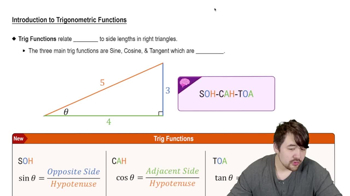
Trigonometric functions, such as sine and cosine, are fundamental in calculus and describe periodic phenomena. The function given, y = 9 cos x, is a cosine function scaled by a factor of 9. Understanding the properties of these functions, including their derivatives, is essential for solving problems involving them.
Recommended video:
6:04
Introduction to Trigonometric Functions

Derivative Rules

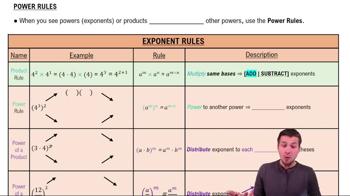
Derivative rules are formulas that simplify the process of finding derivatives of functions. For trigonometric functions, the derivative of cos x is -sin x. Applying these rules repeatedly allows us to compute higher-order derivatives efficiently, which is necessary for finding y⁽⁴⁾ in this problem.
Recommended video:
Related Practice
Textbook Question

Consider the function


f(x) = { x² cos(2/x), x ≠ 0

0, x = 0


b. Determine f' for x ≠ 0.

188
views

Textbook Question

Right circular cone The lateral surface area S of a right circular cone is related to the base radius r and height h by the equation

______

S = πrr² + .


b. How is dS/dt related to dh/dt if r is constant?

270
views
Textbook Question

Analyzing Motion Using Graphs


[Technology Exercise] Exercises 31–34 give the position function s = f(t) of an object moving along the s-axis as a function of time t. Graph f together with the velocity function v(t) = ds/dt = f'(t) and the acceleration function a(t) = d²s/dt² = f''(t). Comment on the object’s behavior in relation to the signs and values of v and a. Include in your commentary such topics as the following:


b. When does it move to the left (down) or to the right (up)?


s = 200t - 16t², 0 ≤ t ≤ 12.5 (a heavy object fired straight up from Earth’s surface at 200 ft/sec)

189
views
Textbook Question

Right circular cylinder The total surface area S of a right circular cylinder is related to the base radius r and height h by the equation S = 2πr² + 2πrh.


b. How is dS/dt related to dh/dt if r is constant?

244
views
Textbook Question

Tolerance


b. About how accurately must the tank’s exterior diameter be measured to calculate the amount of paint it will take to paint the side of the tank to within 5% of the true amount?

187
views
Textbook Question

b. Show that


f(x) = { x² sin(1/x), x ≠ 0

0, x = 0

is differentiable at x = 0 and find f′(0).

231
views