

Differentiability and Continuity on an Interval
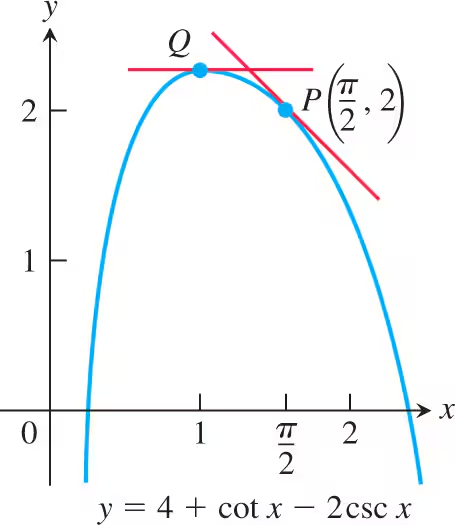
Each figure in Exercises 45–50 shows the graph of a function over a closed interval D. At what domain points does the function appear to be
a. differentiable?
Give reasons for your answers.
Verified step by step guidance
Differentiability and Continuity on an Interval
Each figure in Exercises 45–50 shows the graph of a function over a closed interval D. At what domain points does the function appear to be
a. differentiable?
Give reasons for your answers.
Use the linear approximation (1 + x)ᵏ ≈ 1 + kx to find an approximation for the function f(x) for values of x near zero.
a. f(x) = (1 − x)⁶
The radius r of a circle is measured with an error of at most 2%. What is the maximum corresponding percentage error in computing the circle’s
a. circumference?
Tolerance
a. About how accurately must the interior diameter of a 10-m-high cylindrical storage tank be measured to calculate the tank’s volume to within 1% of its true value?
Quadratic approximations
a. Let Q(x) = b₀ + b₁(x − a) + b₂(x − a)² be a quadratic approximation to f(x) at x = a with these properties:
i. Q(a) = f(a)
ii. Q′(a) = f′(a)
iii. Q″(a) = f″(a).
Determine the coefficients b₀, b₁, and b₂.
Diagonals If x, y, and z are lengths of the edges of a rectangular box, then the common length of the box’s diagonals is s = √(x² + y² + z²).
a. Assuming that x, y, and z are differentiable functions of t, how is ds/dt related to dx/dt, dy/dt, and dz/dt?