Ch. 3 - Derivatives
Hass - Thomas' Calculus 15th Edition
Hass15th EditionThomas' CalculusISBN: 9780137616077Not the one you use?Change textbook
Chapter 3, Problem 3.1.1

Slopes and Tangent Lines


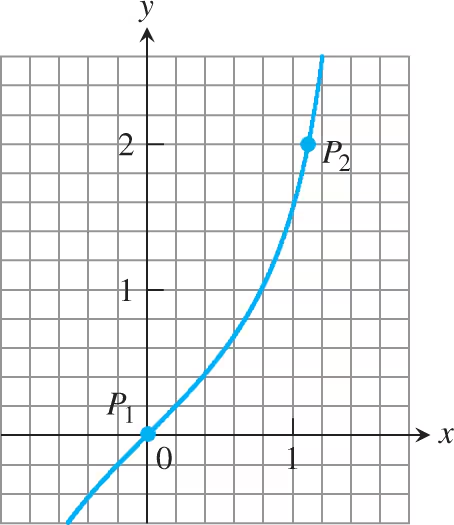
In Exercises 1–4, use the grid and a straight edge to make a rough estimate of the slope of the curve (in y-units per x-unit) at the points P₁ and P₂.


Graph showing a curve with points P₁ and P₂ marked, illustrating slopes and tangent lines on a grid.

Verified step by step guidance
1
To estimate the slope of the curve at point P₁, first identify the coordinates of P₁ on the graph. It appears that P₁ is at (0, 0).
Next, draw a tangent line at point P₁ using a straight edge. The tangent line should just touch the curve at P₁ without crossing it.
Estimate the slope of the tangent line at P₁ by choosing two points on the tangent line. Calculate the rise over run (change in y over change in x) between these two points.
Repeat the process for point P₂. Identify the coordinates of P₂, which appear to be approximately (1, 2) on the graph.
Draw a tangent line at point P₂ using a straight edge. Estimate the slope of this tangent line by selecting two points on it and calculating the rise over run.

Verified video answer for a similar problem:

This video solution was recommended by our tutors as helpful for the problem above.
Video duration:
2m
Was this helpful?

Key Concepts

Here are the essential concepts you must grasp in order to answer the question correctly.

Slope of a Curve

The slope of a curve at a given point represents the rate of change of the function at that point. It is calculated as the ratio of the vertical change (rise) to the horizontal change (run) between two points on the curve. For a smooth curve, this slope can be approximated by drawing a tangent line at the point of interest.
Recommended video:
05:45
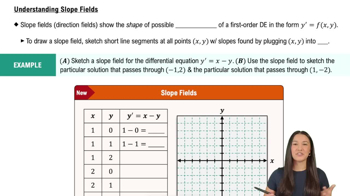
Understanding Slope Fields

Tangent Line

A tangent line to a curve at a specific point is a straight line that touches the curve at that point without crossing it. The slope of the tangent line at that point is equal to the derivative of the function at that point, providing a linear approximation of the curve's behavior nearby.
Recommended video:
05:13
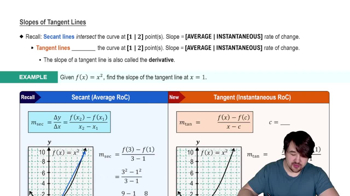
Slopes of Tangent Lines

Estimating Slopes

Estimating slopes involves visually analyzing the graph to determine the steepness of the curve at specific points. This can be done by selecting two points close to the point of interest and calculating the slope of the line connecting them, or by drawing a tangent line and measuring its slope. This estimation is crucial for understanding the function's behavior in calculus.
Recommended video:
05:45
Understanding Slope Fields
Related Practice
Textbook Question

Derivative Calculations


In Exercises 1–12, find the first and second derivatives.


y = x³/3 + x²/2 + x/4

265
views

Textbook Question

Derivative of multiples Does knowing that a function g(t) is differentiable at t = 7 tell you anything about the differentiability of the function 3g at t = 7? Give reasons for your answer.

172
views
Textbook Question

In Exercises 41–44, determine whether the piecewise-defined function is differentiable at x = 0.


g(x) = { 2x − x³ − 1, x ≥ 0

x − (1 / (x + 1)), x < 0

306
views
Textbook Question

In Exercises 5–10, find an equation for the tangent line to the curve at the given point. Then sketch the curve and tangent line together.


y = (1 / x²), (−1, 1)

209
views
Textbook Question

In Exercises 41–44, determine whether the piecewise-defined function is differentiable at x = 0.


f(x) = { 2x − 1, x ≥ 0

x² + 2x + 7, x < 0

198
views
Textbook Question

The best quantity to order One of the formulas for inventory management says that the average weekly cost of ordering, paying for, and holding merchandise is

A(q) = (km / q) + cm + (hq / 2),

where q is the quantity you order when things run low (shoes, TVs, brooms, or whatever the item might be); k is the cost of placing an order (the same, no matter how often you order); c is the cost of one item (a constant); m is the number of items sold each week (a constant); and h is the weekly holding cost per item (a constant that takes into account things such as space, utilities, insurance, and security).

Find dA/dq and d²A/dq².

155
views