

Ch. 3 - Derivatives
Hass - Thomas' Calculus 15th Edition
Hass15th EditionThomas' CalculusISBN: 9780137616077Not the one you use?Change textbook
Chapter 3, Problem 3.6.75g

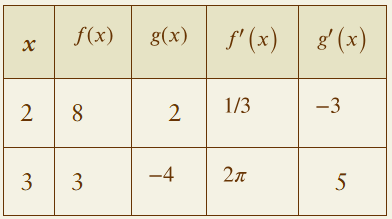
Suppose that functions f and g and their derivatives with respect to x have the following values at x = 2 and x = 3.


<IMAGE>


Find the derivatives with respect to x of the following combinations at the given value of x.


g. 1 / g²(x), x = 3

Verified step by step guidance
1
Step 1: Recall the derivative rule for the reciprocal of a function. If h(x) = 1 / g²(x), then h'(x) can be found using the chain rule and the power rule. Specifically, h'(x) = -2 * g(x)^(-3) * g'(x).
Step 2: Substitute the given value of x = 3 into the formula. From the table, g(x) = -4 and g'(x) = 5 at x = 3.
Step 3: Replace g(x) and g'(x) in the derivative formula. This gives h'(x) = -2 * (-4)^(-3) * 5.
Step 4: Simplify the expression step by step. First, calculate (-4)^(-3), which is the reciprocal of (-4)^3. Then multiply by -2 and g'(x).
Step 5: The simplified expression will give the derivative h'(x) at x = 3. Ensure all calculations are consistent with the rules of exponents and multiplication.

Verified video answer for a similar problem:

This video solution was recommended by our tutors as helpful for the problem above.
Video duration:
2m
Was this helpful?

Key Concepts

Here are the essential concepts you must grasp in order to answer the question correctly.

Chain Rule

The chain rule is a fundamental differentiation technique used when dealing with composite functions. It states that the derivative of a composite function f(g(x)) is f'(g(x)) * g'(x). In this problem, the chain rule helps differentiate expressions involving powers of functions, such as g²(x), by considering the derivative of the outer function and multiplying it by the derivative of the inner function.
Recommended video:
05:02
Intro to the Chain Rule

Power Rule

The power rule is a basic differentiation rule that states if f(x) = x^n, then f'(x) = n*x^(n-1). This rule is essential for finding the derivative of functions raised to a power, such as g²(x). In the context of the problem, it helps simplify the differentiation process by providing a straightforward method to handle powers of functions.
Recommended video:

Quotient Rule

The quotient rule is used to differentiate functions that are ratios of two other functions. It states that if h(x) = f(x)/g(x), then h'(x) = (f'(x)g(x) - f(x)g'(x))/g²(x). In this problem, the quotient rule is applied to find the derivative of 1/g²(x), which involves differentiating a function in the form of a reciprocal, requiring careful application of the rule to ensure accuracy.
Recommended video:
06:43
The Quotient Rule
Related Practice
Textbook Question

Analyzing Motion Using Graphs


[Technology Exercise] Exercises 31–34 give the position function s = f(t) of an object moving along the s-axis as a function of time t. Graph f together with the velocity function v(t) = ds/dt = f'(t) and the acceleration function a(t) = d²s/dt² = f''(t). Comment on the object’s behavior in relation to the signs and values of v and a. Include in your commentary such topics as the following:


f. When is it farthest from the axis origin?


s = t³ - 6t² + 7t, 0 ≤ t ≤ 4

223
views
Textbook Question

Suppose that the functions f and g and their derivatives with respect to x have the following values at x = 0 and x = 1.


" style="max-width: 100%; white-space-collapse: preserve;" width="250">


Find the derivatives with respect to x of the following combinations at the given value of x.


g. f(x + g(x)), x = 0

225
views
Textbook Question

Slopes and Tangent Lines


In Exercises 13–16, differentiate the functions and find the slope of the tangent line at the given value of the independent variable.


f(x) = x + 9/x, x = −3

160
views
Textbook Question

Finding Derivative Functions and Values 


Using the definition, calculate the derivatives of the functions in Exercises 1–6. Then find the values of the derivatives as specified.


p(θ) = √3θ; p′(1), p′(3), p′(2/3)

220
views
Textbook Question

Suppose that functions f and g and their derivatives with respect to x have the following values at x = 2 and x = 3.


" style="max-width: 100%; white-space-collapse: preserve;" width="250">


Find the derivatives with respect to x of the following combinations at the given value of x.


h. √(f²(x) + g²(x)), x = 2

290
views
Textbook Question

Suppose that functions ƒ(x) and g(x) and their first derivatives have the following values at x = 0 and x = 1.


x ƒ(x) g(x) ƒ'(x) g'(x)

0 1 1 -3 1/2

1 3 5 1/2 -4


Find the first derivatives of the following combinations at the given value of x.


g. ƒ(x + g(x)), x = 0

350
views