Ch. 4 - Applications of Derivatives
Hass - Thomas' Calculus 15th Edition
Hass15th EditionThomas' CalculusISBN: 9780137616077Not the one you use?Change textbook
Chapter 4, Problem 4.5.38b

38. What values of a and b make f(x) = x^3 + ax^2 + bx have
b. a local minimum at x = 4 and a point of inflection at x = 1?

Verified step by step guidance
1
To find the values of a and b, we need to use the conditions given: a local minimum at x = 4 and a point of inflection at x = 1.
First, find the first derivative of f(x): f'(x) = 3x^2 + 2ax + b. For a local minimum at x = 4, f'(4) must be 0.
Substitute x = 4 into f'(x) to get the equation: 3(4)^2 + 2a(4) + b = 0. Simplify this to find one equation in terms of a and b.
Next, find the second derivative of f(x): f''(x) = 6x + 2a. For a point of inflection at x = 1, f''(1) must be 0.
Substitute x = 1 into f''(x) to get the equation: 6(1) + 2a = 0. Solve this equation to find the value of a, and then use it in the first equation to find b.

Verified video answer for a similar problem:

This video solution was recommended by our tutors as helpful for the problem above.
Video duration:
5m
Was this helpful?

Key Concepts

Here are the essential concepts you must grasp in order to answer the question correctly.

Local Minimum

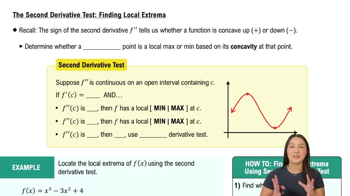
A local minimum of a function occurs at a point where the function value is lower than at nearby points. To find a local minimum, the first derivative of the function is set to zero, indicating a critical point, and the second derivative is checked to be positive, confirming a local minimum. In this problem, the function f(x) must have a local minimum at x = 4.
Recommended video:
06:02
The Second Derivative Test: Finding Local Extrema

Point of Inflection

A point of inflection is where the function's concavity changes, which can be identified by the second derivative. At a point of inflection, the second derivative is zero, but the sign of the second derivative changes around this point. For the function f(x), there must be a point of inflection at x = 1, meaning the second derivative changes sign at this point.
Recommended video:
04:50
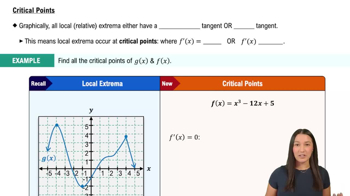
Critical Points

Derivatives

Derivatives are fundamental in calculus for analyzing the behavior of functions. The first derivative provides information about the slope and critical points, while the second derivative gives insights into concavity and points of inflection. Solving the problem requires calculating both the first and second derivatives of f(x) = x^3 + ax^2 + bx to find values of a and b that satisfy the given conditions.
Recommended video:
05:44
Derivatives
Related Practice
Textbook Question

Checking Antiderivative Formulas


Right, or wrong? Say which for each formula and give a brief reason for each answer.


∫xsinx dx = -x cos x + C

35
views

Textbook Question

[Technology Exercise] 16. Designing a box with a lid A piece of cardboard measures 10 in. by 15 in. Two equal squares are removed from the corners of a 10-in. side as shown in the figure. Two equal rectangles are removed from the other corners so that the tabs can be folded to form a rectangular box with lid.

" style="" width="335">

b. Find the domain of V for the problem situation and graph V over this domain.

222
views
Textbook Question

[Technology Exercise] 17. Designing a suitcase A 24-in.-by-36-in. sheet of cardboard is folded in half to form a 24-in.-by-18-in. rectangle as shown in the accompanying figure. Then four congruent squares of side length x are cut from the corners of the folded rectangle. The sheet is unfolded, and the six tabs are folded up to form a box with sides and a lid.

" style="" width="400">

b. Find the domain of V for the problem situation and graph V over this domain.

170
views
Textbook Question

Theory and Examples


Cubic functions Consider the cubic function f(x) = ax³ + bx² + cx + d.


b. How many local extreme values can f have?

267
views
Textbook Question

Finding Antiderivatives

In Exercises 1–16, find an antiderivative for each function. Do as many as you can mentally. Check your answers by differentiation.

x⁷

28
views
Textbook Question

Analyzing Functions from Derivatives


Answer the following questions about the functions whose derivatives are given in Exercises 1–14:


b. On what open intervals is f increasing or decreasing?


f′(x) = 1− 4/x², x ≠ 0

161
views