
Textbook Question
In Exercises 1–10, find the extreme values (absolute and local) of the function over its natural domain, and where they occur.
y = (𝓍 + 1) / (𝓍² + 2𝓍 + 2)
212
views

 Verified step by step guidance
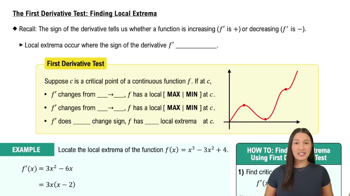
 07:09
07:09
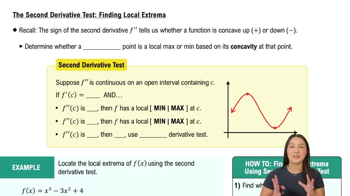 06:02
06:02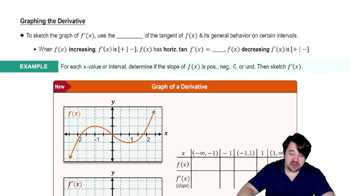 06:15
06:15In Exercises 1–10, find the extreme values (absolute and local) of the function over its natural domain, and where they occur.
y = (𝓍 + 1) / (𝓍² + 2𝓍 + 2)
6. You are planning to close off a corner of the first quadrant with a line segment 20 units long running from (a, 0) to (0,b). Show that the area of the triangle enclosed by the segment is largest when a = b.
Initial Value Problems
Solve the initial value problems in Exercises 71–90.
dy/dx = 2x − 7, y(2) = 0
Finding Position from Velocity or Acceleration
Exercises 45–48 give the acceleration a=d²s/dt², initial velocity, and initial position of an object moving on a coordinate line. Find the object’s position at time t.
a = 9.8, v(0) = −3, s(0) = 0
Finding Functions from Derivatives
Suppose that f(0) = 5 and that f'(x) = 2 for all x. Must f(x) = 2x + 5 for all x? Give reasons for your answer.
Finding Indefinite Integrals
In Exercises 17–56, find the most general antiderivative or indefinite integral. You may need to try a solution and then adjust your guess. Check your answers by differentiation.
∫(√x + ³√x) dx