
Ch. 4 - Applications of Derivatives
Hass - Thomas' Calculus 15th Edition
Hass15th EditionThomas' CalculusISBN: 9780137616077Not the one you use?Change textbook
Chapter 4, Problem 4.4.77

Each of Exercises 67–88 gives the first derivative of a continuous function y=f(x). Find y'' and then use Steps 2–4 of the graphing procedure described in this section to sketch the general shape of the graph of f.
77. y' = cot(θ/2), for 0 < θ < 2π

Verified step by step guidance
1
Step 1: To find the second derivative y'', start by differentiating the given first derivative y' = cot(θ/2). Use the chain rule and the derivative of cot(x), which is -csc²(x). Specifically, differentiate cot(θ/2) with respect to θ.
Step 2: Apply the chain rule to account for the inner function θ/2. The derivative of θ/2 with respect to θ is 1/2. Combine this with the derivative of cot(θ/2) to find y''.
Step 3: Simplify the expression for y'' to obtain y'' = -(1/2)csc²(θ/2). This represents the second derivative of the function.
Step 4: Analyze the behavior of y'' to determine concavity. Recall that if y'' > 0, the graph of f is concave up, and if y'' < 0, the graph of f is concave down. Use the interval 0 < θ < 2π to identify regions of concavity based on the sign of y''.
Step 5: Combine the information from y' and y'' to sketch the general shape of the graph of f. Use the critical points (where y' = 0), inflection points (where y'' changes sign), and the concavity analysis to create a rough sketch of the graph.

Verified video answer for a similar problem:

This video solution was recommended by our tutors as helpful for the problem above.
Video duration:
9m
Was this helpful?

Key Concepts

Here are the essential concepts you must grasp in order to answer the question correctly.

First Derivative

The first derivative of a function, denoted as y' or f'(x), represents the rate of change of the function with respect to its variable. It provides information about the slope of the tangent line to the graph of the function at any given point. Understanding the first derivative is crucial for determining critical points, where the function may have local maxima or minima.
Recommended video:
07:09
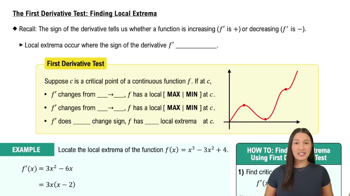
The First Derivative Test: Finding Local Extrema

Second Derivative

The second derivative, denoted as y'' or f''(x), is the derivative of the first derivative. It indicates the rate of change of the slope of the function, providing insights into the concavity of the graph. A positive second derivative suggests the graph is concave up, while a negative second derivative indicates concave down, which is essential for sketching the function's general shape.
Recommended video:
06:02
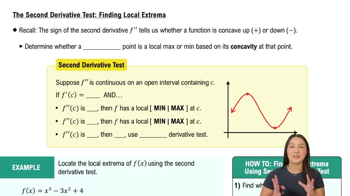
The Second Derivative Test: Finding Local Extrema

Graphing Procedure

The graphing procedure involves analyzing the first and second derivatives to sketch the function's graph accurately. Steps typically include identifying critical points, determining intervals of increase or decrease, and assessing concavity. This systematic approach helps in visualizing the behavior of the function, including its turning points and inflection points, leading to a more complete understanding of its overall shape.
Recommended video:
06:15
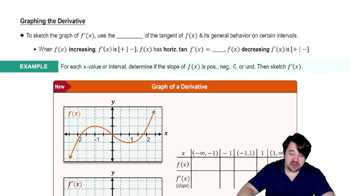
Graphing The Derivative
Related Practice
Textbook Question

In Exercises 9–66, graph the function using appropriate methods from the graphing procedures presented just before Example 9, identifying the coordinates of any local extreme points and inflection points. Then find coordinates of absolute extreme points, if any.

39. y = 8 / (x² + 4) (Witch of Agnesi)

102
views
Textbook Question

Finding Indefinite Integrals


In Exercises 17–56, find the most general antiderivative or indefinite integral. You may need to try a solution and then adjust your guess. Check your answers by differentiation.


∫(3t² + t/2) dt

29
views
Textbook Question

The intensity of illumination at any point from a light source is proportional to the square of the reciprocal of the distance between the point and the light source. Two lights, one having an intensity eight times that of the other, are 6 m apart. How far from the stronger light is the total illumination least?

250
views
Textbook Question

Finding Indefinite Integrals


In Exercises 17–56, find the most general antiderivative or indefinite integral. You may need to try a solution and then adjust your guess. Check your answers by differentiation.


∫(1 − cot²x) dx

35
views
Textbook Question

Finding Indefinite Integrals


In Exercises 17–56, find the most general antiderivative or indefinite integral. You may need to try a solution and then adjust your guess. Check your answers by differentiation.


∫(t√t + √t) / t² dt

30
views
Textbook Question

Initial Value Problems


Solve the initial value problems in Exercises 71–90.


dy/dx = 1/x² + x, x > 0; y(2) = 1

14
views