
Textbook Question
Identifying Extrema
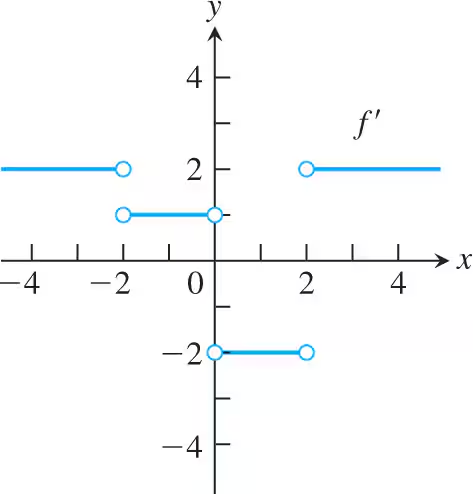
In Exercises 61 and 62, the graph of f' is given. Assume that f is continuous, and determine the x-values corresponding to local minima and local maxima.
178
views

 Verified step by step guidance
 04:50
04:50
 07:09
07:09 05:34
05:34Identifying Extrema
In Exercises 61 and 62, the graph of f' is given. Assume that f is continuous, and determine the x-values corresponding to local minima and local maxima.
In Exercises 1–10, find the extreme values (absolute and local) of the function over its natural domain, and where they occur.
______
y = √𝓍² ― 1
54. Fermat’s principle in optics Light from a source A is reflected by a plane mirror to a receiver at point B, as shown in the accompanying figure. Show that for the light to obey Fermat’s principle, the angle of incidence must equal the angle of reflection, both measured from the line normal to the reflecting surface. (This result can also be derived without calculus. There is a purely geometric argument, which you may prefer.)
Identify the inflection points and local maxima and minima of the functions graphed in Exercises 1–8. Identify the open intervals on which the functions are differentiable and the graphs are concave up and concave down.
2. y=x^4/4-2x^2+4
Absolute Extrema on Finite Closed Intervals
In Exercises 21–36, find the absolute maximum and minimum values of each function on the given interval. Then graph the function. Identify the points on the graph where the absolute extrema occur, and include their coordinates.
f(t) = 2 − |t|, −1 ≤ t ≤ 3
Initial Value Problems
Find the curve y = f(x) in the xy-plane that passes through the point (9,4) and whose slope at each point is 3√x.