
Textbook Question
Applications
Suppose that f(x) = d/dx (1 − √x) and g(x) = d/dx (x + 2).
Find:
∫f(x) dx
24
views

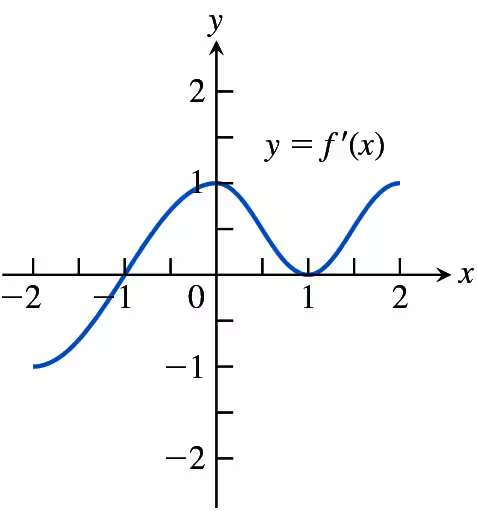
 Verified step by step guidance
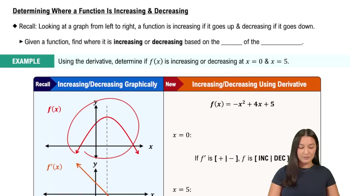
 07:32
07:32
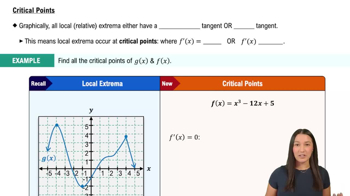 04:50
04:50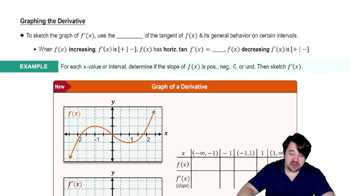 06:15
06:15Applications
Suppose that f(x) = d/dx (1 − √x) and g(x) = d/dx (x + 2).
Find:
∫f(x) dx
Checking Antiderivative Formulas
Right, or wrong? Say which for each formula and give a brief reason for each answer.
∫√(2x + 1) dx = √(x² + x +C)
Finding Indefinite Integrals
Find the indefinite integrals (most general antiderivatives) in Exercises 73–88. You may need to try a solution and then adjust your guess. Check your answers by differentiation.
∫ 1/( r + 5)²dr
Identifying Extrema
In Exercises 41–52:
a. Identify the function’s local extreme values in the given domain, and say where they occur.
f(t) = 12t − t³, −3 ≤ t < ∞
Finding Antiderivatives
In Exercises 1–16, find an antiderivative for each function. Do as many as you can mentally. Check your answers by differentiation.
2x
Identifying Extrema
In Exercises 41–52:
a. Identify the function’s local extreme values in the given domain, and say where they occur.
f(t) = t³ − 3t², −∞ < t ≤ 3