 Back
BackAerobic Respiration and the Mitochondrion: Citric Acid Cycle, Electron Transport Chain, and ATP Synthesis
Study Guide - Smart Notes
 Tailored notes based on your materials, expanded with key definitions, examples, and context.
Aerobic Respiration & The Mitochondrion
Cellular Respiration: Definition and Overview
Cellular respiration is the process by which cells extract energy from nutrients through the flow of electrons from reduced coenzymes (such as NADH and FADH2) to an external electron acceptor, typically oxygen. This process results in the production of ATP, the cell’s primary energy currency.
Fermentation (Anaerobic): Utilizes internal electron acceptors (e.g., pyruvate), produces little ATP, and does not fully oxidize substrates.
Aerobic Respiration: Utilizes oxygen as the external electron acceptor, allows complete oxidation of glucose, and produces significantly more ATP.
Key Point: Oxygen’s high electronegativity enables continuous electron flow, preventing NADH accumulation and maintaining ATP production.
Stages of Aerobic Respiration
Aerobic respiration consists of five distinct stages, each contributing to the overall energy yield:
Glycolysis (Cytosol): Glucose is converted to pyruvate, producing 2 ATP and NADH.
Pyruvate Oxidation (Mitochondrial Matrix): Pyruvate is converted to acetyl-CoA, generating NADH and CO2.
Citric Acid Cycle (Matrix): Acetyl-CoA is fully oxidized to CO2, producing NADH, FADH2, and a small amount of ATP.
Electron Transport Chain (Inner Membrane): NADH and FADH2 donate electrons to oxygen, creating a proton gradient across the membrane.
Oxidative Phosphorylation: The proton gradient drives ATP synthase, resulting in the bulk of ATP production.
Mitochondrion: Structure and Function
The mitochondrion is the primary site of aerobic respiration, often referred to as the “powerhouse” of the cell. Its structure is specialized for efficient energy production:
Outer Membrane: Contains porins, allowing passage of small molecules.
Inner Membrane: Highly selective, houses the electron transport chain and ATP synthase, and is folded into cristae to increase surface area.
Intermembrane Space: Location where protons accumulate during electron transport.
Matrix: Contains enzymes for the citric acid cycle, pyruvate oxidation, mitochondrial DNA, and ribosomes.
Cristae maximize ATP production by increasing membrane surface area and providing sites for electron transport chain proteins.
Endosymbiosis and Mitochondrial Origin
Mitochondria are believed to have originated from bacteria via endosymbiosis, supported by their double membrane, circular DNA, bacterial-like ribosomes, and similar electron transport chain arrangements.
Protein Import into Mitochondria
Most mitochondrial proteins are encoded by nuclear DNA and synthesized in the cytosol. They are imported into mitochondria via a transit sequence and specialized translocase complexes:
TOM (Translocase of Outer Membrane): Recognizes and transports proteins across the outer membrane.
TIM (Translocase of Inner Membrane): Facilitates protein passage into the matrix.
Import requires ATP and chaperones to maintain protein folding.
ATP Synthase: Structure and Function
ATP synthase, located in the inner mitochondrial membrane, consists of two main components:
F0: Embedded in the membrane, forms a proton channel.
F1: Projects into the matrix, synthesizes ATP.
Proton flow through F0 causes F1 to rotate, catalyzing ATP formation from ADP and inorganic phosphate.
Mitochondrial Functions by Compartment
Outer Membrane: Fatty acid modification, phospholipid synthesis.
Inner Membrane: Electron transport, proton pumping, oxidative phosphorylation, transport proteins.
Matrix: Pyruvate oxidation, citric acid cycle, β-oxidation of fats, mtDNA replication, transcription, translation.
Bacteria vs. Mitochondria
Bacteria lack mitochondria but perform similar functions:
Cytoplasm: Analogous to mitochondrial matrix.
Plasma Membrane: Functions like the inner mitochondrial membrane, with embedded ATP synthase.
This similarity supports the endosymbiosis theory.
Citric Acid Cycle (Krebs/TCA Cycle)
Overview and Purpose
The citric acid cycle, also known as the Krebs or TCA cycle, is a central metabolic pathway that fully oxidizes carbon from pyruvate to CO2 and stores released energy in NADH and FADH2. It occurs in the mitochondrial matrix of eukaryotes.
Inputs: Acetyl-CoA, oxaloacetate, NAD+, FAD, ADP + Pi
Outputs: 2 CO2, 3 NADH, 1 FADH2, 1 ATP (or GTP), oxaloacetate (regenerated)
Important: The CO2 released is not from the acetyl group that just entered.
Cycle Steps and Key Enzymes
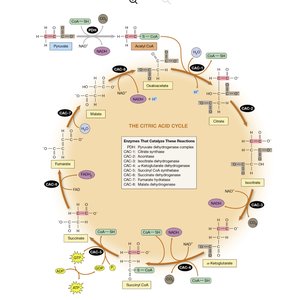
Entry/Condensation: Acetyl-CoA (2C) + oxaloacetate (4C) → citrate (6C)
Rearrangement: Citrate → isocitrate
Oxidative Decarboxylations: Isocitrate → α-ketoglutarate (NADH, CO2); α-ketoglutarate → succinyl-CoA (NADH, CO2, thioester bond)
Substrate-level Phosphorylation: Succinyl-CoA → succinate (GTP/ATP)
Regeneration: Succinate → fumarate (FADH2); fumarate → malate; malate → oxaloacetate (NADH)
Regulation: High ATP, NADH, and acetyl-CoA inhibit; high ADP/AMP and NAD+ activate. PDH is regulated by phosphorylation.
Citric Acid Cycle Diagram
The following diagram illustrates the steps, intermediates, and enzymes of the citric acid cycle:
Metabolic Integration: Fats and Proteins
Fats: Broken into glycerol (enters glycolysis) and fatty acids (β-oxidation yields acetyl-CoA, NADH, FADH2).
Proteins: Amino acids converted to pyruvate, acetyl-CoA, or TCA intermediates.
Amphibolic Pathway: The citric acid cycle is both catabolic (energy extraction) and anabolic (provides precursors for biosynthesis).
Glyoxylate Cycle (Plants, Fungi, Bacteria)
The glyoxylate cycle allows conversion of fats to sugars by bypassing CO2-releasing steps, producing succinate for gluconeogenesis. Occurs in glyoxysomes.
Electron Transport Chain (ETC)
Purpose and Location
The ETC is the site of major ATP production, using electrons from NADH and FADH2 to power proton pumping and drive ATP synthase. It is located in the inner mitochondrial membrane (eukaryotes) or plasma membrane (bacteria).
Electron Carriers
Flavoproteins (FMN/FAD): Accept electrons and protons; found in Complex I and II.
Iron-sulfur proteins (Fe-S): Carry one electron at a time.
Cytochromes: Heme proteins, carry one electron; cytochrome c is mobile.
Copper centers: In Complex IV, transfer electrons to oxygen.
Coenzyme Q (ubiquinone): Non-protein carrier, moves within membrane, carries electrons and protons.
Main ETC Complexes and Proton Pumping
Complex I (NADH dehydrogenase): Accepts electrons from NADH, passes to CoQ, pumps 4 H+.
Complex II (succinate dehydrogenase): Accepts electrons from FADH2, passes to CoQ, no proton pumping.
Complex III (cytochrome bc1): Accepts electrons from CoQH2, passes to cytochrome c, pumps 4 H+.
Complex IV (cytochrome c oxidase): Accepts electrons from cytochrome c, transfers to O2, pumps 2 H+.
Proton Pumping Totals:
From NADH: 10 H+ pumped (Complex I + III + IV)
From FADH2: 6 H+ pumped (Complex II + III + IV)
This difference explains why NADH yields more ATP than FADH2.
Proton Gradient and ATP Synthesis
Protons pumped into the intermembrane space create a gradient, storing energy like a battery. ATP synthase uses this gradient to synthesize ATP in a process called oxidative phosphorylation.
ETC Poisons
Cyanide and azide inhibit Complex IV, halting electron flow, preventing proton gradient formation, and stopping ATP production—resulting in cell death.
Key Equations
ATP Synthesis:
Pyruvate Oxidation:
Citric Acid Cycle (per turn):
Electron Transport:
Example: In heart and muscle cells, abundant cristae maximize ATP production to meet high energy demands.
Additional info: The citric acid cycle diagram included above visually reinforces the stepwise reactions, enzyme names, and coenzyme yields, directly supporting the textual explanation of the cycle’s structure and function.
