 Back
BackAerobic Respiration: The Complete Oxidation of Glucose in Eukaryotic Cells
Study Guide - Smart Notes
 Tailored notes based on your materials, expanded with key definitions, examples, and context.
Aerobic Respiration Overview
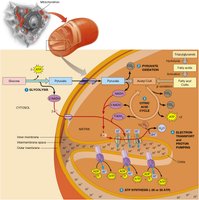
Aerobic respiration is the process by which cells use oxygen to fully oxidize glucose, generating carbon dioxide, water, and large amounts of ATP. This process is central to cellular energy metabolism and occurs in several distinct stages, each catalyzed by specific enzymes and protein complexes within the cytosol and mitochondria.
Location: Begins in the cytosol (glycolysis), continues in the mitochondrial matrix (pyruvate oxidation, citric acid cycle), and concludes at the inner mitochondrial membrane (electron transport chain and ATP synthesis).
Overall Reaction:
Step I: Glycolysis
Conversion of Glucose to Pyruvate
Glycolysis is the initial pathway of glucose catabolism, occurring in the cytosol. It converts one molecule of glucose (6 carbons) into two molecules of pyruvate (3 carbons each), producing a small amount of ATP and NADH.
Location: Cytosol
Net Yield per Glucose: 2 ATP, 2 NADH, 2 Pyruvate
Key Points:
Does not require oxygen (anaerobic process)
Prepares substrates for mitochondrial oxidation
Step II: Pyruvate Oxidation
Transport and Conversion to Acetyl CoA
After glycolysis, pyruvate is transported into the mitochondrial matrix. This involves crossing both the outer and inner mitochondrial membranes:
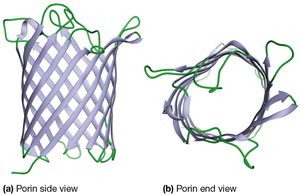
Outer Membrane: Pyruvate passes through porins (large, barrel-shaped proteins that allow small molecules to diffuse).
Inner Membrane: Pyruvate is transported via a specific symporter into the matrix.
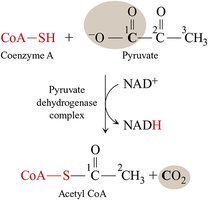
Once inside the matrix, pyruvate undergoes oxidative decarboxylation by the pyruvate dehydrogenase complex:
Reaction:
Yield per Glucose: 2 NADH (1 per pyruvate)
Step III: Citric Acid Cycle (Krebs Cycle, TCA Cycle)
Complete Oxidation of Acetyl CoA
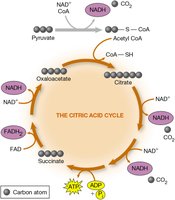
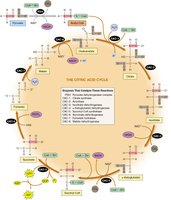
The citric acid cycle is a series of enzyme-catalyzed reactions in the mitochondrial matrix that fully oxidize the acetyl group of Acetyl CoA to CO2. Electrons are transferred to NAD+ and FAD, forming NADH and FADH2.
Key Steps:
Acetyl CoA (2C) combines with oxaloacetate (4C) to form citrate (6C).
Two decarboxylation steps release 2 CO2 per cycle.
Four oxidation steps transfer electrons to NAD+ (3 times) and FAD (once).
One substrate-level phosphorylation produces ATP (or GTP in animals).
Yield per Glucose (2 cycles): 6 NADH, 2 FADH2, 2 ATP, 4 CO2
Step IV: Electron Transport Chain (ETC)
Generation of the Proton Gradient
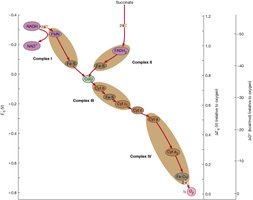
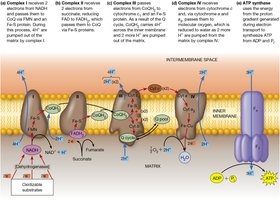
The electron transport chain is a series of protein complexes and mobile carriers embedded in the inner mitochondrial membrane. Electrons from NADH and FADH2 are transferred through these complexes to molecular oxygen, the final electron acceptor, forming water. The energy released is used to pump protons from the matrix to the intermembrane space, creating an electrochemical gradient (proton motive force).
Main Complexes: I (NADH dehydrogenase), II (succinate dehydrogenase), III (cytochrome bc1), IV (cytochrome c oxidase)
Mobile Carriers: Coenzyme Q (ubiquinone), cytochrome c
Proton Pumping: About 10 protons are pumped per pair of electrons from NADH
Redox Potential: Electrons flow from carriers with lower to higher redox potential, ending with oxygen (highest affinity for electrons)
Step V: ATP Synthesis (Oxidative Phosphorylation)
ATP Synthase and Chemiosmotic Coupling
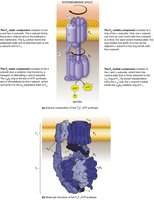
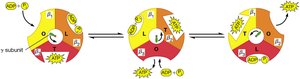
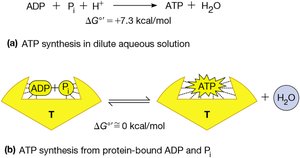
The proton gradient generated by the ETC drives protons back into the matrix through ATP synthase, a large enzyme complex that synthesizes ATP from ADP and inorganic phosphate (Pi). This process is called oxidative phosphorylation.
ATP Synthase Structure: Composed of F0 (membrane-embedded, proton channel) and F1 (catalytic, matrix-facing) subunits
Mechanism: Proton flow causes rotation of the F0 subunit, inducing conformational changes in F1 that catalyze ATP formation
Yield: Approximately 3-4 protons are required to synthesize one ATP molecule
Summary of ATP Yield from Aerobic Respiration
The complete oxidation of one glucose molecule by aerobic respiration yields a maximum of 38 ATP molecules, as summarized below:
Stage | ATP Produced (substrate-level) | NADH Produced | FADH2 Produced |
|---|---|---|---|
Glycolysis | 2 | 2 | 0 |
Pyruvate Oxidation | 0 | 2 | 0 |
Citric Acid Cycle | 2 | 6 | 2 |
Oxidative Phosphorylation (from NADH/FADH2) | 34 | - | - |
Total | 38 | 10 | 2 |

Key Equations
Overall Reaction:
Electron Carrier Oxidation: ,
ATP Synthesis: , (in solution)
Additional info:
Actual ATP yield may be slightly lower in eukaryotic cells due to transport costs and leaky membranes.
Oxidative phosphorylation is tightly regulated by the availability of ADP, oxygen, and substrates.
Defects in any step of this pathway can lead to severe metabolic diseases.
