 Back
BackBioenergetics and Glycolysis: Cellular Energy Metabolism Study Notes
Study Guide - Smart Notes
 Tailored notes based on your materials, expanded with key definitions, examples, and context.
Bioenergetics: The Flow of Energy in the Cell
Metabolism: Catabolism and Anabolism
Metabolism encompasses all chemical reactions occurring within a cell, divided into two main categories: catabolism and anabolism. Catabolic reactions break down molecules, releasing energy, while anabolic reactions synthesize complex molecules, requiring energy input.
Catabolism: Breakdown of molecules, increases entropy (S), exergonic, spontaneous.
Anabolism: Synthesis of molecules, decreases entropy (S), endergonic, nonspontaneous.
Metabolism: The sum of catabolic and anabolic reactions.
Example: Cellular respiration (catabolic) and protein synthesis (anabolic).
Adenosine Triphosphate (ATP): Structure and Function
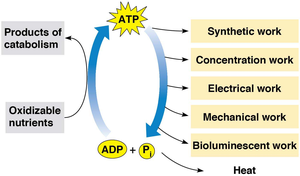
ATP is the primary energy currency of the cell, linking catabolic and anabolic processes. Hydrolysis of the terminal phosphate group releases energy, making ATP central to cellular energy transfer.
Phosphoanhydride bonds: Located between the three phosphate groups; hydrolysis releases significant energy.
Phosphoester bond: Between phosphate and sugar; releases less energy upon hydrolysis.
ATP hydrolysis:
AMP hydrolysis:
ATP's intermediate position: Can both donate and accept phosphate groups in metabolic reactions.
Why is ATP Hydrolysis Exergonic?
ATP hydrolysis is highly exergonic due to three main factors:
Charge repulsion: Three negatively charged phosphate groups repel each other.
Resonance stabilization: Hydrolysis products (ADP and Pi) are more stabilized by resonance than ATP.
Increased entropy: Hydrolysis produces two molecules from one, increasing disorder.
Phosphoanhydride vs. Phosphoester Bonds
Phosphoanhydride bonds (between phosphates) release more energy than phosphoester bonds (between phosphate and sugar) due to greater resonance stabilization and charge repulsion in the products.
Phosphoanhydride: Both products are resonance stabilized and charged.
Phosphoester: Only one product is resonance stabilized and charged.
ATP in Cellular Work
ATP is used to drive various types of cellular work, including synthetic, concentration, electrical, mechanical, and bioluminescent work.
Synthetic work: Building macromolecules.
Concentration work: Transporting molecules against gradients.
Electrical work: Maintaining membrane potentials.
Mechanical work: Muscle contraction, movement.
Bioluminescent work: Light production in organisms.
Chemotropic Energy Metabolism: Glycolysis and Fermentation
Redox Reactions and NAD+
Redox reactions involve the transfer of electrons. Reduction is the gain of electrons (RIG: Reduction Is Gain), while oxidation is the loss of electrons (OIL: Oxidation Is Loss). In biological systems, oxidation often removes both electrons and protons (hydrogen atoms).
NAD+: A coenzyme that stores energy by accepting electrons and protons, forming NADH.
Dehydrogenases: Enzymes that catalyze dehydrogenation (removal of hydrogen atoms).
Glucose oxidation: Glucose loses electrons to NAD+, which is reduced to NADH.
Overall reaction:
Organisms Classified by Oxygen Requirements
Organisms are categorized based on their oxygen requirements:
Obligate aerobes: Require oxygen for survival.
Obligate anaerobes: Oxygen is toxic; survive without it (e.g., certain bacteria and archaea).
Facultative anaerobes: Can survive with or without oxygen, but prefer aerobic conditions (e.g., some bacteria and fungi).
Glycolysis: Overview and Bioenergetics
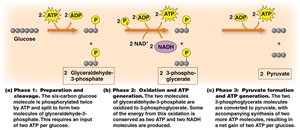
Glycolysis is a universal pathway occurring in the cytosol, converting glucose (6 carbons) into two pyruvate molecules (3 carbons each). It does not require oxygen and generates ATP and NADH.
Location: Cytosol (or glycosomes in some organisms).
Products: 2 pyruvate, 2 NADH, 2 net ATP per glucose.
Phases: Preparation and cleavage, oxidation and ATP generation, pyruvate formation and ATP generation.
Phase 1: Preparation and Cleavage
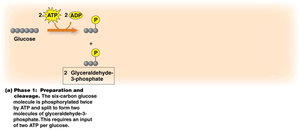
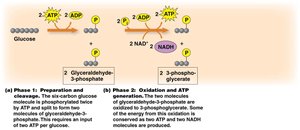
In the first phase, glucose is phosphorylated twice by ATP and split into two molecules of glyceraldehyde-3-phosphate (G3P). This phase requires an input of two ATP per glucose.
Hexokinase: Catalyzes phosphorylation of glucose to glucose-6-phosphate (G6P).
Phosphofructokinase-1: Converts G6P to fructose-6-phosphate (F6P) and phosphorylates it.
Cleavage: F16BP is split into two 3-carbon molecules.
Phase 2: Oxidation and ATP Generation
G3P is oxidized, reducing NAD+ to NADH and generating a doubly phosphorylated intermediate. ATP is produced via substrate-level phosphorylation.
G3P dehydrogenase: Catalyzes oxidation of G3P, reducing NAD+ to NADH.
Substrate-level phosphorylation: Direct transfer of phosphate from substrate to ADP, forming ATP.
ΔG°’ for ATP production:
Phase 3: Pyruvate Formation and ATP Generation
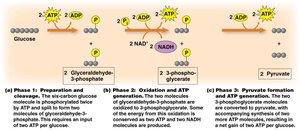
Phosphate is rearranged to form a high-energy intermediate (phosphoenolpyruvate, PEP), which donates its phosphate to ADP, generating ATP and pyruvate.
PEP: High-energy intermediate; its hydrolysis is highly exergonic ().
Pyruvate kinase: Catalyzes transfer of phosphate from PEP to ADP.
End products: 2 pyruvate, 2 NADH, 4 ATP (gross), 2 ATP (net).
Glycolysis Summary
Glycolysis is a central pathway in cellular metabolism, providing energy and metabolic intermediates. The net result is the oxidation of one glucose molecule to two pyruvate, with a net gain of two ATP and two NADH.
Used: 1 glucose, 2 ATP
Generated: 2 pyruvate, 2 NADH, 4 ATP (gross), 2 ATP (net)
ΔG’:
Summary Table: Comparison of Catabolism and Anabolism
Process | Direction | Entropy (S) | Energetics | Spontaneity |
|---|---|---|---|---|
Catabolism | Breakdown | Increases | Exergonic | Spontaneous |
Anabolism | Synthesis | Decreases | Endergonic | Nonspontaneous |
Additional info:
Glycolysis is the first step in both aerobic and anaerobic respiration.
NADH produced in glycolysis can be used in further metabolic pathways (e.g., fermentation or oxidative phosphorylation).
ATP is not only an energy carrier but also a regulator of metabolic pathways.
