 Back
BackCell Signaling: Mechanisms and Pathways
Study Guide - Smart Notes
 Tailored notes based on your materials, expanded with key definitions, examples, and context.
Cell Signaling Cascades
Overview of Cell Signaling
Cell signaling is a fundamental process by which cells communicate with each other and respond to their environment. It involves the transmission of signals from the exterior to the interior of the cell, resulting in specific cellular responses.
Extracellular signal molecules bind to receptor proteins on the cell surface.
Receptor activation triggers intracellular signaling molecules that relay and amplify the signal.
Effector proteins mediate the final cellular response, such as changes in metabolism, gene expression, or cell shape.
Cell signaling can alter metabolism, gene expression, and cell movement.
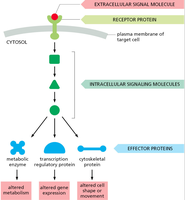
Forms of Intracellular Signaling
Types of Cell Communication
Cells use several distinct mechanisms to communicate, each suited to different biological contexts.
Contact-dependent signaling: Requires direct contact between signaling and target cells via membrane-bound molecules.
Paracrine signaling: Local mediators are released and affect nearby cells.
Synaptic signaling: Neurons release neurotransmitters across synapses to target cells.
Endocrine signaling: Hormones are secreted into the bloodstream and act on distant target cells.
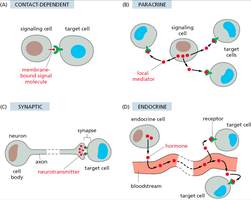
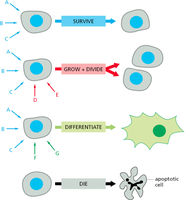
Dependence on Multiple Extracellular Cues
Cell Fate Determination
Cells often rely on multiple signals to determine their fate, such as survival, growth, differentiation, or apoptosis.
Different combinations of signals can induce survival, division, differentiation, or cell death.
The same cell may respond differently to the same signal depending on context and other cues.
Main Classes of Cell Surface Receptors
Types of Receptors
Cell surface receptors are specialized proteins that detect extracellular signals and initiate intracellular responses.
Ion-channel-coupled receptors: Open or close ion channels in response to signal molecules, altering membrane potential.
G-protein-coupled receptors (GPCRs): Activate G proteins, which then regulate various intracellular pathways.
Enzyme-coupled receptors: Possess intrinsic enzymatic activity or associate with enzymes upon activation.
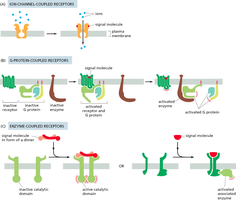
Signaling Proteins as Molecular Switches
Mechanisms of Signal Regulation
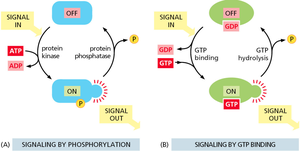
Signaling proteins often act as molecular switches, toggling between active and inactive states in response to signals.
Phosphorylation: Protein kinases add phosphate groups (using ATP), activating or deactivating proteins. Protein phosphatases remove phosphates.
GTP binding: GTPases switch between active (GTP-bound) and inactive (GDP-bound) states.
Regulation of Signaling Molecules
Monomeric GTPases
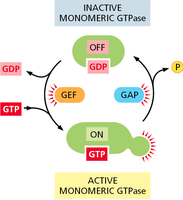
Monomeric GTPases are regulated by guanine nucleotide exchange factors (GEFs) and GTPase-activating proteins (GAPs).
GEFs: Promote exchange of GDP for GTP, activating the GTPase.
GAPs: Stimulate GTP hydrolysis, inactivating the GTPase.
Reversal of Inhibition by Phosphorylation
Gene Expression Regulation
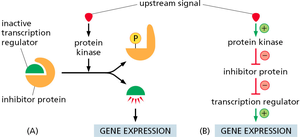
Phosphorylation can relieve inhibition of transcription regulators, allowing gene expression.
Protein kinases phosphorylate inhibitor proteins, releasing transcription regulators.
Gene expression is activated as a result.
Signaling Complex Assembly
Mechanisms of Complex Formation
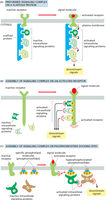
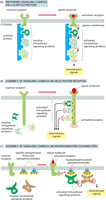
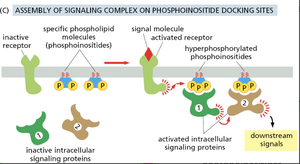
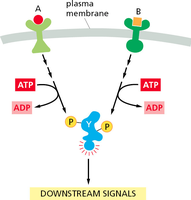
Signaling complexes assemble at the plasma membrane in response to receptor activation, facilitating efficient signal transduction.
Complexes can form on scaffold proteins, activated receptors, or phosphoinositide docking sites.
Assembly ensures spatial and temporal regulation of signaling pathways.
Modular Interaction Domains
Protein-Protein Interactions in Signaling
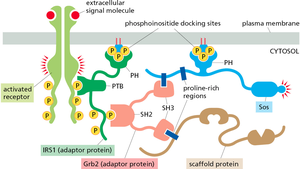
Signaling proteins often contain modular domains that mediate specific interactions, such as SH2, SH3, PH, and PTB domains.
These domains recognize phosphorylated residues or proline-rich regions, enabling assembly of signaling complexes.
Adaptor and scaffold proteins organize signaling networks.
Receptor Clusters Mediated by Multivalent Interactions
Cluster Formation and Signal Amplification
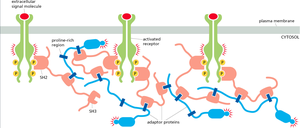
Multivalent interactions between receptors and adaptor proteins can lead to receptor clustering, amplifying the signal.
Clusters enhance the efficiency and specificity of signal transduction.
Scaffold proteins facilitate the formation of large signaling complexes.
Signaling Integration
Integration of Multiple Signals
Cells integrate signals from multiple pathways to produce coordinated responses.
Signaling integration allows cells to respond appropriately to complex environments.
Downstream signals can be modulated by the combined input from different receptors.
Signaling Processing in Relation to Response
Temporal Dynamics of Cell Signaling
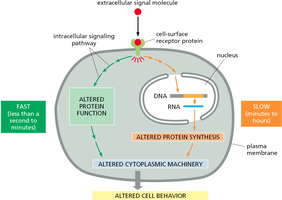
Cellular responses to signaling can be fast or slow, depending on the pathway and the nature of the signal.
Fast responses (seconds to minutes) typically involve changes in protein function.
Slow responses (minutes to hours) involve changes in gene expression and protein synthesis.
Response Curves in Cell Signaling
Types of Response Curves
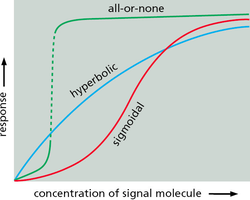
The relationship between signal concentration and cellular response can be described by different types of curves.
Hyperbolic: Gradual increase in response with increasing signal.
Sigmoidal: Threshold effect, with a sharp increase after a certain concentration.
All-or-none: Abrupt switch from no response to full response.
Summary Table: Main Classes of Cell Surface Receptors
Comparison of Receptor Types
Receptor Type | Mechanism | Example |
|---|---|---|
Ion-channel-coupled | Opens/closes ion channels | Neurotransmitter receptors |
G-protein-coupled | Activates G proteins | Adrenergic receptors |
Enzyme-coupled | Intrinsic or associated enzyme activity | Receptor tyrosine kinases |
Key Equations
Phosphorylation and GTPase Cycle
Phosphorylation:
GTPase Cycle:
GTP Hydrolysis:
