 Back
BackChemotropic Energy Metabolism: Glycolysis and Fermentation – Study Notes
Study Guide - Smart Notes
 Tailored notes based on your materials, expanded with key definitions, examples, and context.
CHAPTER 9 - Chemotropic Energy Metabolism: Glycolysis and Fermentation
Learning Objectives
This chapter explores the fundamental processes by which cells extract energy from organic molecules, focusing on glycolysis and fermentation. Key objectives include understanding bioenergetics, classifying metabolic pathways, analyzing ATP structure and function, and describing the regulation and outcomes of glycolysis and fermentation.
Bioenergetics: Application of thermodynamic laws to cellular energy transformations.
Metabolic Pathways: Classification as anabolic (synthetic) or catabolic (degradative).
ATP: Structure and function as a universal energy coupler.
Glycolysis: Breakdown of glucose, ATP and NADH yield.
Fermentation: Catabolism of pyruvate in absence of oxygen.
Enzyme Regulation: Role of glycolytic enzymes in metabolism and cellular regulation.
Metabolic Pathways
Anabolic and Catabolic Pathways
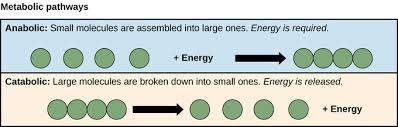
Metabolic pathways are organized as either anabolic or catabolic. Anabolic pathways build complex molecules from simpler ones, requiring energy input, while catabolic pathways break down complex molecules, releasing energy.
Anabolic reactions: Endergonic, involve reduction reactions, require energy.
Catabolic reactions: Exergonic, involve oxidation reactions, release energy.
Interdependence: Catabolism provides energy for anabolism.
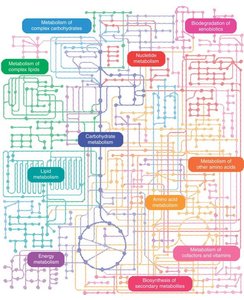
Overview of Cellular Metabolism
Cellular metabolism encompasses a complex network of interconnected pathways, including carbohydrate, lipid, nucleotide, and amino acid metabolism.
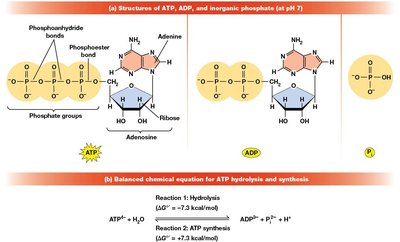
ATP: The Primary Energy Molecule in Cells
Structure and Function of ATP
ATP (adenosine triphosphate) is the universal energy currency in cells. Its terminal phosphoanhydride bond has an intermediate free energy of hydrolysis, making ATP an effective donor and acceptor of phosphate groups.
ATP hydrolysis: Releases energy for cellular processes.
ADP: Can accept phosphate groups to regenerate ATP.
Energy coupling: ATP links exergonic and endergonic reactions.
Key equation:
Chemotrophic Energy Metabolism
Energy Generation in Chemotrophs
Most chemotrophs generate ATP by catabolizing organic nutrients. This occurs via fermentation (anaerobic) or aerobic respiration (with oxygen). Glycolysis is the central pathway for glucose degradation, conserving energy as ATP.
Substrates: Carbohydrates, fats, proteins.
Pathways: Fermentation (anaerobic), aerobic respiration.
Glycolysis: Degrades glucose at physiological conditions.
Glycolysis: ATP Generation Without Oxygen
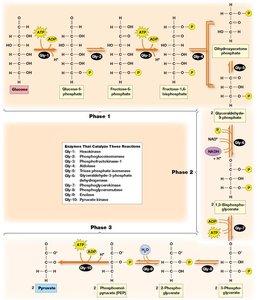
Overview of Glycolysis
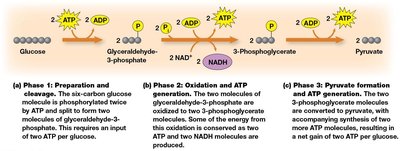
Glycolysis is a ten-step pathway converting glucose to pyruvate, producing ATP and NADH. It operates under both aerobic and anaerobic conditions.
Substrate: Glucose (prototype).
Products: 2 ATP, 2 NADH, 2 pyruvate per glucose.
Phases: Preparation, oxidation, ATP generation.
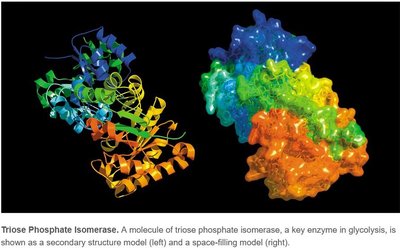
Key Glycolytic Enzyme: Triose Phosphate Isomerase
Triose phosphate isomerase is a crucial enzyme in glycolysis, catalyzing the interconversion of dihydroxyacetone phosphate and glyceraldehyde-3-phosphate.
Fermentation
Fermentation Pathways and Importance
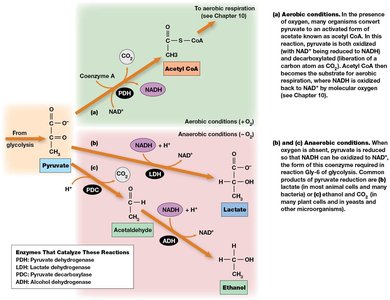
Fermentation occurs in the absence of oxygen, allowing cells to regenerate NAD+ by transferring electrons from NADH to pyruvate or other organic molecules. This produces end-products such as lactate or ethanol, with only the ATP from glycolysis generated.
End-products: Lactate (animals), ethanol + CO2 (yeast, bacteria).
Energy yield: Only 2 ATP per glucose.
Importance: Maintains NAD+ supply for glycolysis.
Alternative Substrates for Glycolysis
Metabolism of Other Sugars
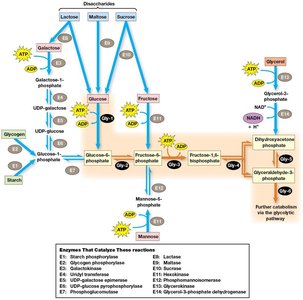
Glycolysis can catabolize sugars other than glucose, including fructose, galactose, and mannose. It also metabolizes glucose-1-phosphate from storage polysaccharides like starch and glycogen.
Alternative substrates: Fructose, galactose, mannose, glucose-1-phosphate.
Pathway integration: Entry points for different sugars into glycolysis.
Gluconeogenesis
Pathway and Regulation
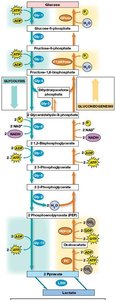
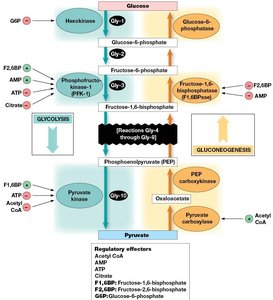
Gluconeogenesis synthesizes glucose from three- and four-carbon precursors such as pyruvate. It shares seven reactions with glycolysis but bypasses three exergonic steps using energy from ATP and GTP.
Substrates: Pyruvate, lactate, amino acids.
Distinct steps: Three bypass reactions for exergonic steps.
Energy input: ATP and GTP required.
Regulation of Glycolysis and Gluconeogenesis
Enzyme Regulation and Allosteric Control
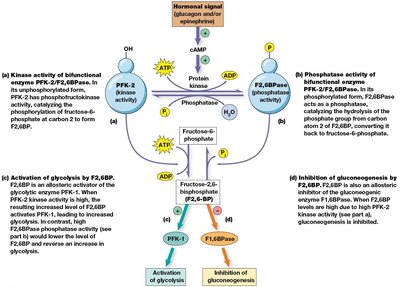
Glycolysis and gluconeogenesis are regulated by enzymes unique to each pathway, influenced by cellular energy status and key intermediates. Fructose-2,6-bisphosphate (F2,6BP) is a major allosteric regulator, controlled by the bifunctional enzyme PFK-2/F2,6BPase.
Regulatory molecules: ATP, ADP, AMP, acetyl CoA, citrate.
Allosteric regulation: F2,6BP modulates glycolysis and gluconeogenesis.
Hormonal control: Glucagon and epinephrine affect PFK-2 via cAMP.
Additional Roles of Glycolytic Enzymes
Beyond catalysis, glycolytic enzymes participate in gene regulation, programmed cell death, and cancer cell migration, highlighting their multifunctional roles in cellular physiology.
Summary Table: Glycolysis vs. Gluconeogenesis
The following table compares key features of glycolysis and gluconeogenesis:
Feature | Glycolysis | Gluconeogenesis |
|---|---|---|
Direction | Glucose → Pyruvate | Pyruvate → Glucose |
Energy Yield | 2 ATP (net) | Requires ATP & GTP |
Key Regulators | ATP, ADP, AMP, F2,6BP | ATP, AMP, F2,6BP |
Unique Enzymes | Hexokinase, PFK-1, Pyruvate kinase | Glucose-6-phosphatase, FBPase, PEP carboxykinase |
Hormonal Regulation | Insulin, glucagon, epinephrine | Glucagon, epinephrine |
Key Equations
ATP Hydrolysis:
Glycolysis (overall):
Fermentation (lactate):
Fermentation (ethanol):
Conclusion
Glycolysis and fermentation are central to cellular energy metabolism, providing ATP under both aerobic and anaerobic conditions. Their regulation ensures metabolic flexibility and adaptation to cellular energy demands.
