 Back
BackEnzymes: The Catalysts of Life – Cell Biology Study Guide
Study Guide - Smart Notes
 Tailored notes based on your materials, expanded with key definitions, examples, and context.
Enzymes: The Catalysts of Life
Introduction to Enzymes
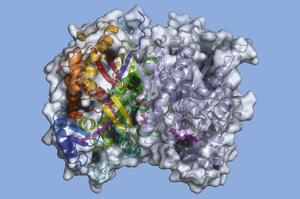
Enzymes are biological catalysts that dramatically increase the rate of cellular reactions by lowering the activation energy required. They are essential for life, as they enable reactions to occur under physiological conditions that would otherwise proceed too slowly to sustain cellular processes.
Definition: Enzymes are proteins (or RNA molecules, in the case of ribozymes) that catalyze biochemical reactions.
Importance: Enzymes make the difference between a reaction that can take place and one that will take place in a cell.
Example: The hydrolysis of ATP is thermodynamically favorable but occurs slowly without enzymatic catalysis.
 e
e
Activation Energy and the Metastable State
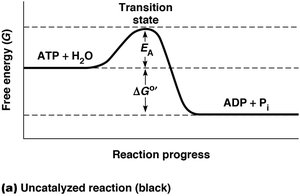
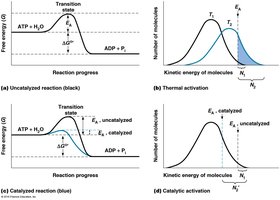
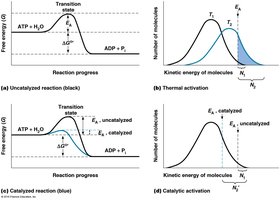
Many cellular reactions are thermodynamically feasible but do not occur at appreciable rates due to high activation energy barriers. The activation energy (EA) is the energy required to reach the transition state of a reaction.
Metastable State: Reactants remain stable until sufficient energy is provided to overcome EA.
Example: ATP hydrolysis has a negative ΔG, but ATP remains stable in water for days without a catalyst.
Normal Distribution of Kinetic Energy
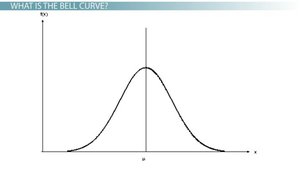
The kinetic energy of molecules in a system follows a normal (bell curve) distribution. Only a fraction of molecules have enough energy to overcome the activation energy barrier at any given time.
Mean Kinetic Energy: Most molecules have energy near the mean, but only those in the high-energy tail can react spontaneously.
Effect of Temperature on Reaction Rate
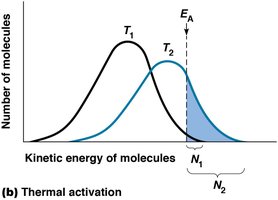
Increasing temperature raises the average kinetic energy of molecules, increasing the proportion of molecules with sufficient energy to react. However, cells are isothermal and cannot rely on temperature increases to accelerate reactions.
Isothermal: Cells maintain constant temperature (homeostasis).
Key Point: Heat input is not a practical method for increasing reaction rates in living cells.
Lowering Activation Energy: Catalysis
Catalysts, including enzymes, lower the activation energy by providing a surface for reactants to interact, facilitating the formation of the transition state. Catalysts are not consumed in the reaction.
Mechanism: Enzymes bind substrates, bring them close together, and stabilize the transition state.
Result: Enhanced reaction rate without altering the equilibrium position.
Properties of Enzymes as Biological Catalysts
Enzymes share three fundamental properties with all catalysts:
Increase reaction rates by lowering activation energy (EA).
Form transient, reversible complexes with substrates.
Alter the rate at which equilibrium is achieved, not the equilibrium position itself.
Classes of Enzymes
Enzymes are classified into six major groups based on the type of reaction they catalyze.
Most enzymes are proteins, but some RNA molecules (ribozymes) also have catalytic activity.
Example: Ribonuclease P and peptidyl transferase activity in ribosomes are catalyzed by RNA.
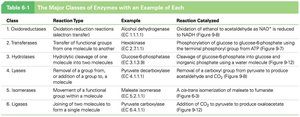
Class | Reaction Type | Example | Reaction Catalyzed |
|---|---|---|---|
Oxidoreductases | Oxidation-reduction | Alcohol dehydrogenase | Oxidation of ethanol to acetaldehyde |
Transferases | Transfer of functional groups | Hexokinase | Phosphorylation of glucose |
Hydrolases | Hydrolytic cleavage | Protease | Cleavage of peptide bonds |
Lyases | Addition/removal of groups | Pyruvate decarboxylase | Decarboxylation of pyruvate |
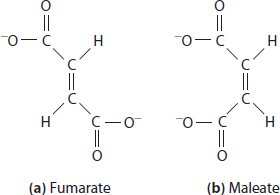
Isomerases | Isomerization | Maleate isomerase | Conversion of maleate to fumarate |
Ligases | Joining of molecules | Pyruvate carboxylase | Addition of CO2 to pyruvate |
The Active Site of Enzymes
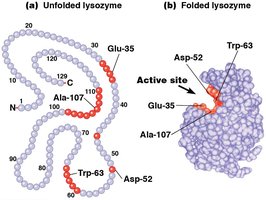
The active site is a specific region formed by the three-dimensional folding of the enzyme, where substrates bind and catalysis occurs. It is typically a groove or pocket with high substrate affinity.
Cluster of Amino Acids: The active site contains key amino acids essential for substrate binding and catalysis.
Example: Lysozyme active site includes Glu-35, Asp-52, Trp-63, and Ala-107.
Enzyme Specificity
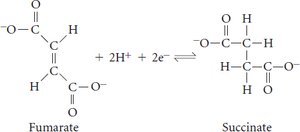
Enzymes exhibit high substrate specificity due to the precise shape and chemical properties of their active sites. Only specific substrates can bind and be converted to products.
Example: Succinate dehydrogenase acts only on succinate, not similar molecules.
The Induced-Fit Model
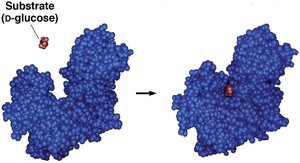
The induced-fit model describes how substrate binding causes a conformational change in the enzyme, bringing necessary amino acid side chains into the active site for optimal catalysis.
Noncovalent Interactions: Substrate is held in place by hydrogen bonds, ionic bonds, and van der Waals forces.
Specificity: These interactions distinguish the correct substrate from similar molecules.
Cofactors and Prosthetic Groups
Some enzymes require nonprotein cofactors for catalytic activity. These include metal ions and small organic molecules called coenzymes, often derived from vitamins.
Prosthetic Groups: Tightly bound cofactors essential for enzyme function.
Coenzymes: Organic cofactors, often vitamin derivatives, that assist in catalysis.
Enzyme Inhibition
Enzyme activity can be inhibited by molecules that interfere with substrate binding or catalysis. Inhibitors can be irreversible (covalently bound, causing permanent loss of activity) or reversible (noncovalently bound, allowing dissociation).
Irreversible Inhibitors: Often toxic, such as heavy metals or nerve gases.
Reversible Inhibitors: Include competitive and noncompetitive inhibitors.
Competitive Inhibition
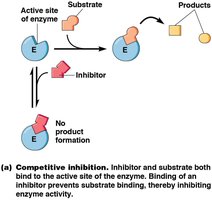
Competitive inhibitors bind to the active site, preventing substrate binding. The effect can be overcome by increasing substrate concentration.
Effect: Increases Km, no effect on Vmax.
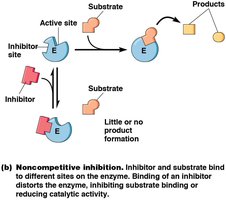
Noncompetitive Inhibition
Noncompetitive inhibitors bind to a site other than the active site, causing conformational changes that reduce enzyme activity. The effect cannot be overcome by increasing substrate concentration.
Effect: Decreases Vmax, no effect on Km.
Enzyme Regulation
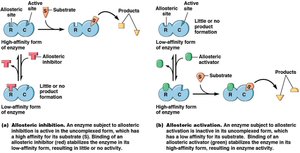
Enzyme activity is regulated to meet cellular needs. Regulation can occur at the substrate level or through allosteric mechanisms.
Substrate-Level Regulation: Increased substrate levels raise reaction rates; increased product levels lower rates.
Allosteric Regulation: Allosteric enzymes have regulatory and catalytic subunits. Binding of effectors at the regulatory site alters enzyme conformation and activity.
Feedback Inhibition
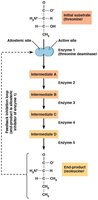
Feedback inhibition is a regulatory mechanism in which the end product of a pathway inhibits an earlier step, preventing overproduction.
Example: The final product binds to an allosteric site on the first enzyme in the pathway.
Covalent Modification
Enzyme activity can also be regulated by covalent modification, such as phosphorylation, methylation, or acetylation. These modifications alter enzyme activity and are reversible.
Example: Addition or removal of phosphate groups by kinases and phosphatases.
Enzyme Kinetics
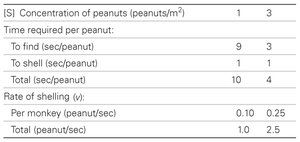
Enzyme kinetics describes the quantitative aspects of catalysis, including reaction rates and substrate conversion. Key parameters include substrate concentration, enzyme concentration, and inhibitor presence.
Initial Velocity (v0): Rate of product formation at the start of the reaction.
Saturation: At high substrate concentrations, reaction velocity approaches a maximum (Vmax).
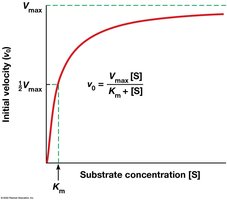
The Michaelis–Menten Equation
The Michaelis–Menten equation models enzyme kinetics under steady-state conditions:
Equation:
Km (Michaelis constant): Substrate concentration at which the reaction rate is half of Vmax.
Vmax: Maximum reaction velocity.
kcat: Turnover number, the number of substrate molecules converted per enzyme per second at Vmax.
Importance of Km and Vmax in Cell Biology
Low Km: Indicates high enzyme-substrate affinity and effectiveness at low substrate concentrations.
Vmax: Reflects the potential maximum rate of the reaction.
Application: By knowing Km, Vmax, and in vivo substrate concentration, cell biologists can estimate reaction rates under physiological conditions.
Enzyme Inhibition Kinetics
Competitive Inhibitors: Increase Km, no effect on Vmax.
Noncompetitive Inhibitors: Decrease Vmax, no effect on Km.
Summary Table: Major Classes of Enzymes
Class | Reaction Type | Example | Reaction Catalyzed |
|---|---|---|---|
Oxidoreductases | Oxidation-reduction | Alcohol dehydrogenase | Oxidation of ethanol to acetaldehyde |
Transferases | Transfer of functional groups | Hexokinase | Phosphorylation of glucose |
Hydrolases | Hydrolytic cleavage | Protease | Cleavage of peptide bonds |
Lyases | Addition/removal of groups | Pyruvate decarboxylase | Decarboxylation of pyruvate |
Isomerases | Isomerization | Maleate isomerase | Conversion of maleate to fumarate |
Ligases | Joining of molecules | Pyruvate carboxylase | Addition of CO2 to pyruvate |
Additional info: Academic context and explanations have been expanded for clarity and completeness. All images included are directly relevant to the adjacent content and reinforce key concepts in enzyme structure, function, and kinetics.
