 Back
BackGlycolysis, Fermentation, and Regulation of Energy Metabolism
Study Guide - Smart Notes
 Tailored notes based on your materials, expanded with key definitions, examples, and context.
Metabolic Pathways: Anabolism and Catabolism
Overview of Metabolic Pathways
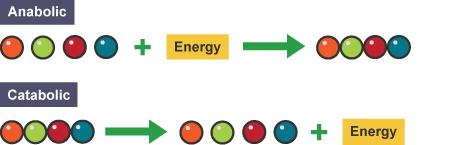
Metabolic pathways are series of interconnected chemical reactions that occur within cells to maintain life. These pathways are tightly regulated and can be classified as either anabolic or catabolic.
Anabolic pathways: Synthesize complex molecules from simpler ones; these processes are typically endergonic (require energy input).
Catabolic pathways: Break down complex molecules into simpler ones; these processes are usually exergonic (release energy).
ATP: The Energy Currency of the Cell
ATP Structure and Function
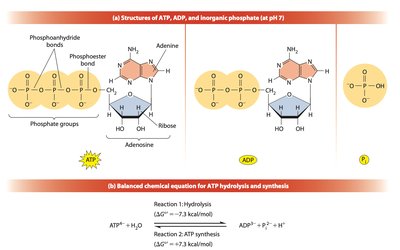
Adenosine triphosphate (ATP) is the primary energy carrier in cells. It couples exergonic and endergonic reactions, allowing energy transfer within the cell.
ATP contains high-energy phosphoanhydride bonds.
Hydrolysis of ATP releases energy: kcal/mol
ATP hydrolysis is highly exergonic due to charge repulsion and resonance stabilization of products.
ATP as an Energy Coupler
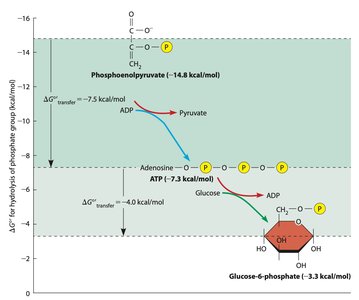
ATP links catabolic and anabolic reactions, acting as an energy shuttle. It can donate or accept phosphate groups, facilitating energy transfer between reactions.
Phosphorylated intermediates can transfer phosphate and energy to compounds with less negative .
Example: Step 1 of glycolysis kcal/mol
Redox Reactions and Coenzymes
Oxidation-Reduction in Metabolism
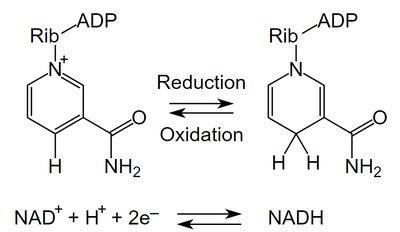
Many metabolic reactions involve oxidation (loss of electrons) and reduction (gain of electrons). Enzymes called oxidoreductases catalyze these reactions, often using coenzymes as electron carriers.
NAD+ (nicotinamide adenine dinucleotide) is a common coenzyme derived from niacin (vitamin B3).
NAD+ accepts 2 electrons and 1 proton to become NADH; one proton remains free, affecting pH.
Oxygen is usually the final electron acceptor in aerobic respiration.
Glucose Catabolism: Glycolysis and Fermentation
Overview of Glucose Catabolism
Glucose is the primary substrate for energy production in cells. It can be metabolized aerobically (with O2) or anaerobically (without O2), with different ATP yields.
Aerobic respiration: Glycolysis → TCA cycle → Electron transport chain (high ATP yield)
Anaerobic respiration: Glycolysis → Fermentation (low ATP yield)
Overall reaction: kcal/mol
Glycolysis: The Central Pathway
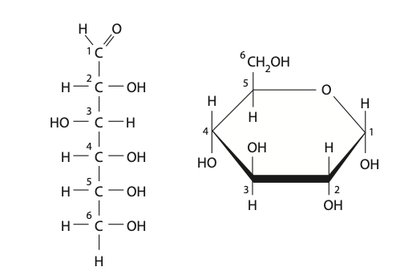
Glycolysis is a ten-step pathway that converts glucose to pyruvate, generating ATP and NADH. It occurs in the cytosol and does not require oxygen.
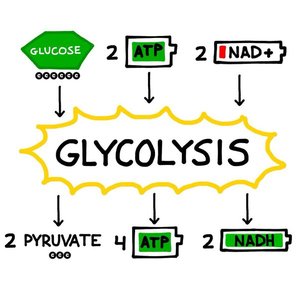
Reactants: Glucose, 2 ATP, 2 NAD+
Products: 2 Pyruvate, 4 ATP (net 2 ATP), 2 NADH
Phases: Preparation (steps 1-5), ATP generation (steps 6-10)
Phase 1: Preparation and Splitting (Steps 1-5)
Step 1: Glucose → Glucose-6-phosphate (G6P) via hexokinase (uses 1 ATP)
Step 2: G6P → Fructose-6-phosphate (F6P) via phosphoglucoisomerase
Step 3: F6P → Fructose-1,6-bisphosphate (F1,6BP) via phosphofructokinase-1 (uses 1 ATP, key regulatory step)
Step 4: F1,6BP splits into dihydroxyacetone phosphate (DHAP) and glyceraldehyde-3-phosphate (G3P) via aldolase
Step 5: DHAP ↔ G3P via triose phosphate isomerase
Phase 2: Oxidation and ATP Generation (Steps 6-7)
Step 6: 2 G3P + 2 Pi + 2 NAD+ → 2 1,3-bisphosphoglycerate + 2 NADH + 2 H+ (glyceraldehyde-3-phosphate dehydrogenase)
Step 7: 2 1,3-bisphosphoglycerate + 2 ADP → 2 3-phosphoglycerate + 2 ATP (phosphoglycerokinase)
Phase 3: Pyruvate Formation and More ATP (Steps 8-10)
Step 8: 2 3-phosphoglycerate → 2 2-phosphoglycerate (phosphoglyceromutase)
Step 9: 2 2-phosphoglycerate → 2 phosphoenolpyruvate (PEP) (enolase)
Step 10: 2 PEP + 2 ADP → 2 pyruvate + 2 ATP (pyruvate kinase)
Fate of Pyruvate: Fermentation
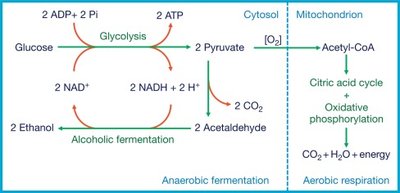
In the absence of oxygen, pyruvate undergoes fermentation to regenerate NAD+, allowing glycolysis to continue.
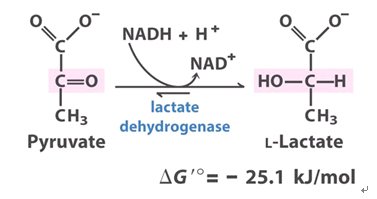
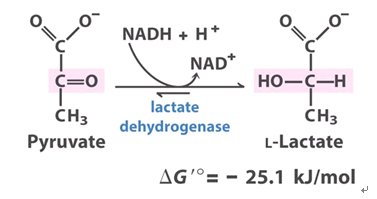
Lactate fermentation: Pyruvate + NADH → Lactate + NAD+ (lactate dehydrogenase)
Alcoholic fermentation: Pyruvate → Acetaldehyde + CO2 (pyruvate decarboxylase), then Acetaldehyde + NADH → Ethanol + NAD+ (alcohol dehydrogenase)
Gluconeogenesis: Synthesis of Glucose
Overview of Gluconeogenesis
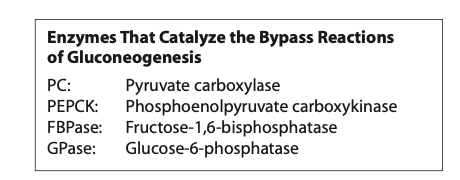
Gluconeogenesis is the process of synthesizing glucose from non-carbohydrate precursors such as lactate or pyruvate. It is not a simple reversal of glycolysis; three steps are bypassed by unique enzymes.
Reactants: Lactate or pyruvate, 4 ATP, 2 NADH, 2 GTP
Products: Glucose, 2 NAD+
Key bypass enzymes:
Step
Glycolysis Enzyme
Gluconeogenesis Enzyme
1
Hexokinase
Glucose-6-phosphatase (GPase)
3
Phosphofructokinase-1
Fructose-1,6-bisphosphatase (FBPase)
10
Pyruvate kinase
Pyruvate carboxylase (PC) & Phosphoenolpyruvate carboxykinase (PEPCK)
Regulation of Glycolysis and Gluconeogenesis
Allosteric Regulation
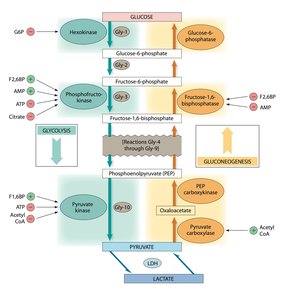
Key steps in glycolysis and gluconeogenesis are regulated by allosteric effectors to ensure proper metabolic flux.
Hexokinase (Glycolysis 1): Inhibited by G6P
Phosphofructokinase-1 (Glycolysis 3): Inhibited by ATP and citrate; activated by AMP and F2,6BP
Pyruvate kinase (Glycolysis 10): Inhibited by ATP and Acetyl CoA; activated by F1,6BP
Hormonal Regulation
Hormones such as insulin and glucagon regulate glycolysis and gluconeogenesis to maintain blood glucose homeostasis.
Insulin: Promotes glycolysis and glucose uptake by cells, lowering blood glucose levels.
Glucagon: Inhibits glycolysis and stimulates gluconeogenesis, raising blood glucose levels.
Summary Table: Glycolysis vs. Gluconeogenesis Key Enzymes
Step | Glycolysis Enzyme | Gluconeogenesis Enzyme |
|---|---|---|
1 | Hexokinase | Glucose-6-phosphatase |
3 | Phosphofructokinase-1 | Fructose-1,6-bisphosphatase |
10 | Pyruvate kinase | Pyruvate carboxylase & PEP carboxykinase |
Fermentation and Its Importance
Lactate and Alcoholic Fermentation
Fermentation allows cells to regenerate NAD+ in the absence of oxygen, sustaining ATP production via glycolysis.
Lactate fermentation occurs in muscle cells during intense exercise, leading to lactic acid buildup and decreased pH (lactic acidosis).
Alcoholic fermentation is used by yeast and some bacteria to produce ethanol and CO2.
Key Concepts for Mastery
Location of glycolytic and fermentative steps in the cell
Reversible vs. irreversible steps and their regulation
Enzyme names and reaction types for each step
ATP and NADH production/consumption at each step
Physiological significance of pathway regulation
