 Back
BackMembrane Transport Mechanisms in Cell Biology
Study Guide - Smart Notes
 Tailored notes based on your materials, expanded with key definitions, examples, and context.
Membrane Transport
Overview of Membrane Transport
Membrane transport is a fundamental process in cell biology, enabling the movement of molecules across the cell membrane. Transport mechanisms are classified as passive or active, depending on whether cellular energy is required.
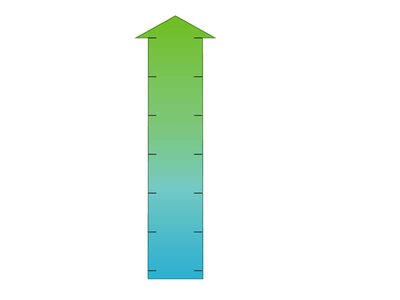
Passive transport: Does not require cellular energy; molecules move down their concentration gradient.
Active transport: Requires energy (usually ATP); molecules move against their concentration gradient.
Passive Membrane Transport
Types of Passive Transport
Passive transport mechanisms allow molecules to cross the membrane without energy input.
Osmosis: Movement of water across a semipermeable membrane.
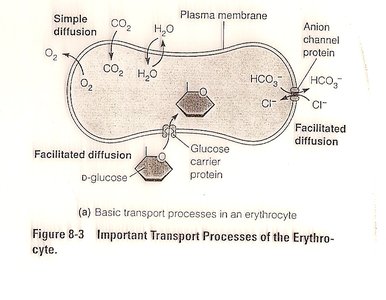
Simple diffusion: Movement of small, nonpolar molecules (e.g., O2, CO2) directly through the lipid bilayer.
Ion channel diffusion: Movement of ions through protein channels.
Facilitated carrier diffusion: Movement of larger or polar molecules via carrier proteins.
Rules of Membrane Diffusion
The permeability of the membrane to different molecules is governed by three main rules:
Size rule: Small molecules pass more easily.
Charge rule: Charged molecules (ions) do not pass freely.
Polarity rule: Nonpolar (hydrophobic) molecules pass more easily than polar (hydrophilic) molecules.
Relative Permeability of Molecules
The permeability of the phospholipid bilayer varies for different types of molecules:
Hydrophobic molecules: (e.g., O2, CO2, N2) pass easily.
Small, uncharged polar molecules: (e.g., H2O, glycerol) pass moderately.
Large, uncharged polar molecules: (e.g., glucose, sucrose) pass poorly.
Ions: (e.g., Na+, K+, Cl-) do not pass without channels or carriers.
Membrane Structure and Permeability
Phospholipid Bilayer and Fluidity
The structure of the phospholipid bilayer affects membrane fluidity and permeability.
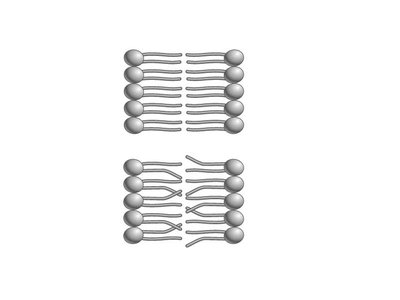
Unsaturated fatty acids: Introduce kinks, increasing fluidity and permeability.
Saturated fatty acids: Allow tight packing, decreasing fluidity and permeability.
Role of Cholesterol
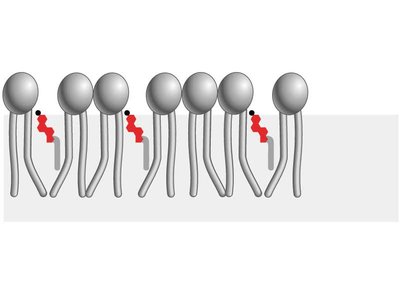
Cholesterol modulates membrane fluidity and permeability.
Cholesterol fills spaces between phospholipids: Reduces permeability to small molecules like water.
Cholesterol paradox: Increases fluidity at low temperatures but decreases permeability as concentration increases.
Ion Channels and Facilitated Diffusion
Ion Channel Diffusion
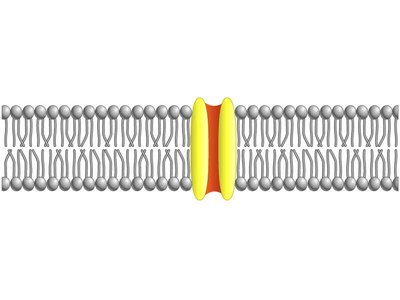
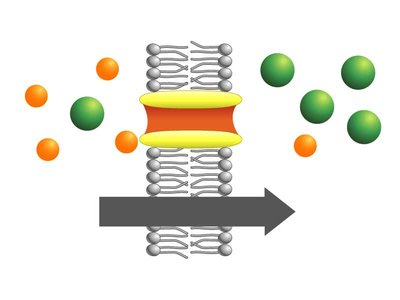
Ion channels are proteins that allow specific ions to pass through the membrane, down their electrochemical gradient.
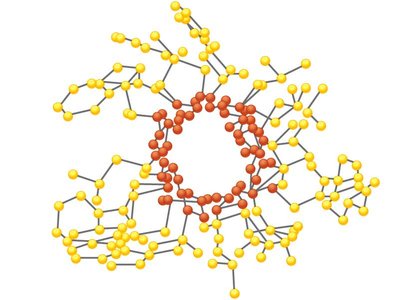
Gramicidin: An antibiotic that forms ion channels, disrupting ion gradients in bacteria.
Electrochemical gradient: Combination of concentration and electrical gradients across the membrane.
Facilitated Carrier Diffusion
Carrier proteins facilitate the diffusion of specific molecules across the membrane.
Valinomycin: Facilitates ion transport by binding ions and diffusing across the membrane.
GLUT-1: Facilitates glucose transport by binding glucose and undergoing a conformational change.
Active Membrane Transport
Active Transport Protein Carriers
Active transport uses energy to move molecules against their electrochemical gradient.
Sodium-potassium pump (Na+/K+ antiporter): Maintains ion gradients by pumping Na+ out and K+ in, using ATP.
Equation: 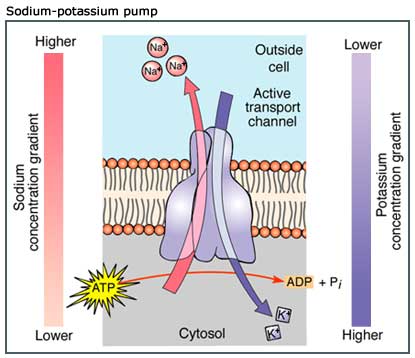
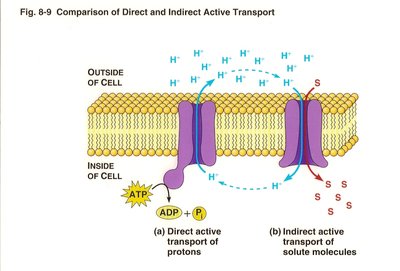
Direct and Indirect Active Transport
Direct active transport: Uses ATP directly to move molecules (e.g., proton pumps).
Indirect active transport: Uses gradients established by direct transport to move other solutes.
Bulk Transport: Endocytosis and Pinocytosis
Endocytosis
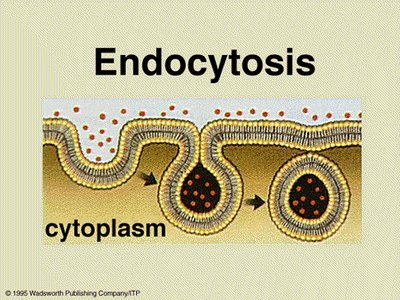
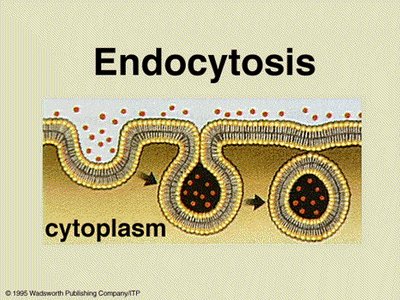
Endocytosis is the process by which cells engulf external substances by forming vesicles from the plasma membrane.
Phagocytosis: Uptake of large particles.
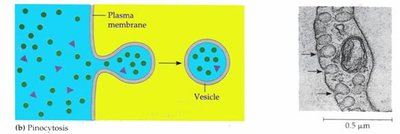
Pinocytosis: Uptake of fluids and small molecules.
Pinocytosis
Pinocytosis is a form of endocytosis where the cell takes in extracellular fluid and dissolved solutes.
Vesicle formation: Plasma membrane invaginates to form a vesicle containing fluid.
Summary Table: Membrane Transport Mechanisms
Transport Type | Energy Required | Direction | Examples |
|---|---|---|---|
Simple Diffusion | No | Down gradient | O2, CO2 |
Osmosis | No | Down gradient | H2O |
Ion Channel Diffusion | No | Down gradient | Na+, K+, Cl- |
Facilitated Diffusion | No | Down gradient | Glucose, amino acids |
Active Transport | Yes | Against gradient | Na+/K+ pump |
Endocytosis/Pinocytosis | Yes | Bulk uptake | Phagocytosis, pinocytosis |
Conclusion
Membrane transport is essential for cellular function, enabling the exchange of nutrients, ions, and waste products. Understanding the mechanisms of transport provides insight into cell physiology and the basis for many cellular processes. Additional info: Academic context was added to clarify the mechanisms and provide self-contained explanations for each transport type.
