 Back
BackNAD+/NADH Function and Glycolysis Regulation Study Guide
Study Guide - Smart Notes
 Tailored notes based on your materials, expanded with key definitions, examples, and context.
Q1. What types of reactions does NAD+/NADH participate in, and what is its function as a coenzyme?
Background
Topic: Redox Reactions and Cellular Respiration
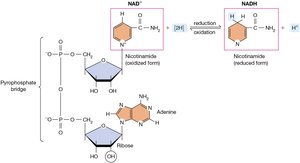
This question tests your understanding of the role of NAD+ (nicotinamide adenine dinucleotide) as a coenzyme in cellular metabolism, specifically in oxidation-reduction (redox) reactions during processes like glycolysis and the citric acid cycle.
Key Terms and Formulas
Oxidation: Loss of electrons (or hydrogen atoms) from a molecule.
Reduction: Gain of electrons (or hydrogen atoms) by a molecule.
NAD+: The oxidized form of the coenzyme; acts as an electron acceptor.
NADH: The reduced form; acts as an electron donor.
The general reaction catalyzed by dehydrogenases is:
Step-by-Step Guidance
Recall that NAD+ is a coenzyme that works with dehydrogenase enzymes to facilitate redox reactions in metabolism.
Understand that in these reactions, NAD+ accepts two electrons and one proton (H+), becoming reduced to NADH. The other proton is released into the solution.
Recognize that NAD+/NADH is crucial in glycolysis, the citric acid cycle, and other metabolic pathways, where it shuttles electrons from catabolic reactions to the electron transport chain.
Think about why cells need to regenerate NAD+ from NADH to keep glycolysis and other pathways running, especially under anaerobic conditions.
Try solving on your own before revealing the answer!
Q2. Using Table 9-1, state where and why ATP/ADP acts as a phosphate donor/acceptor during glycolysis.
Background
Topic: Glycolysis and Substrate-Level Phosphorylation
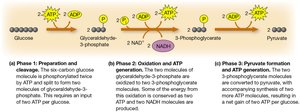
This question is about identifying the steps in glycolysis where ATP is either consumed (as a phosphate donor) or produced (as a phosphate acceptor), and understanding the reasoning behind these roles.
Key Terms and Formulas
Phosphate Donor: A molecule (like ATP) that transfers a phosphate group to another molecule.
Phosphate Acceptor: A molecule (like ADP) that receives a phosphate group to become ATP.
Substrate-Level Phosphorylation: Direct transfer of a phosphate group to ADP to form ATP.
Step-by-Step Guidance
Review the steps of glycolysis and identify where ATP is used (phosphate donor) and where ATP is produced (phosphate acceptor).
Recall that ATP is consumed in the early steps to phosphorylate glucose and fructose-6-phosphate, making these molecules more reactive.
Identify the steps where ADP is phosphorylated to ATP (substrate-level phosphorylation), which occurs later in glycolysis.
Think about why these transfers are necessary for the pathway to proceed and how they help drive glycolysis forward.
Try solving on your own before revealing the answer!
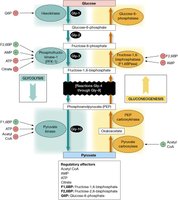
Q3. The breakdown of glucose into pyruvate (glycolysis) is shown in green. The synthesis of glucose from pyruvate (gluconeogenesis) is shown in orange. The allosteric regulatory effectors for the major enzymes are shown. Minus means the regulator inhibits enzyme activity, plus means it is an activator. Based on the role of each enzyme, does the regulatory effect make sense? Why?
Background
Topic: Allosteric Regulation of Metabolic Pathways
This question tests your understanding of how glycolysis and gluconeogenesis are regulated by allosteric effectors, and whether the activation or inhibition of key enzymes is logical based on their roles in metabolism.
Key Terms and Formulas
Allosteric Regulation: Regulation of enzyme activity by binding of effectors at sites other than the active site.
Effector: A molecule that increases (activator) or decreases (inhibitor) enzyme activity.
Key Enzymes: Phosphofructokinase-1 (PFK-1), Fructose-1,6-bisphosphatase, Pyruvate kinase, Pyruvate carboxylase, etc.
Step-by-Step Guidance
Identify the major regulatory enzymes in glycolysis and gluconeogenesis and the effectors that modulate their activity.
Consider the metabolic needs of the cell: when energy (ATP) is abundant, glycolysis should slow down, and gluconeogenesis may be favored.
Analyze whether the effectors (ATP, ADP, AMP, citrate, etc.) activate or inhibit the enzymes in a way that matches the cell’s energy status.
Think about how reciprocal regulation prevents futile cycling between glycolysis and gluconeogenesis.
Try solving on your own before revealing the answer!
